

Someone in your parent group posted a video this week. Their baby — same age as yours — is toddling across the living room floor, arms out, looking delighted with themselves. And you watched it twice, maybe three times, and then looked over at your baby who is sitting quite happily on the play mat, zero apparent interest in standing.
You’re not panicking. Not really. But you’re watching.
That feeling — the one where you’re simultaneously proud of another child and quietly anxious about your own — is one of the most universal experiences of early parenthood. And walking is the milestone that sets it off more than almost any other, because it’s so visible. So public. So easy to compare.
Here’s what I want to tell you before we get into the timeline: the range of normal for walking is genuinely, legitimately wide. Some babies take first steps at 9 months. Others don’t walk independently until 17 or 18 months. Both can be completely healthy. What matters far more than the exact age is the progression — the gradual building of strength, balance, and confidence that leads there.
Let’s talk about what that progression actually looks like.
Key Takeaways
- Most babies take their first independent steps somewhere between 9 and 18 months — with many walking around 12 months, but the full normal range extends significantly on both sides.
- The CDC milestone for walking without holding on is 18 months — meaning a baby who isn’t walking independently at 12 or even 14 months is not automatically behind.
- Walking develops through four predictable stages: pulling up → cruising → standing unassisted → first steps. Progression through these stages matters more than timing.
- Baby walkers are not recommended by the AAP — they can delay walking and pose significant injury risks. Push toys are a safer and more beneficial alternative.
- If your baby is not walking by 18 months, or is not progressing through the preceding stages, that’s worth a same-day call to your pediatrician.
When Do Babies Walk? The Numbers (And Why They’re Less Important Than You Think)
Most babies will start walking between about 9 and 18 months, with many taking their first independent steps around their first birthday. The CDC’s updated milestones list taking a few steps as a milestone for 15 months, and walking without holding on as a milestone for 18 months.
That last part is worth sitting with for a moment. The official milestone for independent walking is 18 months — not 12. Social media, parent groups, and the general cultural pressure around “early” development have created an impression that most babies walk around their first birthday. And many do. But many don’t, and that’s just as normal.
Babies are individuals. Genetics plays a significant role — babies with parents who walked early often walk early. Temperament matters too: more cautious babies tend to cruise for longer before letting go, while bolder ones may attempt independent steps earlier. Physical build affects balance. Time spent on the floor vs. in equipment affects strength development. None of these factors make one baby “ahead” and another “behind” — they’re just the natural variation in a complex physical achievement.
The most useful frame: is your baby progressing? Are they moving through the stages, building strength, showing increasing confidence? If yes — regardless of the exact month — development is happening.
The 4 Stages of Learning to Walk
Walking doesn’t appear from nowhere. It’s the culmination of months of preparation, and most babies move through four identifiable stages on the way to independent steps.
Stage 1: Pulling Up to Stand (7 to 10 Months)
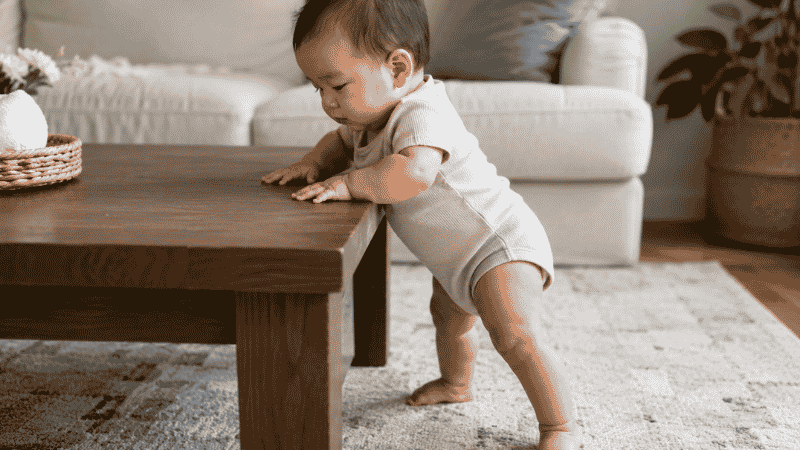
Before a baby can walk, they need to discover that they can hold their own weight on their legs. Pulling up — grabbing a couch cushion, a coffee table, your leg, anything sturdy enough — is how they first experience this.
Pulling up to stand is one of the first steps in learning to walk. Babies do this around 7 to 10 months of age, relying on furniture or a caregiver’s hands or legs. Pulling up typically happens after they’ve learned to sit unsupported or crawl, because the core and arm strength developed in those skills translates directly here.
At first, your baby may pull up and immediately sit back down — almost surprised that they got there. That’s fine. They’re learning the mechanics. Within days to weeks, they’ll begin holding the position longer, bouncing on their legs, and looking very pleased with themselves.
The honest truth about this stage: It is genuinely nerve-wracking to watch. Your baby will pull up on things that aren’t quite sturdy enough. They will fall backward without warning. This is where babyproofing becomes urgent: secure heavy furniture to walls, pad sharp corners, and remove anything they might pull over on themselves.
Stage 2: Cruising (9 to 12 Months)
Once standing is comfortable, babies begin moving sideways while holding on — what’s called cruising. They’ll hold the couch with both hands and shuffle along it. They’ll move from the coffee table to the armchair, bridging the gap with a moment of suspended confidence. They may make their way around an entire room this way.
Cruising is doing serious developmental work. It’s building the leg strength, hip stability, and lateral balance that independent walking requires. It’s also giving your baby practice in shifting their weight from one foot to the other — the fundamental biomechanics of walking.
This stage can last weeks or months. Some babies cruise for a very long time before attempting independent steps, and that patience is actually a sign of good sensory development — they’re calibrating until they feel confident enough to let go. Don’t rush this. It’s not stalling; it’s preparation.
Stage 3: Standing Without Support (10 to 12 Months)
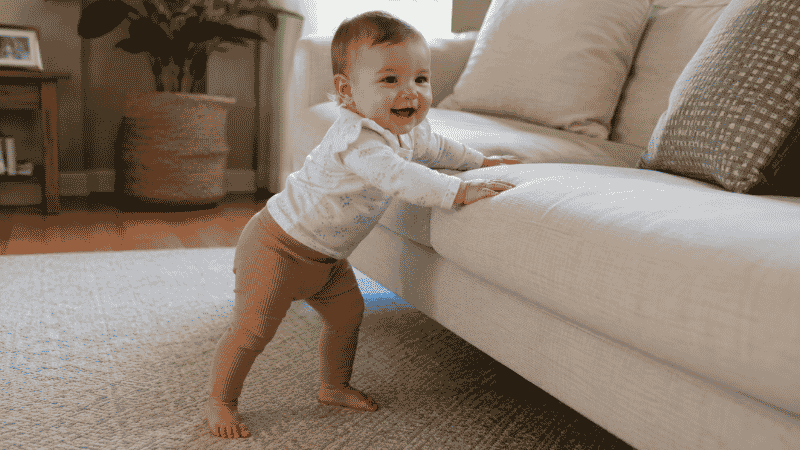
At some point during the cruising phase, your baby will let go. Maybe briefly — a second or two — before grabbing back on. But that moment of free standing, however short, is significant. It means their balance has developed enough to support their own weight without external assistance.
You’ll notice this starting to happen as your baby experiments: moving between supports, turning their body to look at something while holding on with just one hand, briefly releasing their grip. Each of these is a test — of balance, of courage, of coordination.
Standing unassisted typically develops in the same general window as cruising: 10 to 12 months for most babies, but with wide variation. Some babies stand independently for several weeks before walking. Others seem to go directly from brief standing experiments to purposeful steps within days.
Stage 4: First Steps and Independent Walking (9 to 18 Months)
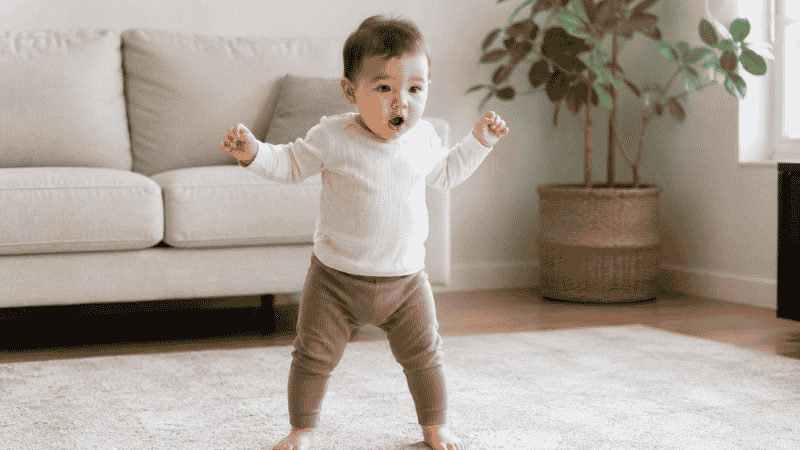
The first independent steps are usually tentative, hilarious, and deeply moving all at once. Arms out, legs wide, body pitched slightly forward — your baby looks like a tiny confident scientist conducting an experiment they’re not fully sure about.
First steps typically happen somewhere in the window of 9 to 15 months, with many babies walking with increasing confidence by 12 to 13 months. Walking without holding on is expected by 18 months according to CDC milestones.
What matters after those first steps: time. A 2021 study found that the best predictor of a child’s skill as a walker is simply how long it has been since they started walking — not the age they started. Early walkers and late walkers who’ve been walking for the same duration have comparable skill. Your baby’s first steps are the beginning of a learning process, not the finish line.
Signs Your Baby Is About to Walk
If you’re deep in the cruising phase and wondering how close first steps actually are, here are the signs that tend to appear in the final weeks before independent walking:
Standing for increasing duration. Your baby holds free-standing for 5, then 10, then 20 seconds. Each day seems slightly longer than the last.
“Bridging” between supports. They move from the coffee table to the couch with a step or two in between, rather than scooting along continuously. This is essentially practice walking, with a safety net on each side.
Squatting and recovering. A baby who can squat down to pick something up and stand back up without holding on has developed remarkable balance. This skill often appears very close to first steps.
Increased fussiness or disrupted sleep. This sounds counterintuitive, but many parents report a period of increased fussiness right before major motor milestones. The current theory is that the neurological work required for learning a major new skill is genuinely tiring and slightly destabilizing. If your cruising baby suddenly seems cranky and unsettled for no obvious reason, walking may be coming.
Attempting to let go on purpose. Instead of accidentally releasing their grip and catching it, your baby starts deliberately testing what happens when they let go. They’ll take a step, stop, steady themselves — and look back at you with unmistakable pride.
How to Encourage Walking (Without Pushing Too Hard)
The best thing you can do for a baby who is working toward walking is give them time, space, and the right environment. There are no shortcuts, and most of what looks like “helping” either does nothing or mildly interferes.
Give them lots of floor time. Babies who spend significant time in bouncers, swings, and jumpers develop walking skills more slowly than those who have ample time on the floor. The floor is where they practice all the movements that lead to walking — crawling, pulling up, cruising. If you can reduce time in equipment during the walking-approach months, do it.
Provide low, sturdy furniture to cruise on. A solid coffee table, a low shelf, a couch at the right height — these give your baby something to hold as they practice weight-shifting and balance. Move breakables out of range.
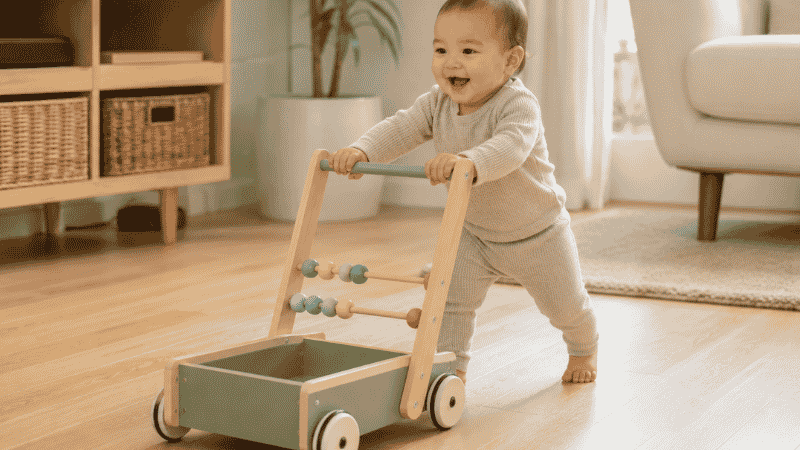
Use push toys, not walkers. Push toys — a solid push walker with a stable base and adjustable resistance — may genuinely help a baby work on walking skills. They provide something to hold while encouraging upright posture and leg use. By contrast, baby walkers (the wheeled seats that suspend babies in a walking position) are actively not recommended by the AAP. Several countries including Canada have banned them. They delay walking development and have been responsible for thousands of injuries annually.
Walk toward them, not behind them. Sit a few feet away from your cruising baby and hold your arms out. Let them walk to you rather than holding their hands from behind — the latter creates dependence and doesn’t build the independent balance they need.
Let them walk barefoot indoors. Bare feet give babies crucial sensory feedback about the floor surface — how it feels, how much grip they have. Socks are slippery; bare feet are better for practice indoors. Shoes are really only needed for outdoor surfaces.
What If My Baby Is 12 Months and Not Walking?
Completely normal — and worth saying clearly, because the anxiety around this is real. The CDC milestone for walking without holding on is 18 months. A baby who is 12 months old and not yet walking is not behind by any clinical standard. They are in the middle of the normal range.
What you want to see at 12 months: pulling up to stand, cruising along furniture, standing briefly without support, and showing general interest in upright movement. These signs indicate that the developmental progression is happening on schedule, even if independent steps are still weeks or months away.
What might indicate a need for evaluation:
- Your baby is 12 months old and not pulling up to stand at all
- Your baby shows no interest in bearing weight on their legs
- You notice significant stiffness or floppiness in the legs
- Your baby consistently falls heavily to one side during standing attempts
If you’re seeing any of those, mention it at your 12-month well-child visit rather than waiting.
Warning Signs: When to Call Your Pediatrician
Contact your pediatrician if:
- Your baby is not walking independently by 18 months — the CDC milestone age
- Your baby is not pulling up to stand by 12 months
- You notice significant asymmetry — always bearing weight on one side, or one leg looking different from the other in movement
- Your baby loses a skill they previously had — this is always worth evaluating promptly
- You notice very high muscle tone (legs seem stiff and rigid) or very low muscle tone (legs seem unusually floppy)
- Your baby walks on their toes consistently after 2 years of age (occasional toe-walking in early walkers is common; persistent toe-walking beyond 2 is worth checking)
- Something just feels off — you know your baby, and your instincts are worth raising
FAQ: The Walking Questions Parents Actually Type at Midnight
My baby is 10 months and already walking. Is that okay? Yes — some babies walk as early as 9 months. Early walking is generally a sign of strong motor development. Keep the floor safe, secure the furniture, and enjoy watching them go.
My baby is 15 months and still just cruising. Should I worry? Not yet. The normal range extends to 18 months, and cruising at 15 months is a normal part of the progression. If your baby is cruising confidently, standing briefly without support, and showing interest in movement, they’re on track. Mention it at your 15-month well-child visit and let your pediatrician know you’re watching it.
Is it true that babies who crawl longer walk better? Crawling and walking draw on related muscle foundations, and babies who spend more time crawling often have well-developed core and hip strength. But skipping crawling doesn’t prevent walking. Some babies go from sitting to pulling up to walking without crawling, and walk just fine. The skill that matters most is simply time walking, once walking begins.
My baby took first steps at 11 months and then stopped for three weeks. Is that normal? Yes, this happens. After first steps, many babies revert to crawling for weeks because it’s faster and more reliable for getting where they want to go. They haven’t “forgotten” how to walk — they’re just choosing the more efficient option. Walking will return and accelerate, usually within a few weeks.
Do walkers help babies learn to walk faster? No — and the AAP strongly recommends against them. Wheeled baby walkers (the seated, wheeled devices) do not develop the muscles or balance needed for independent walking, and they carry significant injury risk from falls down stairs. Push toys are a safe alternative that may actually support walking development.
My baby walks funny — wide-legged and wobbly. Is that normal? Completely. New walkers walk with feet wide apart, toes pointed outward, and arms raised for balance. The gait is uneven and the falls are frequent. This is exactly what early walking looks like. As the weeks pass, the base narrows, balance improves, and the gait becomes more refined. Expect the “drunk penguin” phase to last a few months.
Those First Steps Will Come
There’s nothing quite like watching your baby walk for the first time — the combination of determination and delight on their face, the arms thrown wide, the three steps and then the gentle collapse onto a well-padded bottom.
It will happen. On their schedule, not Instagram’s, not the developmental chart’s exact midpoint, and not because you worried about it enough. It will happen because your baby has been building toward it — every time they pushed up during tummy time, every time they sat up and reached for something, every time they pulled up on the couch and bounced on their legs with enormous satisfaction.
The work has been happening all along. The steps are just the most visible part of it.
What to Read Next
- When Do Babies Sit Up? Stages, Timeline & How to Help — Sitting is the foundation walking builds on — here’s how that earlier milestone develops
- When Do Babies Crawl? What to Expect, How to Help & When to Ask for Support — The motor milestone that often comes between sitting and walking, and why it matters
- Baby Growth Spurts: When They Happen, What They Feel Like & How to Survive Them — That inexplicable fussiness right before first steps? It might be a growth spurt — here’s how to recognize one
References
- Centers for Disease Control and Prevention. Important Milestones: Your Baby By 18 Months. CDC, 2023. https://www.cdc.gov/ncbddd/actearly/milestones/milestones-18mo.html
- American Academy of Pediatrics. Movement: 8 to 12 Months. HealthyChildren.org, 2023. https://www.healthychildren.org/English/ages-stages/baby/Pages/Movement-8-to-12-Months.aspx
- Lovevery Child Development. Walking: When Do Babies Start and How to Encourage It. 2024. https://blog.lovevery.com/skills-stages/walking/
- Karasik LB, et al. WEIRD Walking: Cross-Cultural Research on Motor Development. Behavioral Brain Research, 2018. doi:10.1016/j.bbr.2018.05.016
This article is for informational purposes only and does not constitute medical advice. Always consult your pediatrician with specific concerns about your baby’s motor development or walking timeline.