
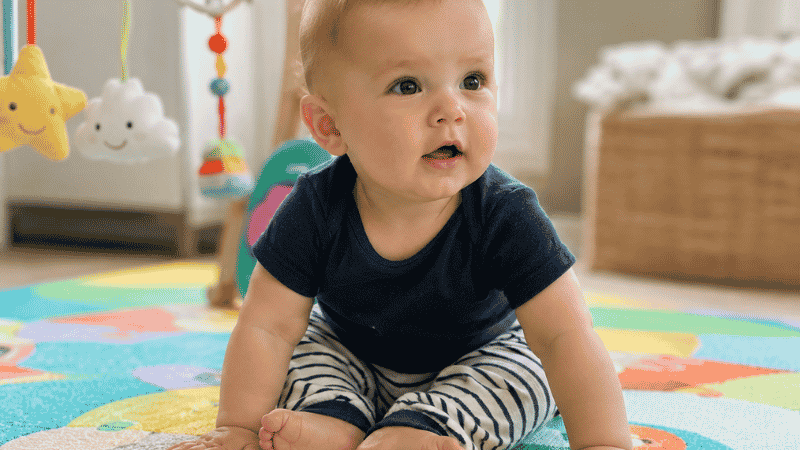
There’s a moment, somewhere around five or six months, when you prop your baby up on the play mat and they don’t immediately topple sideways. They wobble. They sway. They look around at the world from this brand-new vantage point — and you can almost see them thinking: oh, this is interesting.
Sitting up is one of those milestones that changes everything. It opens the world up for your baby in a way that lying down simply can’t — they can see more, reach more, explore more. And for parents, it marks a visible turning point: from the completely dependent newborn stage toward something that starts to look like a tiny, curious person.
If you’re watching your baby and wondering whether they’re on track, this guide gives you the full picture: when babies sit up, how the skill develops in stages, what you can do to support it safely, what to avoid, and the signs that are worth mentioning to your pediatrician.
Key Takeaways
- Most babies begin sitting with support between 4 and 6 months and progress to sitting independently between 6 and 9 months.
- The CDC milestone is sitting without support by 9 months — if your baby isn’t there by then, it warrants a conversation with your pediatrician.
- Sitting develops in clear stages: head control → supported sitting → tripod sitting → independent sitting. Each stage builds on the one before.
- Tummy time is the single most important thing you can do to build the core and neck strength that sitting requires.
- Avoid propping babies in sitting positions before they have the strength to hold themselves there — it can interfere with natural motor development and put stress on the spine.
When Do Babies Sit Up? The Honest Timeline
Babies typically start to sit up supported or in the tripod position anywhere from 4 to 6 months, according to the American Academy of Pediatrics (AAP). Then, they graduate to independent sitting around 6 to 9 months.
Although it’s less common, some babies will begin sitting unassisted as early as 4 months. Most babies will be able to sit up on their own at around 6 months. A few babies may need a little extra time and begin sitting up closer to 8 or 9 months.
What matters more than the exact age is where your baby is in the progression. Sitting is a skill that builds gradually through predictable stages — and understanding those stages helps you recognize whether your baby is on track even if they haven’t hit the final milestone yet.
The 4 Stages of Sitting: How It Actually Develops
Stage 1: Head Control (2 to 4 Months)
Before a baby can sit, they need to control their head. Head control — the ability to hold the head up steadily without it drooping forward or to the sides — is the prerequisite for all sitting progress. If your baby can hold their own head up by the age of four months — and they should be able to — then they’re on their way to developing the muscles and balance they need to sit up independently.
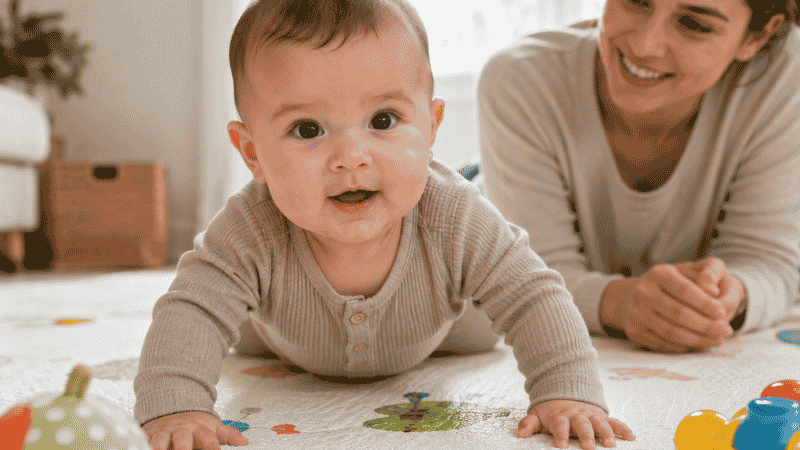
During this stage, tummy time is doing enormous work. Every time your baby pushes up off the floor, they’re building the neck extensors, shoulder stabilizers, and upper back muscles that will eventually support them in a sitting position.
What you’ll notice: Your baby holds their head steady during carried upright positions. During tummy time, they lift their head and chest off the floor. When you pull them to sitting from lying down, their head follows rather than lagging behind.
Stage 2: Supported Sitting (4 to 5 Months)
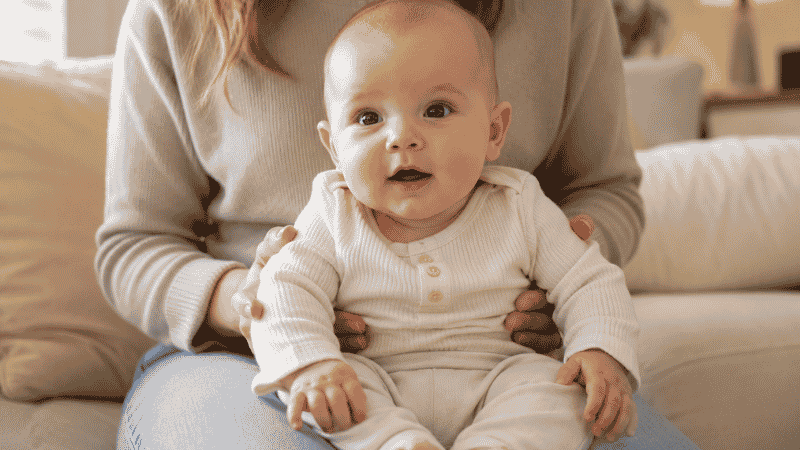
Once head control is established, babies can begin sitting with full external support — meaning you hold them in your lap, support them from behind, or use a pillow or Boppy to prop them. At this stage, they cannot hold themselves upright independently; they need continuous support.
At this age, babies can sit with lots of support. Tummy time is helping them strengthen their upper body, and some might start to balance themselves in the tripod position by using their hands for support. This is when babies start coordinating their upper and lower body movements.
Supported sitting at this stage is good practice — it gives your baby the experience of being upright, strengthens the relevant muscles, and begins to develop the balance responses that independent sitting requires. The key word is “supported”: they should always have something or someone preventing a fall.
What you’ll notice: Your baby can sit in your lap or supported in a seat without their head drooping. They begin to look around actively from the upright position.
Stage 3: Tripod Sitting (5 to 6 Months)
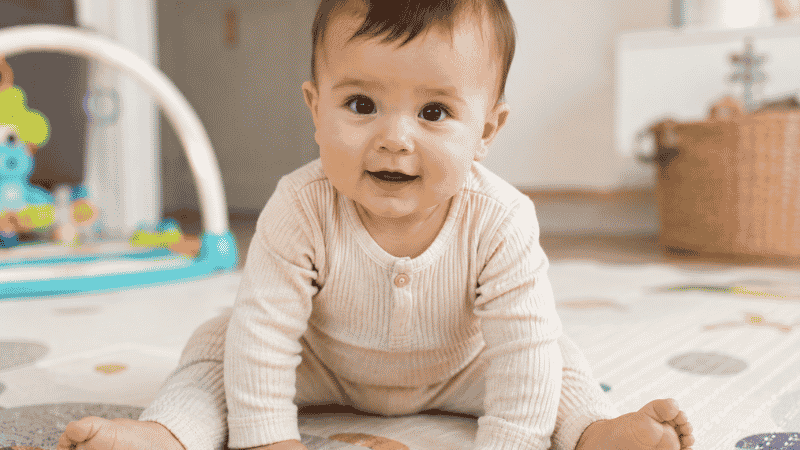
Tripod sitting is the transitional stage between supported and independent sitting. One of the first signs your infant is ready to sit up on their own is being able to sit in a tripod position with both legs extended and one arm steadying them.
In the tripod position, your baby leans forward with one or both hands on the floor in front of them — using their arms as the third “leg” of a tripod to hold themselves steady. It’s not fully independent (they still need those hands for balance), but it’s a significant step: your baby is now generating their own postural support rather than relying entirely on external help.
This stage is often where babies spend several weeks, gradually requiring less hand support and sitting taller before transitioning to full independence.
What you’ll notice: Your baby can briefly hold a tripod position, may topple to one side without warning, and is developing the balance reactions (automatically reaching out to catch themselves) that precede independent sitting.
Stage 4: Independent Sitting (6 to 9 Months)
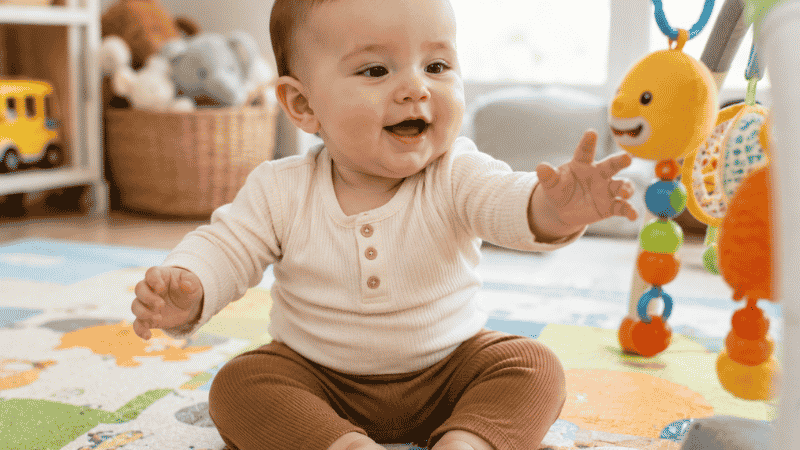
By now, most babies can sit with minimal support, using their arms to keep balance. You’ll notice their head control has improved, and they’ll begin to spend more time in a sitting position. Many babies can now sit independently without needing to prop themselves up. This is a major milestone in their motor development, and you’ll see them using their hands to play and reach for toys, balancing better, and exploring more freely.
According to the CDC, your baby should be sitting without support by 9 months.
True independent sitting — where your baby can sit without any support, reach for toys, turn to look at things, and maintain balance through these small movements — is the finished form of this milestone. Some babies achieve it closer to 6 months; others take until 8 or 9 months. Both ends of this range are within normal development.
Once independent sitting is established, your baby’s world opens up significantly. Both hands are now free for exploration. Reaching, grasping, examining objects — all of these become much easier from a stable seated position.
Why Sitting Matters Beyond the Obvious
Sitting up independently is more than a photo opportunity (though it is an excellent one). It’s a foundational milestone that enables a cascade of other development.
Fine motor development. When a baby can sit without using their hands for balance, their hands are free to explore objects purposefully — picking things up, passing them between hands, examining them from different angles. This is when fine motor skill development accelerates significantly.
Preparation for solid foods. Sitting upright with good head control is a prerequisite for starting solid foods safely. Most pediatricians use sitting ability as one of the readiness signs for introducing solids around 6 months. Around 5 to 6 months is also when introducing solids and having babies sit in their high chairs helps them get comfortable with the sitting position.
Visual and cognitive development. The upright position provides a fundamentally different view of the world than lying down. From sitting, babies can track objects at distance, understand spatial relationships more clearly, and engage with their environment in new ways.
Preparation for crawling. Sitting and crawling share the same muscle foundations — core stability, shoulder strength, and balance. Many babies begin attempts at crawling shortly after mastering independent sitting.
How to Help Your Baby Sit Up: What Actually Works
Prioritize Tummy Time Above Everything Else
If there is one thing you can do that most directly supports sitting development, it’s consistent tummy time from the earliest weeks. The muscles that tummy time builds — neck, shoulders, upper back, core — are the exact muscles needed for sitting.
The AAP recommends starting tummy time from the first day home from the hospital, building toward approximately 10 minutes per month of age per day, spread across multiple short sessions. A 4-month-old should be working toward 40 minutes of tummy time daily. A 5-month-old, toward 50.
For babies who resist tummy time: try it on your chest, use a rolled towel under the chest for slight elevation, get on the floor at their level so your face is the motivation. Most babies who initially dislike tummy time build tolerance with consistent daily practice.
Practice Supported Sitting With Your Baby
From around 4 months, you can begin practicing supported sitting during your daily routine. Sit your baby in your lap, supporting their back and sides. Hold them gently in front of you, supporting their torso while keeping their spine neutral (not hunched). Let them experience the upright position and the visual perspective that comes with it.
Keep sessions short — a few minutes at a time — and watch for signs of fatigue: slumping, head drooping, irritability. Sitting is hard work for a baby who is still building the muscles for it.
Encourage Tripod Sitting Practice
Once your baby can briefly prop on their hands, you can begin gentle tripod practice. Sit them on a firm surface (not a soft mattress, which makes balance harder), place a toy just in front of them to give them something interesting to look at, and sit close enough to catch them when they topple — which they will, frequently.
The catching isn’t a problem. Mild toppling experiences actually help babies develop automatic balance responses — the reflexive reach-and-catch that eventually allows them to maintain balance through small disturbances in a sitting position.
Make the Floor Their Primary Environment
Babies who spend the majority of their waking hours in bouncers, swings, car seats, and jumpers have significantly fewer opportunities to build the strength and coordination that sitting requires. These devices are useful tools for specific situations, but they restrict the free movement that develops motor skills.
When you have a safe, supervised window, put your baby on a firm play mat on the floor. This is where development happens.
What to Avoid
Props and seats designed to assist a baby in sitting can delay your baby’s development when used in excess. Devices like Bumbo seats, ring sitters, and similar products that hold babies in a sitting position before they can do so independently are widely used but widely cautioned against by pediatric physical therapists. The concern: physiotherapists recommend avoiding propping babies into sitting positions before they have the core strength to do so, as it can interfere with their natural motor development.
This doesn’t mean never using these seats — brief, supervised use in appropriate contexts is generally fine. But they shouldn’t replace the floor time and supported practice that build the actual muscle strength sitting requires.
If Your Baby Isn’t Sitting Yet: When to Wait and When to Ask
The range of normal for independent sitting extends to 9 months — so a baby who isn’t sitting independently at 6 months or even 7 months is most likely within the normal range, particularly if they’re showing good progress through the earlier stages.
Signs that suggest normal progression (even without independent sitting yet):
- Good head control established by 4 months
- Can sit with support and enjoys the upright position
- Is progressing through tripod sitting
- Shows interest in their environment and is actively moving
- Is building toward sitting gradually over weeks
Signs worth mentioning to your pediatrician:
- Your baby is not sitting with any support by 6 months and shows no progression toward it
- Your baby is not sitting independently by 9 months
- You notice significant stiffness or floppiness — either extreme of muscle tone can affect sitting development
- Your baby shows significant asymmetry — always falling or leaning heavily to one side
- Your baby loses a sitting ability they previously had — any regression in motor skills should be evaluated
- You have a gut feeling something isn’t right — your instincts are worth a conversation
According to the American Academy of Pediatrics (AAP), it is not necessarily a cause for concern if a baby cannot sit up without help by 6 months of age, but it is a good idea to consult the child’s healthcare provider. The AAP also recommends speaking with the doctor if the baby is floppy or stiff when being placed in a sitting position.
Safety When Your Baby Starts Sitting
Once your baby is sitting independently, a few safety considerations become relevant.
Never leave a sitting baby unattended on an elevated surface. A baby who has been sitting steadily for weeks can topple without warning — a developmental regression during illness, distraction, or fatigue can cause unexpected falls. Keep your baby on the floor or very close to the ground during sitting practice.
Pad the landing zone. Place folded blankets or a foam play mat around your baby during early independent sitting sessions. Falls are normal and expected — padding makes them softer.
Check the furniture. A baby who is sitting independently is often beginning to pull up on furniture within weeks. Ensure heavy furniture is secured to walls before this happens.
High chair safety. Once your baby is sitting in a high chair for solid food introduction, ensure the harness is properly fastened at every meal. A baby who can sit independently can also lean and lunge — the harness prevents falls.
Warning Signs: When to Call Your Pediatrician
Contact your pediatrician if:
- Your baby is not sitting with support by 6 months
- Your baby cannot sit independently by 9 months
- You notice muscle stiffness or floppiness that seems unusual
- Your baby consistently falls heavily to one side and shows no improvement
- Your baby loses sitting ability they previously demonstrated
- Head control is still poor at 4 months — this is the foundation everything else builds on
- You have any concern about motor development — earlier evaluation is always better
FAQ: What Parents Ask About Baby Sitting
My baby is 5 months and can’t sit yet. Is that okay? Yes. The majority of babies are not sitting independently at 5 months — most achieve this between 6 and 9 months. At 5 months, the expected milestones are head control, progress with tummy time, and beginning to sit with full support. If your baby is showing these things, they’re on track.
Should I use a Bumbo or baby seat to help my baby practice sitting? These seats can be used briefly and in supervised settings, but they shouldn’t be the primary way your baby practices sitting. The concern is that they hold babies in a position their muscles haven’t yet earned — which doesn’t build the strength that real sitting requires. Focus on supported sitting in your lap, tripod practice on the floor, and tummy time.
My baby sits great but always falls backward. Is that normal? Yes, very common. Forward balance — catching themselves from falling forward — tends to develop before backward balance. Make sure there’s soft padding behind your baby during sitting practice. Over the next few weeks, backward balance typically improves as the trunk muscles continue to strengthen.
Does my baby need to crawl before they sit? No. Sitting and crawling draw on similar muscle foundations, but they don’t have a strict sequential dependency. Some babies sit before they crawl. Some crawl before they sit fully independently. Some skip crawling entirely. The skills develop in overlapping, parallel fashion rather than a strict sequence.
My baby sat early at 5 months. Does that mean they’re advanced? Early sitting is a positive sign — it indicates strong core and neck development. It doesn’t guarantee anything about later developmental pace, but it’s a great foundation. Continue with tummy time and floor play to build on it.
That First Steady Sit
The first time your baby sits without holding onto you, without tipping over, and looks around the room with obvious satisfaction — it’s a moment worth pausing for. Not because you have to rush to the next milestone, but because this one is genuinely significant.
The world just got bigger for them. And for you, there’s a little less propping, a little more freedom, and a baby who can finally sit across from you at mealtime.
Keep the tummy time going. Keep making the floor the most interesting place. And enjoy this stage — it passes faster than you think.
What to Read Next
- When Do Babies Crawl? What to Expect, How to Help & When to Ask for Support — Sitting and crawling often develop in parallel — here’s what to expect from this next major milestone
- When Do Babies Roll Over? A Realistic Guide to This Big Milestone — Rolling is the motor foundation that sitting and crawling build on — here’s everything you need to know
- Baby Growth Spurts: When They Happen, What They Feel Like & How to Survive Them — Developmental leaps in sitting often coincide with growth spurts — this guide helps you recognize when both are happening at once
References
- American Academy of Pediatrics. Movement: 4 to 7 Months. HealthyChildren.org, 2023. https://www.healthychildren.org/English/ages-stages/baby/Pages/Movement-4-to-7-Months.aspx
- Centers for Disease Control and Prevention. Important Milestones: Your Baby By Nine Months. CDC, 2023. https://www.cdc.gov/ncbddd/actearly/milestones/milestones-9mo.html
- Medical News Today. Helping a Baby Sit Up: Tips, Stages, and Other Milestones. Reviewed by Meredith Wallis, MS, APRN. https://www.medicalnewstoday.com/articles/how-to-help-a-baby-sit-up
- Huckleberry Care. Babies and Sitting: When Do Babies Sit Up. 2022. https://huckleberrycare.com/blog/babies-and-sitting-when-do-babies-sit-up
This article is for informational purposes only and does not constitute medical advice. Always consult your pediatrician with specific concerns about your baby’s motor development.