
You’ve been making the same ridiculous face for three weeks. The one where you raise your eyebrows way too high and say “hiiiii” in a voice you would be embarrassed to use in public. You do it approximately forty times a day. And your baby looks at you with the calm, evaluating gaze of a very small CEO.
And then — one morning, completely without warning — they smile back.
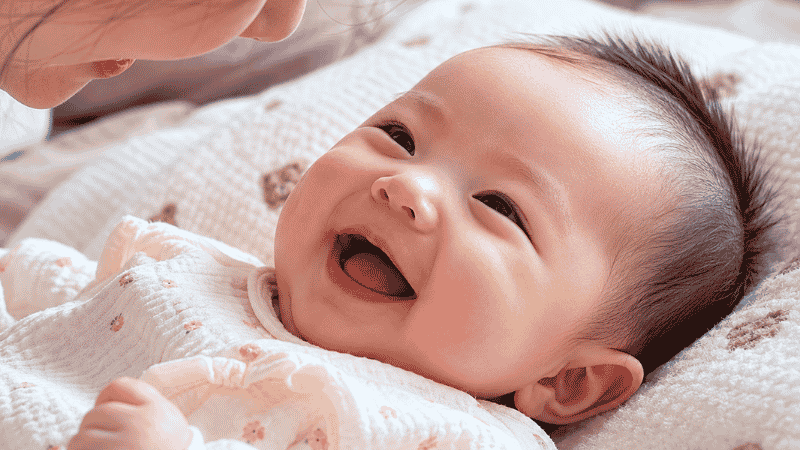
Not the little twitchy sleep-smile you’ve been telling yourself counts. A real one. Eyes crinkle, cheeks round out, mouth opens just slightly. Directed at you, unmistakably. Your whole chest does something complicated.
This is what parents mean when they talk about social milestones. Not the physical ones — the rolling and sitting and walking that get so much airtime — but the ones that feel most deeply human. The first time your baby shows you they know you’re there. That they find you funny. That they want to communicate.
And naturally, because you’re a new parent, you also immediately started wondering if it happened at the right time. That’s what this guide is for.
Key Takeaways
- The first social smile typically appears between 6 and 8 weeks, though some babies smile as late as 3 months — all normal.
- Laughing usually follows around 3 to 4 months, with most babies laughing by 6 months.
- Waving typically begins around 7 to 8 months, often before clapping.
- Clapping usually arrives around 9 months, according to CDC milestones.
- “Milestone anxiety” — the fear that your baby is behind because they haven’t hit a social milestone yet — is one of the most common experiences of new parenthood. The ranges are wider than most parents realize, and comparing to other babies (especially on social media) consistently makes anxiety worse without making it more accurate.
When Do Babies Smile for Real? (And How Do You Know It’s Real?)
This is the first question almost every new parent has, because the newborn weeks are full of face-movements that look like smiling but aren’t quite.
Reflex smiles happen from birth. You’ll see them most often during sleep, and sometimes randomly when your baby is awake — a brief upward twitch at the corners of the mouth, usually asymmetrical, coming and going without any social trigger. These are involuntary. They’re controlled by the lower brain stem rather than the social brain, and while they’re genuinely adorable, they don’t mean your baby is happy or responding to you.
Social smiles are different. They appear in response to something — usually a familiar face, a warm voice, eye contact — and they involve the whole face. The cheeks lift. The eyes narrow slightly. The expression is broader and more sustained than a reflex smile. And critically: it’s directed. Your baby is smiling at you.
Most babies produce their first social smile somewhere between 6 and 8 weeks. The CDC lists smiling when you talk to or smile at them as a 2-month milestone. Some babies smile earlier — around 4 to 5 weeks — and some take until closer to 10 or 12 weeks. The full normal range extends to 3 months before it becomes worth mentioning to a pediatrician.
A few things worth knowing about early smiles:
Babies tend to smile more at faces than at objects, and more at familiar faces than unfamiliar ones. Your baby’s first social smile is almost certainly directed at you or another primary caregiver, not at a toy or a stranger. This is meaningful — it’s evidence that your baby has been studying your face intensely for weeks and recognizes you as someone important.
Also: some babies are just less smiley than others from the start. Temperament plays a real role in how expressive a baby is. A baby who doesn’t flash huge grins every few minutes isn’t necessarily behind — they may just be a more serious, observational personality. (And honestly? Perfectly valid approach to life.)
When Do Babies Start Laughing — and What Makes Them Laugh?
If the first smile is the moment you realize your baby knows you exist, the first laugh is the moment you realize they think you’re kind of great.
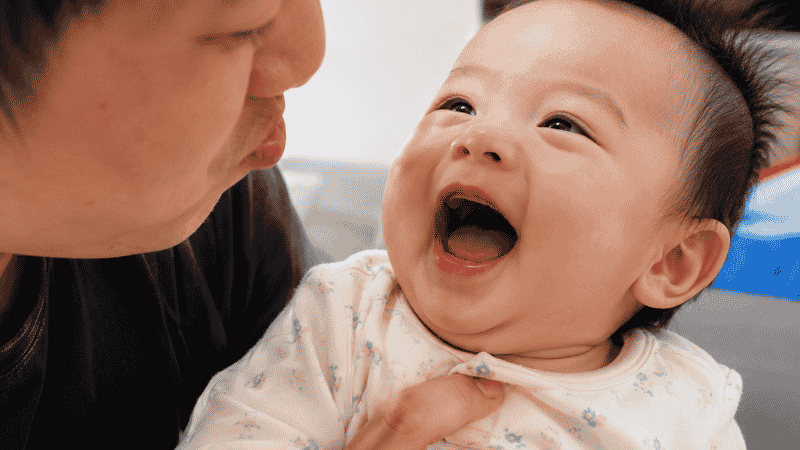
Most babies begin laughing — a real, audible giggle or chuckle — around 3 to 4 months. Before that, you may notice something in between: a kind of sharp exhale, a “heh” sound, a smile that almost crosses into laugh territory but doesn’t quite make it. That’s developmental too. The full vocal laugh requires more breath control and muscle coordination than the smile did.
By 6 months, most babies laugh regularly, according to CDC social-emotional milestones.
What makes babies laugh is legitimately interesting. Early on, it’s almost always sensory — physical surprises like raspberry kisses on the belly, being lifted and lowered, or a sudden gentle tickle. The laugh is a response to unexpected sensory input. Babies aren’t yet processing the idea of something being funny; they’re responding to the physical sensation of surprise.
By 4 to 6 months, social laughter starts appearing — laughing at your funny face, at your silly voice, at peek-a-boo. This is when laughter becomes genuinely social rather than purely reflexive. Your baby is finding you funny, not just a sensation.
By 8 to 9 months, peek-a-boo becomes particularly hilarious. This is because babies at this age are developing object permanence — the understanding that things exist even when they can’t be seen. Peek-a-boo isn’t just a random face appearing; your baby now understands that you were hidden and then came back, which is apparently endlessly delightful.
My honest take as an editor: The pressure to make your baby laugh early is real, and it’s slightly absurd. Every parent has tried every possible silly thing and gotten nothing, then done something completely arbitrary — accidentally made a weird noise while putting on their socks — and gotten a full belly laugh. You cannot engineer the first laugh. You can just be present, be warm, and wait for it to arrive on your baby’s schedule.
When Do Babies Wave? What It Actually Means Developmentally
Waving feels different from smiling and laughing. It’s the first gesture that’s clearly communicative — your baby isn’t just responding to stimulus, they’re using a deliberate movement to send a message.
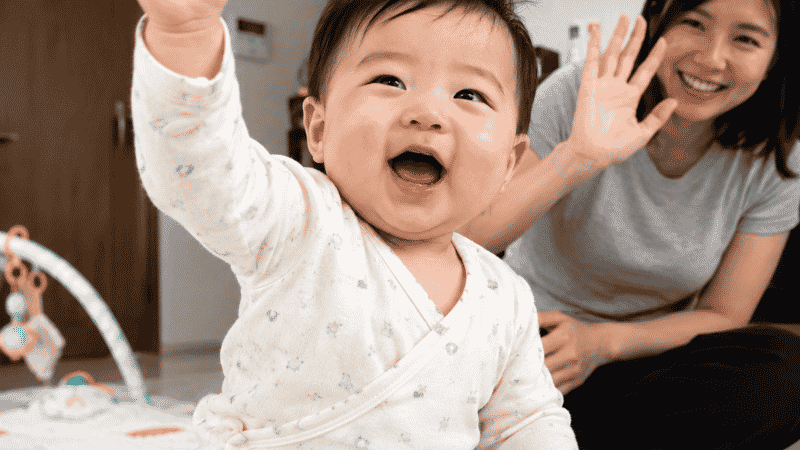
Most babies begin waving around 7 to 8 months, though some wave as early as 6 months and others not until 9 or 10. Early waves often look more like enthusiastic arm-flapping than a neat hand-wave — one arm raising and lowering repeatedly, or a whole-arm swing. It gets more refined over the following weeks.
Waving is significant because it requires several things to come together simultaneously:
- The motor coordination to lift an arm and move the hand intentionally
- The social understanding that this gesture has meaning
- The imitation ability to reproduce a gesture they’ve seen adults doing
That last piece is important. Imitation is one of the primary ways babies learn, and it requires a more sophisticated understanding of other people than early smiling does. A baby who waves is demonstrating that they’ve been watching you wave, understood it as a meaningful act, and decided to do it themselves.
Waving also often comes alongside increased awareness of social exits — your baby waves when someone leaves because they understand, for the first time, that people going away is a thing that happens and has a social ritual attached to it. Which is, honestly, a remarkable amount of conceptual development for someone who still needs help with socks.
When Do Babies Clap — and Why It’s More Than Just Cute
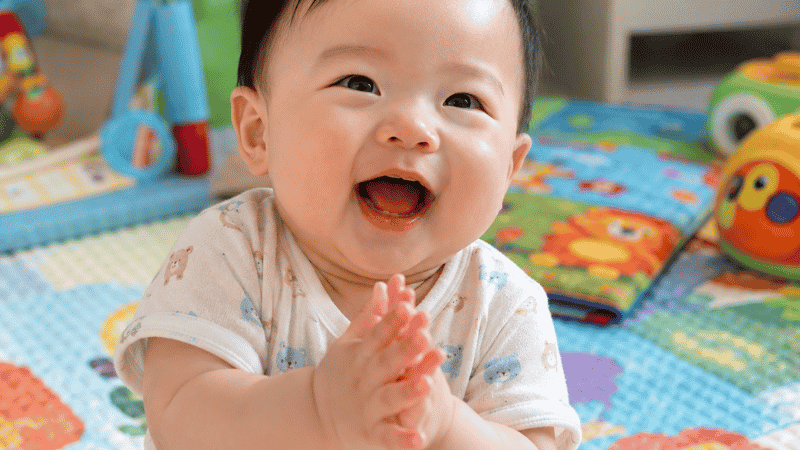
Clapping usually arrives around 9 months, slightly after waving, according to CDC milestones. It requires similar cognitive-motor coordination but adds another layer: understanding that bringing two hands together creates a sound and effect, and that this action has social meaning (celebration, excitement, rhythm).
The physical development that makes clapping possible starts earlier. Around 6 to 8 months, babies begin bringing their hands together at midline — in front of their body — but without the coordination to actually clap. You’ll see them clasping their hands together, playing with their fingers, banging objects on their thighs. All of this is the groundwork.
Around 9 months, the motor coordination to actually clap (both hands moving toward each other simultaneously, with enough speed and force to produce a sound) usually clicks into place. Some babies clap on the earlier side; others don’t reliably clap until 10 or 11 months.
To encourage clapping: clap in front of your baby often, play Pat-a-Cake, and give enthusiastic high fives — the palm-meeting sensation is similar and helps build the coordination. But don’t be surprised if your baby watches you clap for weeks with great interest and then one day just… does it.
The Social Milestone Timeline at a Glance
| Milestone | Typical Age | Normal Range |
|---|---|---|
| Reflex smile | Birth onward | — |
| Social smile | 6–8 weeks | Up to 3 months |
| First chuckle / laugh attempt | 3–4 months | 3–6 months |
| Full laugh | 4–6 months | Up to 6 months |
| Waving | 7–8 months | 6–10 months |
| Clapping | ~9 months | 9–12 months |
What You Can Do to Encourage Social Milestones (Without Stressing About It)
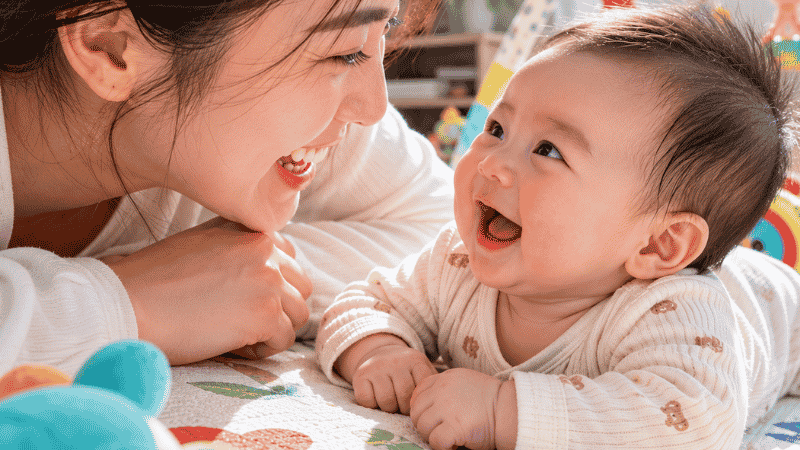
Here’s the thing: you are almost certainly already doing everything right. Talking to your baby, making faces, responding to their sounds, making eye contact during feeds — all of this is exactly what supports social development. You don’t need a curriculum.
That said, a few specific things are well-supported by research:
Face time, not screen time. Social development happens through real-time, face-to-face interaction. A screen showing a smiling face doesn’t produce the same response as an actual person smiling. The AAP’s recommendation to limit screens under 18 months exists partly for this reason — real social interaction is the input that grows social skills.
Respond to every vocalization. When your baby coos or babbles, respond as if they said something interesting. This back-and-forth — what researchers call serve-and-return — builds the neural foundations for communication and social connection. You cannot do this too much.
Follow your baby’s lead. If they look away during play, they’re regulating themselves — taking a break from stimulation. Don’t try to pull their attention back immediately. Give them a moment, then offer re-engagement. This teaches babies that their social signals are respected, which builds the confidence to send more of them.
Sing to them. Seriously. Babies respond to music and rhythmic vocalization in distinct ways from speech. Songs with repeated patterns, like nursery rhymes, engage babies’ social attention reliably and consistently. Your voice matters more than your talent.
“My Baby Isn’t Doing This Yet” — When to Wait and When to Ask
Most milestone anxiety resolves itself within a few weeks. But there are specific signals worth acting on:
Call your pediatrician if:
- Your baby is not smiling at people by 3 months
- Your baby is not laughing by 6 months
- Your baby shows no interest in faces — doesn’t track your face, doesn’t seem to recognize you visually
- Your baby does not wave or gesture by 12 months
- Your baby loses a social skill they previously had — this is always worth evaluating promptly
- Your baby shows little to no eye contact during social interaction
- You have a general sense that something feels off — trust that instinct
The AAP updated their milestone guidelines in 2022 to focus on “what most babies do by” a certain age rather than average ages, specifically to reduce anxiety about normal variation. But the above signs — particularly the loss of a skill or absence of eye contact — remain important flags regardless of timing.
FAQ: The Social Milestone Questions Parents Actually Type at Midnight
My baby is 8 weeks old and hasn’t smiled yet. Is something wrong? Probably not. The CDC milestone for smiling is 2 months, with normal variation extending to 3 months. At 8 weeks, you’re right at the leading edge of the typical window. Keep talking to your baby, making eye contact, and letting their face study yours. The smile is coming. If it hasn’t appeared by 12 weeks, mention it at your next pediatric appointment.
How do I tell if my baby’s smile is real or just gas? Real social smiles are directed — at a face, usually yours — and involve the whole face, not just the corners of the mouth. Gas faces tend to be grimaces rather than smiles, and they’re accompanied by body tension. A social smile tends to come during alert, calm periods when you’re interacting. A sleep-smile is reflexive. Over time, you’ll recognize the difference immediately — the social smile looks unmistakably intentional.
My baby laughs with my partner but not with me. Why? Babies often laugh more readily with certain people — usually whoever is most playful or physically interactive with them. This isn’t a reflection of preference or attachment; it’s often just about play style. The person who does the most raspberry-kisses and surprise lifts tends to get the most laughs. Your baby loves you just as much.
My 10-month-old isn’t clapping yet. Should I be worried? The normal range for clapping extends to 12 months. At 10 months, you’re within the typical window. Continue modeling clapping, playing Pat-a-Cake, and offering high fives. If clapping hasn’t appeared by 12 months, mention it at your 12-month well-child visit.
When should my baby start waving bye-bye intentionally? Most babies begin waving around 7 to 8 months, but it often takes weeks before the wave becomes reliably tied to the social context of someone leaving. By 9 to 10 months, most babies wave intentionally at farewells. If waving hasn’t appeared by 12 months, that’s worth discussing with your pediatrician.
My baby waves and claps but doesn’t laugh much. Is that a concern? Temperament plays a significant role in how much babies laugh. Some babies are more serious and reserved; others are expressive and giggly. If your baby is meeting other milestones — social smiling, making eye contact, responding to your voice, showing interest in faces — the absence of frequent laughter on its own is usually not a developmental concern. Every baby has a personality, and some of them are just quieter than others. Completely valid.
The Milestones That Matter Most Are the Ones Between You
Here’s something the charts don’t capture: the social development that matters most isn’t really about when your baby first waves or claps. It’s about the thousands of small interactions happening every day — the way they search for your face when something startles them, the way they calm down when they hear your voice, the way they study your expressions and start to mirror them.
That’s the real social development. The smile and the laugh and the wave are just the moments when it becomes visible from the outside.
You’re building something with your baby every day. Not by doing tummy time correctly or responding to milestones on schedule, but simply by being there — talking, responding, making ridiculous faces. That’s the work. It’s already happening.
What to Read Next
- Baby Milestones by Month: The Complete 0–12 Month Guide — Social milestones sit inside a bigger picture of development — this guide maps out what to expect across every domain, month by month
- When Do Babies Start Talking? A Month-by-Month Guide to Speech Development — The social development of smiling and waving is the foundation that language builds on — here’s what comes next
- Baby Growth Spurts: When They Happen, What They Feel Like & How to Survive Them — Social leaps often arrive alongside growth spurts — here’s how to recognize when both are happening at once
References
- Centers for Disease Control and Prevention. Developmental Milestones. CDC, updated 2022. https://www.cdc.gov/ncbddd/actearly/milestones/index.html
- American Academy of Pediatrics. Social Development: 8 to 12 Months. HealthyChildren.org, 2023. https://www.healthychildren.org
- Healthline. When Do Babies Start Laughing? Medically reviewed, 2023. https://www.healthline.com/health/parenting/make-a-baby-laugh
- Healthline. When Do Babies Clap? Medically reviewed, 2023. https://www.healthline.com/health/baby/when-do-babies-clap
- Amin M, MD. Millennial parents are feeling “milestone anxiety.” Pediatrician commentary via Yahoo In The Know, 2023.
This article is for informational purposes only and does not constitute medical advice. Always consult your pediatrician with specific concerns about your baby’s social or emotional development.