
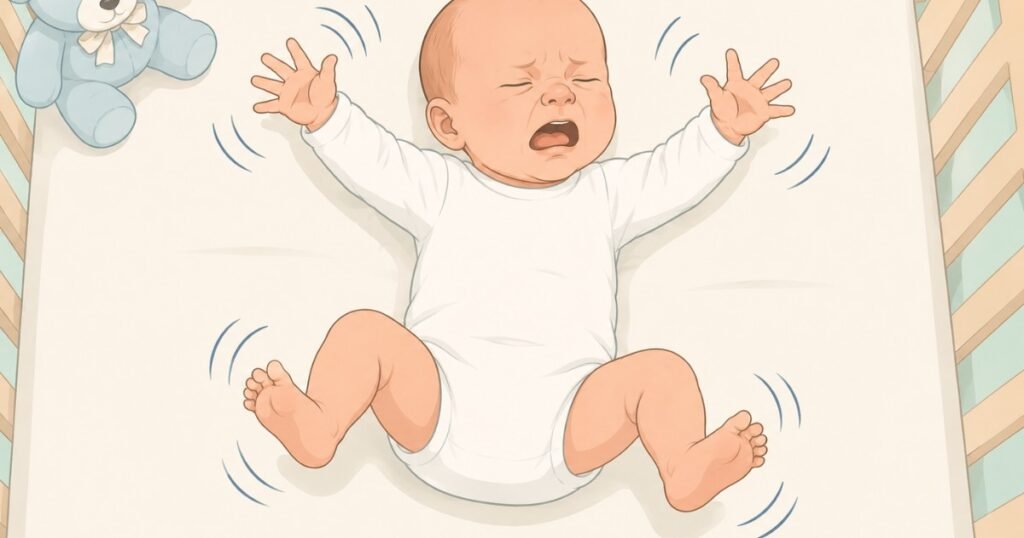
One minute your newborn is sound asleep in your arms. The next, you lay them down and those little arms suddenly fly up, waking them almost instantly. It’s frustrating, especially when everyone is running on very little sleep.
That’s exactly why so many parents try swaddling. A good swaddle helps reduce the startle reflex and gives many newborns the snug, secure feeling they’re used to from the womb. The challenge isn’t deciding whether to swaddle—it’s knowing how to do it safely.
This guide walks you through every step, from wrapping your baby correctly to avoiding common mistakes, choosing the right swaddle style, dressing your baby for sleep, and knowing exactly when it’s time to stop.
Quick Answer
Swaddling is safe when the wrap is snug around the chest and loose around the hips, your baby is always placed on their back, and you stop the moment they show signs of rolling. Here’s the essential checklist before you start:
- Always place baby on their back to sleep, every time.
- Keep the swaddle snug around the chest, but loose around the hips and legs.
- Leave room for two to three fingers to slide in at the chest.
- Dress your baby for the room temperature, not for an extra blanket layer.
- Stop swaddling as soon as your baby starts trying to roll.
The rest of this guide breaks each of these down so you understand not just what to do, but why it matters.
What Is Swaddling and Why Does It Help Newborns?
Swaddling is the practice of wrapping a newborn snugly in a lightweight blanket to mimic the secure, contained feeling of the womb. It doesn’t work through magic — it works by managing a very specific newborn reflex.
What the startle reflex is
Newborns are born with a Moro reflex, an involuntary jerk of the arms and legs that happens in response to sudden movement, sound, or even the sensation of falling asleep. It’s completely normal, but it also tends to wake babies up right when they’re drifting off. A properly done swaddle keeps the arms gently contained, so the startle doesn’t fully jolt your baby awake.
Benefits of safe swaddling
When done correctly, swaddling can help newborns settle faster and stay asleep longer, since they’re not repeatedly waking themselves up with their own arm movements. It also recreates a snug, familiar pressure that many babies find calming after nine months in the womb.
Babies who may not enjoy swaddling
Not every baby loves it, and that’s worth knowing upfront. It’s surprisingly common for a baby to fuss or squirm for the first 10 to 20 seconds of being wrapped, then settle once the wrap is secure and they’re picked up or rocked. If your baby continues to fight it well beyond that window every single time, they may simply prefer having their hands free — and that’s a normal preference, not a sign you’re doing something wrong.
Swaddling helps calm newborns when done correctly and safely — but it’s one tool among several, not a requirement for every baby.
How to Swaddle a Baby Step by Step
Once you have a lightweight, breathable blanket (roughly 40×40 inches works well for most newborns), the actual wrap takes less than a minute.
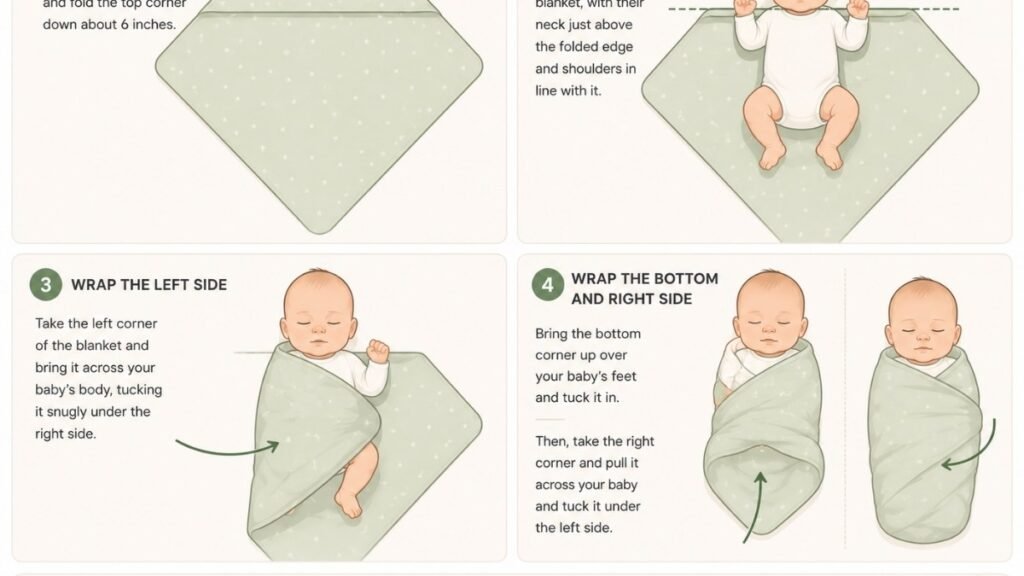
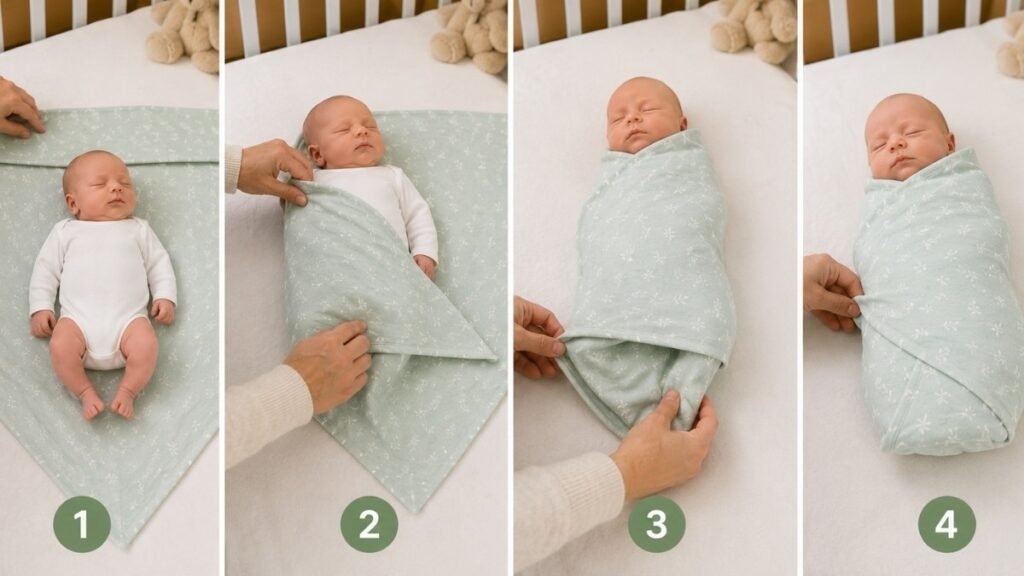
Step 1: Fold the blanket. Lay the blanket flat in a diamond shape and fold the top corner down about 6 inches, creating a straight edge.
Step 2: Position your baby. Place your baby face-up on the blanket, with their neck resting just above the folded edge and shoulders in line with it.
Step 3: Wrap the first side. Take the left corner of the blanket, bring it across your baby’s body, and tuck it snugly under the right side, leaving the right arm free for now if you’re doing an arms-up or half-swaddle, or wrapping it in if using the traditional method.
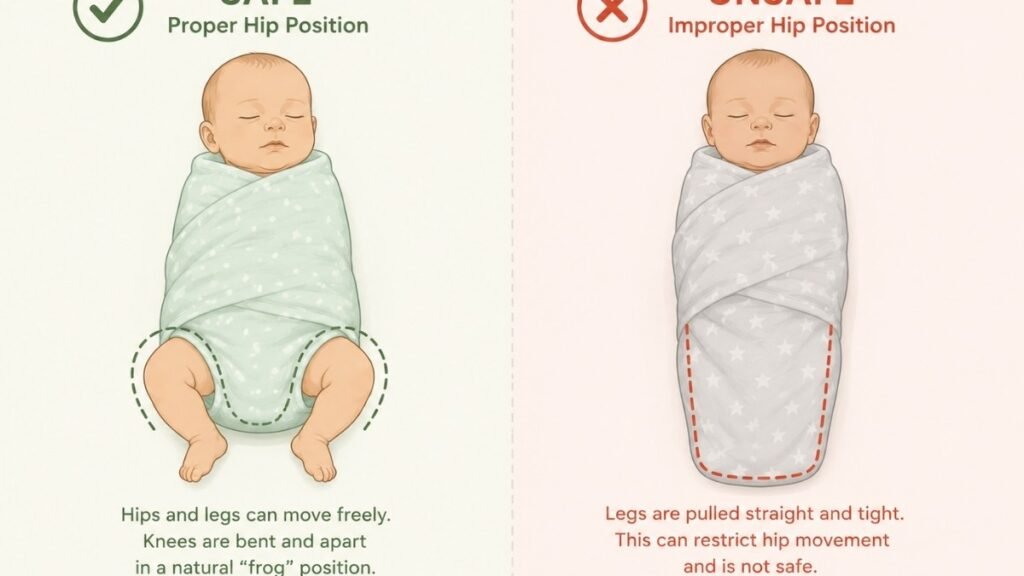
Step 4: Fold the bottom. Bring the bottom corner up and over your baby’s feet, tucking it into the top of the wrap. Leave enough slack here for your baby’s legs to bend up and out, frog-style.
Step 5: Secure the final side. Take the right corner, pull it snugly across your baby’s chest, and tuck it under their left side, so the wrap holds together without any Velcro or pins.
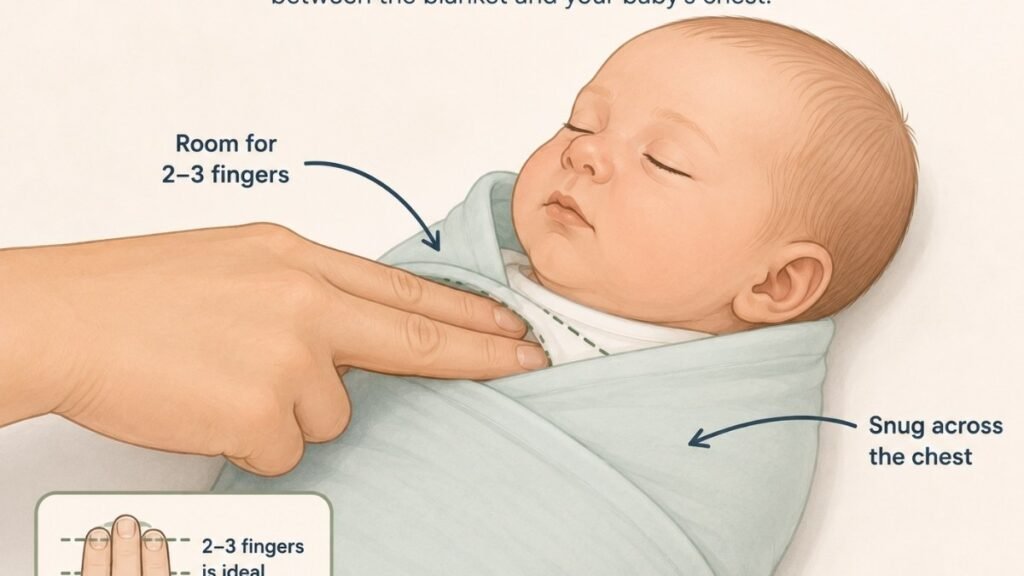
Final safety check: Slide two to three fingers between the blanket and your baby’s chest to confirm it’s snug but not restrictive, and check that the hip area still allows natural movement.
Safe swaddling checklist before every nap
- Blanket is lightweight, breathable cotton or muslin
- Chest area passes the two-to-three-finger test
- Hips and legs can move freely, not pinned straight
- Baby is placed on their back after wrapping
- No loose fabric near baby’s face or neck
It’s genuinely common for beginners to need several attempts before the wrap feels natural. Many parents find their first few swaddles come undone within minutes — that’s a normal part of the learning curve, not a sign the technique is wrong. Practicing during the day, when your baby is calm and awake, tends to build confidence faster than trying to perfect it during an exhausted midnight wake-up.
A snug upper body and loose lower body create the safest swaddle — everything else is refinement.
Safe Swaddling Rules Every Parent Should Know
Learning how to wrap a baby is important, but knowing the safety rules is what really protects your baby while they sleep.
Back sleeping only
A swaddled baby should always be placed on their back to sleep, never on their side or stomach. If a swaddled baby rolls onto their stomach, their arms are restricted and they can’t reposition themselves, which increases risk. This is the single non-negotiable rule of swaddling.
Two-finger tightness test
Slide two to three fingers between the swaddle and your baby’s chest. If you can’t fit them in, the wrap is too tight and may restrict breathing. If the fabric feels loose enough to slide down, it’s too loose and could work its way up toward the face.
Hip-healthy swaddling explained
The hips and knees need room to bend up and out naturally, in what’s often described as a froggy position. Wrapping the legs straight and tight can strain developing hip joints over time. This is why the bottom fold should always be looser than the chest wrap, never pulled taut.
Signs your baby is getting too warm
Overheating is one of the most overlooked swaddling risks. Watch for flushed cheeks, damp hair at the neckline, or rapid breathing. A quick way to check is to feel the back of your baby’s neck — it should feel warm, not sweaty or hot.
| Practice | Safe | Unsafe |
|---|---|---|
| Sleep position | Always on the back | Side or stomach |
| Chest fit | Snug, two-to-three fingers fit | Tight enough to restrict breathing |
| Hip and leg position | Loose, room to bend up and out | Legs pulled straight and tight |
| Fabric near face | Kept clear of chin and neck | Loose fabric near the face |
| Layering | Dressed for room temperature | Swaddle over a thick sleeper or extra blanket |
Wrapping tighter does not make babies sleep better — it’s one of the most common misconceptions new parents run into. A too-tight swaddle is more likely to cause discomfort or hip strain than to improve sleep quality. The goal is secure, not restrictive.
Safe sleep practices matter more than wrapping technique alone. For a complete overview of safe sleep positioning beyond swaddling, it’s worth reviewing full safe sleep guidelines as a companion to this guide.
What Should Baby Wear Under a Swaddle?
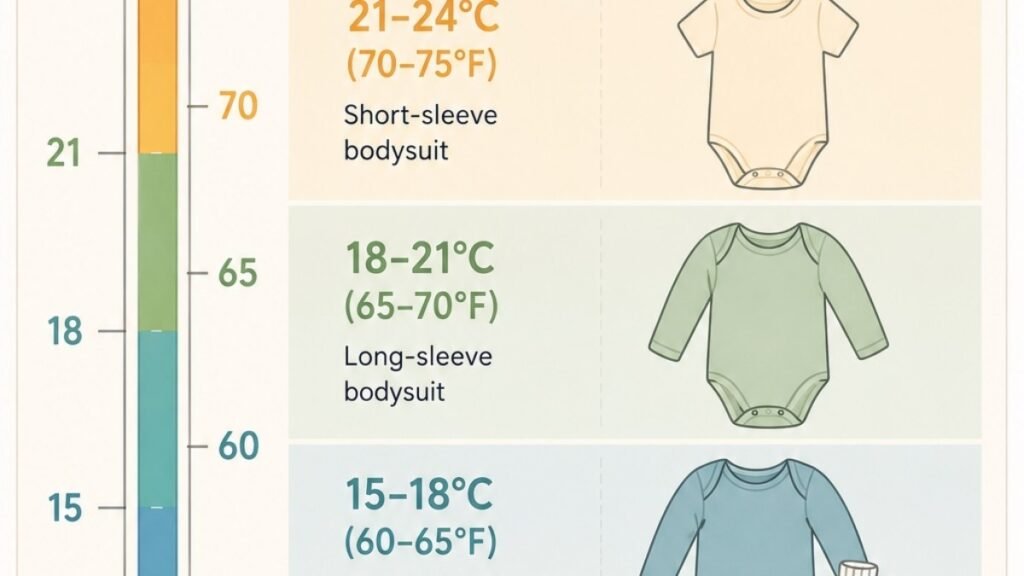
The direct answer: dress your baby in a single light layer, like a short-sleeve bodysuit, and use the swaddle blanket itself as the main layer — skip the extra sleeper or thick pajamas underneath.
Understanding TOG ratings
TOG (Thermal Overall Grade) is a measurement of a fabric’s warmth, commonly used on swaddles and sleep sacks. A lower TOG rating (around 0.5) suits warm rooms, while a higher TOG (around 2.5) is meant for cooler nurseries. Most standard cotton or muslin swaddles fall in the lightweight range.
Dressing for different room temperatures
| Room Temperature | Recommended TOG | Suggested Clothing Underneath |
|---|---|---|
| Above 75°F (24°C) | 0.5 TOG | Diaper only or a light onesie |
| 68–75°F (20–24°C) | 1.0 TOG | Short-sleeve bodysuit |
| 64–68°F (18–20°C) | 2.5 TOG | Long-sleeve bodysuit |
| Below 64°F (18°C) | 2.5+ TOG with added layer | Long-sleeve bodysuit plus socks |
Signs baby is too hot
Sweating, flushed skin, rapid breathing, or a hot chest are all signs to remove a layer immediately. It’s worth checking in on this during the first few nights, since every nursery holds temperature a little differently.
A recurring point of confusion is dressing babies for the season rather than the actual room. Parents in warmer climates sometimes overdress a baby out of habit, while parents worried about the cold add extra layers under an already warm swaddle. Checking a nursery thermometer is usually more reliable than guessing by feel. A dedicated baby room temperature guide can help you fine-tune this further.
Dress for the room — not the season — and avoid excessive layers.
Arms Down, Arms Up, or Hands Near the Face: Which Swaddle Style Is Best?
There’s no single “correct” arm position — the best style is whichever one keeps your specific baby calm while still following safe sleep rules.
Arms-down swaddling
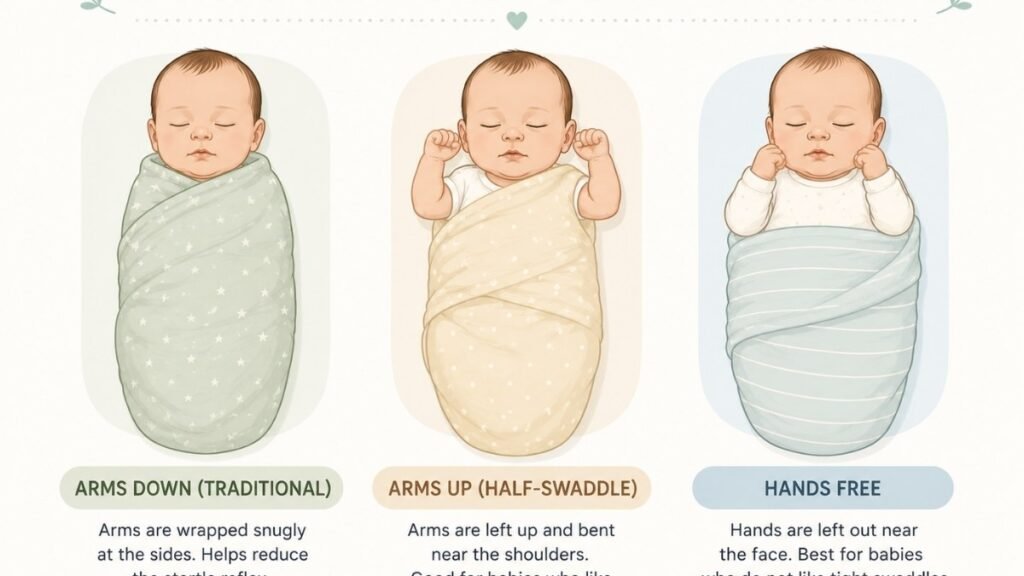
The traditional method, with both arms tucked fully inside the wrap. This gives the most startle-reflex control and tends to work best for babies who seem to wake themselves up frequently.
Arms-up swaddles
Some sleep sacks and wraps allow the arms to stay bent upward near the shoulders instead of pinned to the sides. This suits babies who resist having their arms fully restrained but still benefit from a snug body wrap.
Half-swaddle options
A half-swaddle secures the body and legs while leaving the hands free near the face. Many babies naturally self-soothe by bringing their hands toward their mouth or cheek, and for these babies, a hands-free option often works better than fighting that instinct with a full wrap.
| Style | Best For | Trade-Off |
|---|---|---|
| Arms-down (traditional) | Babies with a strong startle reflex | Least freedom of movement |
| Arms-up | Babies who resist full arm restriction | Slightly less startle control |
| Half-swaddle (hands free) | Babies who self-soothe with their hands | Less containment overall |
It’s common for parents to assume their baby dislikes swaddling entirely, when really the baby just prefers one arm position over another. Trying a different style for a few nights before giving up on swaddling altogether is a reasonable and low-risk experiment.
The safest effective swaddle is the one that matches your baby’s natural comfort while following safe sleep rules — not the tightest or most traditional-looking one.
Traditional Swaddle Blanket vs Swaddle Sack
| Feature | Traditional Blanket | Velcro Swaddle | Zipper Swaddle |
|---|---|---|---|
| Learning curve | Higher — technique-dependent | Low | Low |
| Speed at night | Slower | Fast | Fastest |
| Adjustability | Fully customizable | Somewhat adjustable | Least adjustable |
| Diaper change ease | Requires full unwrap | Partial access | Two-way zippers allow bottom access |
| Cost | Lowest | Moderate | Moderate to higher |
| Durability of closure | No wear parts | Velcro can lose grip over time | Zippers hold up longer |
Many parents start with traditional blankets because they’re inexpensive and versatile, then switch to a zipper swaddle after a few frustrating nights of re-wrapping a baby who worked their way loose at 2 a.m. This is one of the most common product transitions in the newborn stage, and it’s not a sign the blanket method failed — it’s simply a matter of convenience once sleep deprivation sets in.
If you’re comparing specific products, a dedicated roundup of swaddle blankets and sleep sacks can help you narrow down options by fabric, closure type, and price range.
Swaddle sacks often make nighttime care easier for new parents, especially in the first few exhausting weeks.
Common Swaddling Problems and How to Fix Them
Almost every parent runs into a few swaddling challenges at first. Whether your baby keeps breaking an arm free or cries during the wrap, there’s usually a simple solution.
Baby keeps getting arms out
This usually means the chest wrap isn’t snug enough, or the fabric doesn’t have enough grip. Re-check the two-finger test, and consider switching to a swaddle sack with a secure closure if a traditional blanket keeps loosening.
Baby cries while being wrapped
As mentioned earlier, brief fussing during the wrap itself is common and different from disliking the swaddle overall. If crying continues after your baby is fully wrapped and picked up, try a different arm position before assuming swaddling isn’t for them.
Better nighttime diaper changes
Look for a swaddle sack with a two-way zipper, which opens from the bottom so you can change a diaper without undoing the entire wrap. This small feature makes a noticeable difference during overnight changes.
Batwing Method
The Batwing Method is a swaddling technique where the arms are folded across the chest before wrapping, rather than straight down at the sides. Some parents find it gives a bit more room for natural arm bend while still controlling the startle reflex, though it isn’t dramatically different in safety from a standard arms-down wrap.
Is double swaddling safe?
Double swaddling — wrapping a baby in two layers, such as a blanket over a sleep sack — is generally not recommended. It significantly increases the risk of overheating and reduces the accuracy of the chest snugness test. If your baby keeps breaking free, the better fix is a more secure single wrap or a swaddle sack designed with escape-resistant closures, not an additional layer.
Troubleshooting checklist before changing swaddle products
- Confirm the chest wrap passes the two-finger test
- Check for pinching or bunched fabric near the arms
- Try a different arm position before switching products
- Rule out overheating as a cause of restlessness
- Consider a zipper swaddle if Velcro keeps loosening
Most swaddling problems can be solved by adjusting technique instead of wrapping tighter — a tighter wrap is rarely the answer.
When Should You Stop Swaddling?
Stop swaddling as soon as your baby shows any sign of trying to roll over, even if they still seem comfortable in the wrap — this is typically somewhere between 2 and 4 months old, though it varies by baby.
Signs baby is ready
Watch for your baby pushing up during tummy time, rolling from stomach to back, or attempting to turn onto their side during awake periods. The moment any of these appear, it’s time to stop swaddling with the arms contained, regardless of age. For a broader sense of typical timing, it can help to check general milestones around when babies roll over.
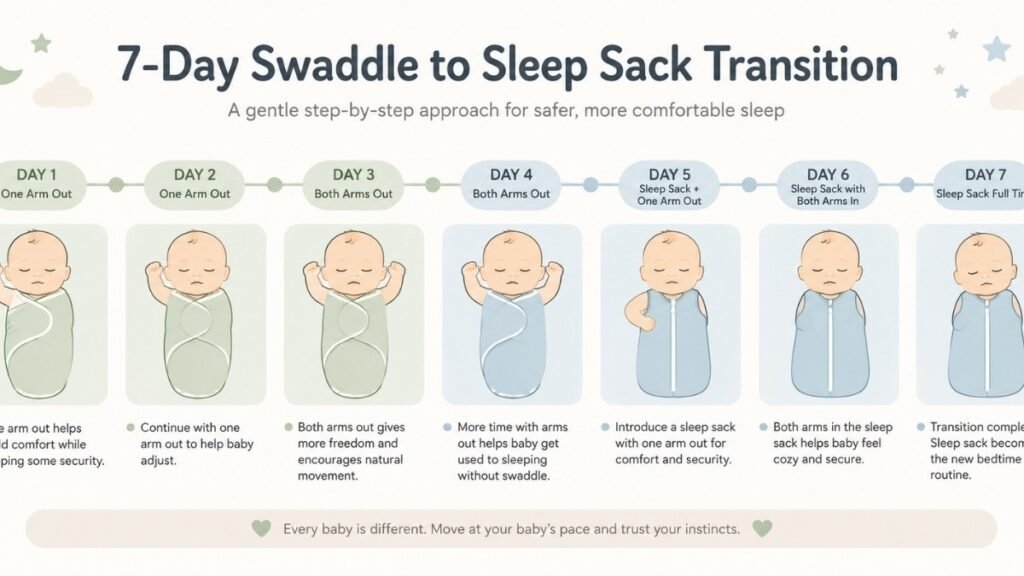
Seven-day transition plan
| Day | Approach |
|---|---|
| 1–2 | Swaddle with one arm out, other arm secured |
| 3–4 | Swaddle with both arms out, body still wrapped |
| 5–6 | Switch to a wearable sleep sack, no arm restriction |
| 7+ | Fully transitioned to sleep sack for all sleep |
One-arm-out progression
Freeing one arm at a time, rather than stopping cold, tends to make the adjustment smoother for babies who’ve grown used to the contained feeling. It also gives you a chance to gauge whether your baby wakes themselves up more without the swaddle, which is normal for the first several nights.
Swaddle transition checklist
- Stop arm containment at the first sign of rolling attempts
- Move to a one-arm-out swaddle for a few nights
- Progress to a wearable sleep sack with no arm restriction
- Keep the sleep environment otherwise consistent
- Expect a short adjustment period of lighter sleep
Some babies transition smoothly within a few nights, while others take one to two weeks to settle into sleeping without the contained feeling. Both are within the range of normal, and consistency with the rest of the bedtime routine tends to help more than rushing the process. Once your baby has fully transitioned, a proper sleep sack becomes the safer long-term option, and it’s worth reviewing newborn care basics generally to make sure other parts of the sleep routine are aligned.
Stop swaddling as soon as rolling attempts begin, even if your baby still sleeps well while wrapped — safety takes priority over routine.
FAQ
Still have questions? Here are answers to some of the concerns new parents ask most often about swaddling.
How do I keep my newborn from getting their hands out of a swaddle?
Focus on a snug chest wrap using the two-finger test, and make sure the fabric has enough tension to hold its fold. If a traditional blanket keeps loosening, a swaddle sack with a secure zipper or Velcro closure usually solves this more reliably than technique alone.
What is the “Batwing Method” for swaddling, and does it really work?
It’s a variation where the arms are folded across the chest before wrapping instead of held straight down. It can offer a bit more natural arm positioning, though it isn’t a dramatically different safety approach from a standard arms-down swaddle. Try it if your baby seems to resist having their arms pinned straight.
Should I swaddle my baby with arms up or arms down?
It depends on your baby’s preference. Arms-down offers the most startle control, while arms-up or half-swaddle styles suit babies who resist full restriction or like to self-soothe with their hands near their face. Testing both for a few nights is a reasonable way to decide.
Is a traditional blanket swaddle better than a zipper or Velcro swaddle sack?
Neither is inherently safer when done correctly. A blanket offers more flexibility and lower cost, while swaddle sacks are typically faster and easier during exhausted nighttime changes. Many parents use a blanket at first and switch to a sack later for convenience.
How do I know if my baby actually hates being swaddled or is just fighting the process?
Brief fussing during the wrap itself, lasting 10 to 20 seconds, is normal and different from ongoing distress after being fully wrapped and settled. If crying continues well after wrapping across multiple attempts and arm positions, your baby may simply prefer to sleep unswaddled.
How do I change a diaper at night without completely undoing the swaddle?
A swaddle sack with a two-way zipper that opens from the bottom lets you access the diaper area without unwrapping the arms or upper body, which keeps your baby calmer during the change and makes it easier to resettle them afterward.
What should I do if my baby gets frustrated because they can’t suck on their hands while swaddled?
Consider a half-swaddle or arms-up style that leaves the hands free while still securing the body and legs. This allows the self-soothing behavior while still providing the calming, contained feeling in the torso.
Can I double swaddle my baby safely if they keep breaking free?
No, double swaddling isn’t recommended, since it raises overheating risk and makes it harder to judge chest snugness accurately. A more secure single wrap, a different arm position, or an escape-resistant swaddle sack is the safer fix.
Final Thoughts
Swaddling is a genuinely useful newborn sleep tool, but only when the safety basics stay non-negotiable: back sleeping, a snug chest, loose hips, appropriate layering, and a firm stop the moment rolling begins. The technique itself is simple to learn, even if it takes a few tries to feel natural, and there’s plenty of flexibility in style and product choice once the safety fundamentals are in place. Treat swaddling as a temporary, adjustable tool rather than a fixed routine, and it’ll serve both you and your baby well during these early months.
🏠 Behind This Guide
Every new parent has the same goal: helping their baby sleep safely while getting a little more rest themselves. Swaddling can make those first weeks easier—but only when it’s done correctly.
That’s why this guide focuses on the practical steps parents actually need, from wrapping your baby safely to avoiding common mistakes and knowing when it’s time to stop.
This guide is built around three essentials:
- 👶 Safe Swaddling Basics — How to wrap your baby securely without restricting healthy movement.
- 🌙 Better Sleep Habits — Simple tips to reduce the startle reflex and create a safer sleep routine.
- ✅ Confidence for New Parents — Clear answers to the questions almost every family asks during the newborn stage.
Because the goal isn’t a perfect swaddle.
It’s helping your baby sleep safely—and giving you more confidence every day.
📚 Related Reading
Looking for more trusted parenting advice? Explore our most popular newborn guides for practical tips on safe sleep, daily care, baby development, and the common questions parents ask during the first year.
- Safe Sleep for Babies: The Complete AAP-Based Guide
- Newborn Baby Care: The Complete Guide for First-Time Parents
- Newborn Hiccups: Why They Happen, How to Help & When to Worry
- When Do Babies Roll Over? A Realistic Guide to This Big Milestone
- The 4-Month Sleep Regression: Why It Happens, How Long It Lasts & How to Cope
❤️ A Final Note
Every parenting journey begins with small, informed decisions—not perfect ones.
At Kindyly, we believe trustworthy advice should be simple, practical, and easy to use in everyday life. That’s why every guide we publish is designed to help new parents understand the basics, avoid common mistakes, and feel more confident as their baby grows.
Our goal is simple: helping families raise happy, healthy babies with confidence, one trusted guide at a time.