

Maybe you found this article while holding a baby in one arm, scrolling your phone with the other, wondering when exactly you’re supposed to fit another pumping session into an already impossible day.
You see one mom online with a freezer full of perfectly labeled milk bags. Another wakes up every night for a 3 a.m. pump. Someone else casually mentions pumping 10 ounces in one session — while you’re staring at half an ounce in the bottle wondering if your body is keeping up.
But breastfeeding was never meant to be a competition measured in ounces.
Some moms build a big freezer stash. Some are just-enoughers who make exactly what their baby needs. Some combine nursing, pumping, and formula because real life does not always follow a perfect feeding chart.
A good breastfeeding and pumping schedule is not about squeezing the maximum amount of milk out of every day. It’s about finding a rhythm that protects your supply, gives your baby what they need, and still leaves room for you to rest and feel like yourself.
This guide walks through realistic breastfeeding and pumping schedules for different situations — whether you’re preparing to return to work, building a small freezer stash, exclusively nursing with occasional pumps, or figuring out combo feeding one day at a time.
Do You Really Need a Pumping Schedule While Breastfeeding?
The short answer is: not always. If you’re exclusively breastfeeding, your baby is your pump — and often the most effective one. Direct nursing stimulates supply more efficiently than any breast pump, because your baby’s suck pattern is more variable and responsive than a machine.
Here’s a quick way to think about whether adding a pumping schedule makes sense for you:
| Situation | Do you need to pump? |
|---|---|
| Returning to work or school | Yes — you’ll need milk for bottles during separations |
| Occasionally leaving baby with a caregiver | Maybe — a small back-up stash is useful |
| Building a freezer stash before returning to work | Optional, but helpful to start 2–4 weeks out |
| Baby is nursing well and supply feels established | Not always — nursing on demand is enough |
| Supplementing or combo feeding | Depends on your goals |
| Low supply concerns | Possibly — extra pumping can signal your body to produce more |
The demand-and-supply mechanism is the key to understanding all of this. Your body produces milk based on how often and how completely milk is removed. More removal = more production signal. So adding pumping sessions does increase supply — but it also increases the ongoing demand on your body. That’s worth factoring in before you add sessions you can’t sustain.

How Breast Milk Supply Actually Works Before Creating a Schedule
Before you set a single alarm for a pump session, it helps to understand what’s actually driving your supply. Because a lot of pumping anxiety comes from not understanding this — and once you do, a lot of that anxiety dissolves.
Milk removal drives supply. Your breasts don’t produce a fixed daily amount and then fill up and stop. They’re constantly producing milk, and the rate of production is regulated by how much milk is being removed and how often. When milk sits in the breast, a protein called Feedback Inhibitor of Lactation (FIL) accumulates and signals the breast to slow production. When milk is removed frequently and thoroughly, that signal is suppressed and production continues.
Storage capacity is different for every woman. Some women have large storage capacity and can go longer between feeds or pumps without supply being affected. Others have smaller storage capacity and need more frequent removal to maintain production. Neither is better or worse — they’re just different. A woman with small storage capacity who pumps every 2.5 hours isn’t less efficient than one who pumps every 4 hours. She’s just responding to her own anatomy.
Your baby is more effective than your pump. This is one of the most important things to know if you’re going to breastfeed and pump simultaneously. A well-latched baby typically extracts more milk per minute than most electric pumps, and baby’s suck pattern — which varies in speed and pressure — is better at stimulating letdown than a machine. If you pump immediately after nursing and get very little, this is almost always because your baby has already done an effective job.
Why Can I Only Pump 0.5–1 oz After Nursing?
This is one of the most common questions in breastfeeding Reddit threads, and the anxiety it generates is real and unnecessary. The honest answer: pumping after nursing is essentially asking your already-drained breast to produce more for a second customer. Getting 0.5 to 1 oz total after a full nursing session is completely normal and does not indicate low supply.
Your baby is not going hungry. The pump is not seeing the full picture of what your body makes. Pump output after nursing tells you almost nothing about your actual milk supply — your baby’s weight gain, wet diapers, and general contentment are much more reliable indicators.
Breastfeeding + Pumping Schedule by Situation
Stay-at-Home Mom: Nursing + Building a Small Freezer Stash
If you’re home with your baby and primarily nursing directly, you may not need to pump at all — or you may want to build a small stash for occasional separations or peace of mind. Here’s a realistic approach that doesn’t require treating yourself like a dairy operation.
Sample schedule:
| Time | Activity |
|---|---|
| 6:30 AM | Nurse baby |
| 7:00–7:15 AM | Pump 10–15 minutes (morning session) |
| Daytime | Feed on demand, no scheduled pumping |
| Evening | Optional pump if you feel full or want to add to stash |
Why morning? Prolactin — the hormone that drives milk production — is naturally higher overnight and in the early morning. This means your first pump of the day, especially shortly after the morning nursing session, typically yields the most milk. Exploiting this window by pumping 30 to 60 minutes after the first morning nursing session is the most efficient way to accumulate stash without adding multiple sessions throughout the day.
The Haakaa option: If adding a full pumping session feels like too much, a silicone milk collector (like a Haakaa or similar) placed on the opposite breast during nursing captures the letdown from the other side — passively, without any pumping effort. This is a low-effort way to collect an extra 0.5 to 2 oz per nursing session without adding a scheduled pump.
The goal for a SAHM building a moderate stash isn’t 10 oz per day. It’s a bag here and there over several weeks. A stash of 30 to 50 oz before a return to work — which could take 4 to 6 weeks of occasional pumping — is genuinely enough for most situations.
Working Mom Pumping Schedule: Returning to the Office

This is where pumping schedules become non-optional — and where the planning matters most. When you’re away from your baby for 8 to 10 hours, you need to remove milk at roughly the same frequency your baby would normally feed, both to maintain supply and to prevent engorgement and mastitis.
Sample schedule (standard 9-5, with commute):
| Time | Activity |
|---|---|
| 6:30 AM | Nurse baby before leaving |
| 10:00 AM | Pump at work (20–25 minutes) |
| 12:30 PM | Pump at work (20–25 minutes) |
| 3:30 PM | Pump at work (20–25 minutes) |
| 6:30 PM | Nurse baby after returning home |
| Evening/Night | Nurse on demand |
Three pump sessions during an 8-hour workday keeps removal frequency close to what your baby would naturally need. This is the baseline recommendation from most lactation consultants.
What if you only have time to pump twice at work?
This is a real situation — not everyone has access to three breaks, a private room, or enough flexibility to pump three times. Twice is not ideal, but it’s workable. The key is to pump for longer during each session (25 to 30 minutes rather than 20) and to make sure morning and evening nursing sessions are thorough. Your supply may dip slightly, but for many women it stabilizes at the reduced frequency. If you notice a significant sustained drop, adding even one partial session (10 to 15 minutes) during lunch can help.
Know your rights: The PUMP Act (2022) expanded the original FLSA “break time for nursing mothers” provision. Most employees in the US are now entitled to reasonable break time to pump and a private space (not a bathroom) for up to one year after your baby’s birth. If your workplace isn’t accommodating this, this is a federal labor rights issue worth raising with HR or an employment attorney.
The daycare bottle math: Babies generally need approximately 1 to 1.5 oz of milk per hour away from mom. For a 9-hour separation, that’s roughly 9 to 13 oz needed at daycare. If you’re not pumping enough to cover this, supplementing with formula for daycare bottles while continuing to nurse at home is completely compatible with maintaining your breastfeeding relationship.
Combo Feeding Schedule: Breast + Pump + Formula

This is one of the most underrepresented scenarios in breastfeeding content, despite being extremely common. Combo feeding — using some combination of nursing, pumping, and formula — can look completely different from family to family and is valid in all of its forms.
Maybe you’re a just-enougher who is nursing what you have and supplementing with formula because your supply isn’t meeting full demand. Maybe you’re choosing combo feeding for mental health reasons — the constant nursing demand was unsustainable, and adding some formula bottles gave you breathing room. Maybe you started supplementing in the NICU and never fully transitioned to exclusive breastfeeding.
A realistic combo feeding schedule:
| Time | Activity |
|---|---|
| Morning | Nurse baby (both sides) |
| Mid-morning | Formula bottle if baby still hungry |
| Afternoon | Nurse or pump-and-bottle |
| Evening | Nurse baby |
| Night | Formula bottle if needed for overnight coverage |
There is no formula (pun slightly intended) for getting the combo feeding ratio right. You adjust based on what your baby needs, what your body produces, and what you can sustain. The goal is a fed, growing baby and a mom who isn’t breaking down.
Should You Wake Up for a Middle-of-the-Night Pump (MOTN)?
This question generates more Reddit posts than almost anything else in the breastfeeding community. The short answer: it depends on where you are in your breastfeeding journey.
| Situation | MOTN pump recommendation |
|---|---|
| 0–12 weeks, establishing supply | Probably worth doing — prolactin is highest overnight |
| Supply established, baby still waking | Baby is already doing the job — MOTN pump may not be needed |
| Baby newly sleeping through the night | Evaluate — if you’re waking up engorged, pump briefly to comfort |
| Noticeable supply dip | Adding a MOTN pump can help restore production signal |
| Severe exhaustion affecting daytime functioning | Sleep may protect your breastfeeding more than the pump session does |
The nuance that most guides miss: sleep deprivation itself affects milk supply. Cortisol (the stress hormone) inhibits oxytocin (the letdown hormone). A severely sleep-deprived mother who is nursing and pumping may actually see better supply outcomes by sleeping through the night than by adding a 2 a.m. pump session. This isn’t permission to skip the MOTN pump if your supply is still establishing — it’s a reminder that sustainability matters.
How to Build a Freezer Stash Without Creating Oversupply

The internet version of a freezer stash looks like a deep freezer packed with hundreds of bags labeled in orderly rows. The realistic version for most moms is a zipper bag in the back of the regular freezer with 30 to 60 bags accumulated slowly over several weeks.
You don’t need 300 oz before you go back to work. You need enough to cover the first week while you’re building your pumping-at-work routine. That’s roughly 50 to 75 oz — achievable by adding one morning pump session per day starting 3 to 4 weeks before your return date.
The morning pump method: Pump once in the morning, 30 to 60 minutes after the first nursing session. Do this daily. Pour whatever you get — even 1 oz — into a storage bag. Label it with the date. Freeze it. In 4 weeks, you’ll have a stash.
Avoid chasing oversupply. Pumping aggressively to build a massive stash can train your body to produce more milk than your baby actually needs. When you eventually reduce pumping sessions, you may experience uncomfortable engorgement, blocked ducts, or mastitis as supply adjusts downward. Moderate, consistent extra pumping is easier on your body than pumping to oversupply and then weaning back.
Storage products that help:
- Storage bags that lay flat for efficient freezer stacking
- A freezer organizer or small basket to keep bags organized chronologically (oldest in front)
- The pitcher method: collect small amounts throughout the day in a refrigerated pitcher and combine into one bag — avoids wasting small volumes
Pumping Problems That Break Most Schedules (And How to Fix Them)
Baby’s Cluster Feeding Ruined My Schedule
Growth spurts and developmental leaps trigger cluster feeding — your baby nursing every 45 to 60 minutes for hours at a time. Your carefully planned pumping schedule becomes impossible to maintain, and any stash you had is rapidly depleted.
What to do: lean into the cluster feeding rather than fighting it. Your baby’s increased nursing is the most efficient supply boost available. Pump sessions can be skipped or shortened during a cluster feeding period without long-term damage to supply — the baby is covering the removal frequency. Resume your schedule once the cluster feeding settles, usually within 2 to 4 days.
My Pump Output Suddenly Dropped
Sudden pump output drops have predictable causes that are worth systematically checking before assuming supply has decreased:
- Flange size: An incorrectly sized flange (the funnel piece that goes against the breast) is one of the most common causes of poor pump output. The nipple should move freely without the areola being pulled in. Most women need a flange size smaller than the default included with most pumps.
- Pump parts needing replacement: Membranes, valves, and tubing all degrade over time and affect suction. Membranes especially should be replaced every 4 to 8 weeks with regular use.
- Pump cycle settings: Stimulation mode (faster, lighter) initiates letdown. Expression mode (slower, stronger) extracts milk. Make sure you’re using both phases correctly.
- Stress and hydration: Dehydration directly reduces milk production. Chronic stress inhibits letdown. Both are often overlooked.
Pumping Takes Too Much Cleaning Time
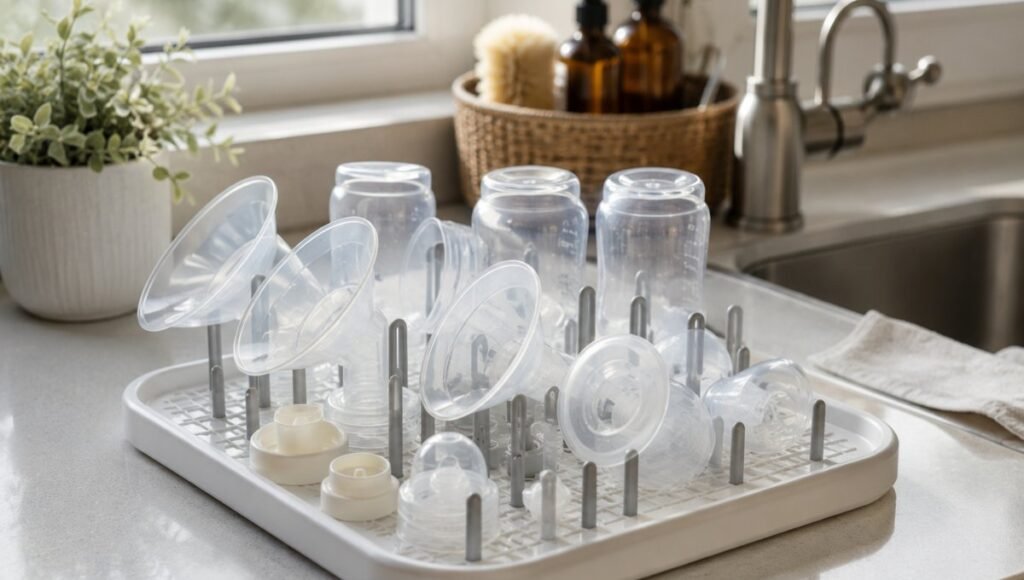
Washing pump parts after every session is one of the most tedious parts of pumping — and one of the most common reasons moms reduce their pumping frequency or stop altogether.
Practical solutions:
- Store parts in the refrigerator between sessions during the workday (CDC guidance allows this for up to 24 hours, minimizing washes to once daily)
- Buy extra sets of pump parts so you can rotate rather than wash between sessions
- Portable cleaning options (wipes designed for pump parts, steam bags) for when you’re away from a sink
- A portable electric pump for the workday eliminates the need to haul and reassemble a full pump kit
Essential Pumping Tools That Actually Make Life Easier
| Problem | Helpful Tool |
|---|---|
| Hands occupied during pumping | Hands-free pumping bra |
| Pumping at work discreetly | Wearable in-bra pump (Elvie, Willow, Momcozy) |
| Traveling with pumped milk | Insulated cooler bag with ice packs |
| Collecting extra milk during nursing | Silicone milk collector (Haakaa or similar) |
| Washing fatigue | Extra set of pump parts; refrigerator storage between sessions |
| Building a stash efficiently | Pitcher method + flat-freeze storage bags |
When Should You Change Your Pumping Schedule?
Your pumping schedule isn’t a permanent contract. It should evolve as your situation changes.
Times to reassess:
- Baby starts sleeping longer stretches overnight → you may be able to drop the MOTN pump
- Returning to work → transition from stash-building to work-day pumping schedule
- Starting solid foods (around 6 months) → baby’s milk needs gradually decrease; pump sessions can reduce
- Supply consistently exceeds demand → you can reduce sessions without affecting what baby needs
- Supply consistently falls short → adding a session or extending session length may help
The general principle: match milk removal to milk need. As baby’s needs change, your schedule should too.
Warning Signs: When to Contact a Lactation Consultant or Pediatrician
Talk to an IBCLC (International Board Certified Lactation Consultant) or your baby’s pediatrician if:
- Your baby is not gaining weight appropriately despite frequent nursing and/or pumping
- You’re experiencing repeated blocked ducts or mastitis
- Pump output has dropped significantly and schedule adjustments haven’t helped
- You’re experiencing nipple or breast pain that persists beyond the first few weeks
- You’re considering stopping breastfeeding for supply-related reasons and want to explore options first
Lactation consultants are the appropriate professional resource for supply concerns — they can assess latch, observe a nursing session, conduct a weighted feed, and make specific recommendations. Many hospital systems offer lactation support postpartum, and WIC provides free IBCLC access.
FAQ: Real Questions from Real Parents
Will pumping after breastfeeding empty my breast and leave nothing for my baby? No. Your breast is not a container that empties and refills on a timer. Milk is produced continuously, and your baby can always get milk at the breast. The breast that feels “empty” after pumping will still provide milk when your baby nurses — the letdown may take slightly longer to initiate, but the milk is there.
Is pumping only 0.5–1 oz after nursing normal? Yes, completely. Pumping after nursing is asking your already-depleted breast to produce more for a second removal session. Getting less than 1 oz total after a feeding is standard and does not indicate low supply. Your baby’s weight gain is the reliable indicator, not your pump output.
Can I skip the MOTN pump if my baby sleeps through the night? If your supply is well-established and your baby is gaining weight appropriately, sleeping through without pumping is generally fine once your body has adjusted. If you wake up engorged, pump briefly to comfort only — not to empty — to avoid signaling your body to produce more milk overnight than your baby needs during the day.
Will pumping only twice at work hurt my supply? It may cause a modest reduction over time compared to three sessions. Longer sessions and thorough emptying during the two available pumps can help mitigate this. Many moms maintain a workable supply with two sessions, particularly after the first few months when supply is more established.
Do I need to follow the same pumping schedule on weekends? Not necessarily. If your baby is nursing directly on weekends, that’s replacing the pump sessions. Your body responds to overall milk removal across 24 hours — the source (baby vs. pump) matters less than the frequency. Nursing on demand over the weekend naturally covers what your pump did during the week.
Can I mix milk pumped at different times? Yes, with one guideline: cool freshly pumped milk in the refrigerator before combining it with previously refrigerated or already-cooled milk. Don’t add warm fresh milk directly to cold stored milk, as this can raise the temperature of the stored milk.
How much freezer stash do I really need before going back to work? About 3 to 5 days’ worth, which is roughly 50 to 75 oz for most babies. This buffer covers your first week back while your pumping-at-work routine is still establishing. You’ll replenish the stash as you go. You don’t need 200 bags.
The Schedule That Matters Most Is the One You Can Actually Keep
The most effective breastfeeding and pumping schedule is not the most aggressive one, the one that produces the most milk, or the one that earns the most approval on parenting forums.
It’s the one you can sustain — through work stress and sick days and cluster feeding weeks and the particular exhaustion of keeping a small human alive — without destroying your mental health in the process.
Some moms pump three times at work and build a 150-bag freezer stash. Some pump twice and supplement with formula and make it to a year. Some stop pumping at 6 months because they can’t do it anymore and continue nursing directly. Every single one of these is a legitimate, loving choice.
Feed your baby. Protect your sleep when you can. Adjust as you go. You’re doing this right.
🤱 Kindyly Care Notes: The Research Behind This Guide
Breastfeeding is not about following the perfect schedule — it is about finding a rhythm that supports both your baby and you.
This guide is based on evidence-informed breastfeeding research, lactation guidance, and recommendations from trusted health organizations.
Research on milk production helps explain why consistent milk removal supports supply, while lactation resources from KellyMom and breastfeeding professionals help parents understand realistic pumping expectations.
Guidance from organizations such as the American Academy of Pediatrics (AAP) and workplace resources related to the PUMP Act also shaped this guide’s approach to infant nutrition, pumping, and real-life feeding challenges.
Every feeding journey looks different.
The best schedule is not the one that produces the most milk — it is the one that helps your baby grow while allowing you to keep going.
What to Read Next
- How to Increase Milk Supply: Science-Backed Tips That Actually Work — If pumping output concerns you, this guide covers what the evidence actually says about increasing supply
- How to Store Breast Milk: A Complete Safety Guide — Once you’re pumping, proper storage keeps that milk safe — this covers all the guidelines
- Newborn Feeding Schedule: How Much & How Often, Week by Week — Understanding how much your baby needs at each stage helps you know how much to pump
At Kindyly, we believe good parenting guidance should combine trusted research with real-life experiences — because families need information that works outside of a perfect textbook scenario.
This article is for educational purposes only and does not replace advice from an IBCLC, pediatrician, or healthcare provider.