
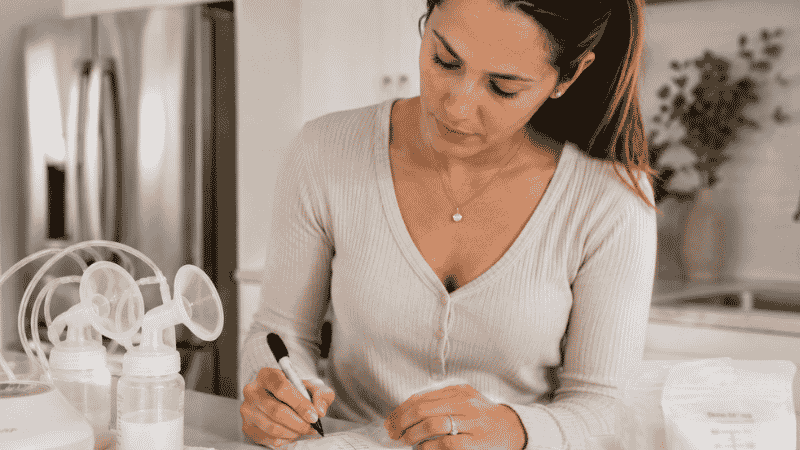
You’ve just finished pumping. Maybe it took twenty minutes, maybe forty. You look at the bottles — two ounces, four ounces, whatever you managed — and you feel that familiar mix of pride and exhaustion. That milk represents real effort, real time, and real nourishment for your baby. The last thing you want is to do something wrong and have to throw it out.
If you’ve ever stood in your kitchen at midnight, bottle in hand, trying to remember whether the milk has been sitting out too long — or found yourself second-guessing whether it’s still safe after thawing — this guide is for you. Knowing exactly how to store breast milk isn’t complicated, but the rules are specific enough that guessing is genuinely stressful.
This is everything you need: the exact time limits, the container choices, the thawing and reheating rules, the common mistakes that waste milk, and what to do in the edge cases that nobody warns you about. No vague advice. Just clear, science-backed answers you can trust.
Key Takeaways
- The CDC’s core rule is simple to remember: 4 hours at room temperature, 4 days in the refrigerator, 6 months in the freezer (up to 12 months is acceptable but quality declines).
- Always store milk in the back of the fridge or freezer — never in the door, where temperature fluctuates every time it opens.
- Never microwave breast milk. It creates hot spots that can burn your baby’s mouth and destroys some of the milk’s beneficial proteins.
- Once thawed, breast milk must be used within 24 hours — it cannot be refrozen.
- Leftover milk from a feeding (milk your baby didn’t finish) must be used or discarded within 2 hours.
Breast Milk Storage Time Limits: The Complete Reference Table
These guidelines come directly from the CDC and the Academy of Breastfeeding Medicine. Use them as your go-to reference.
| Storage Location | Temperature | Freshly Expressed Milk | Thawed Milk | Leftover from a Feeding |
|---|---|---|---|---|
| Room temperature (countertop) | 77°F / 25°C or cooler | Up to 4 hours | 1–2 hours | 2 hours — then discard |
| Insulated cooler bag with ice packs | ~59°F / 15°C | Up to 24 hours | Not recommended | Not applicable |
| Refrigerator | 40°F / 4°C or below | Up to 4 days | Up to 24 hours | 2 hours — then discard |
| Freezer (standard, attached to fridge) | 0°F / -18°C or below | Up to 6 months (best quality) | Never refreeze | Not applicable |
| Deep freezer (standalone) | 0°F / -18°C or below | Up to 12 months (acceptable) | Never refreeze | Not applicable |
A quick memory shortcut: 4-4-6. Four hours on the counter, four days in the fridge, six months in the freezer. Everything else branches from there.
One important note: these are guidelines for healthy, full-term babies at home. If your baby was born premature, is hospitalized, or has immune system concerns, your care team may give you more conservative guidelines — always follow their specific instructions.
What Containers to Use for Storing Breast Milk
The container you choose matters more than most people realize, both for safety and for preserving the quality of your milk.
Best options:
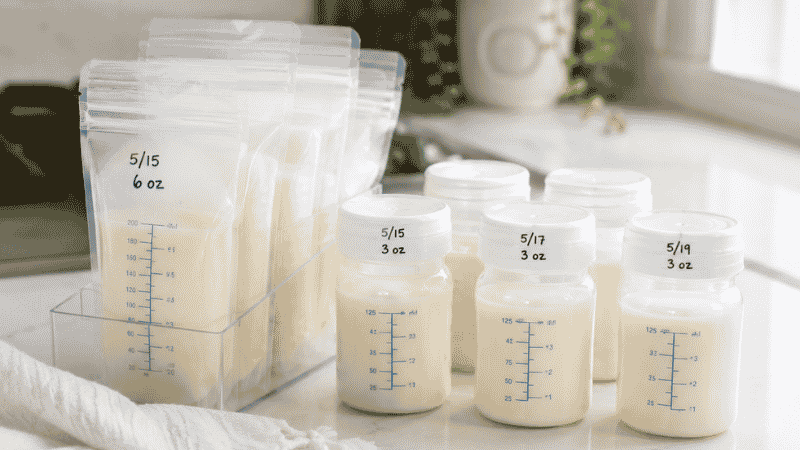
- Breast milk storage bags designed specifically for this purpose — they are pre-sterilized, made from food-safe materials, and lay flat for efficient freezer stacking
- Hard-sided BPA-free plastic containers with tight-fitting lids
- Glass containers with secure lids
What to avoid:
- Regular zip-lock bags or sandwich bags — not designed for breast milk storage and can leak or contaminate
- Disposable bottle liners — too thin and not intended for freezing
- Any plastic with recycle symbol #7 — may contain BPA
How much to store per container: The CDC recommends freezing in small amounts — typically 2 to 4 ounces per bag or container. This minimizes waste when your baby doesn’t finish a feeding and helps milk thaw faster. Consider also keeping a few 1-ounce portions for unexpected situations or when your baby only needs a top-up.
Leave one inch of space at the top of any container you’re freezing — breast milk expands as it freezes, and a too-full container can crack or leak.
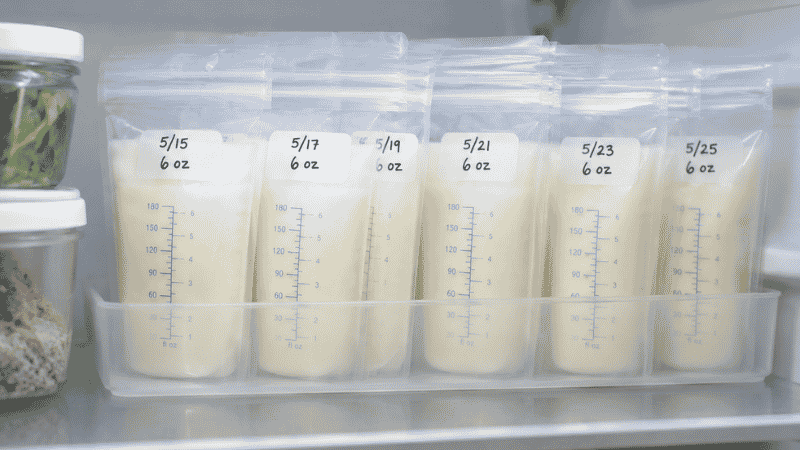
Label every container with the date it was expressed (and your baby’s name if it’s going to daycare). Use waterproof labels or write directly on storage bags with a permanent marker. When using your freezer stash, always use the oldest milk first — rotate the stock like you would food in your pantry.
Where to Store Breast Milk in Your Fridge and Freezer
Location within your fridge or freezer is one of those details that sounds minor but genuinely affects safety.
In the refrigerator: Store milk at the back, on a middle shelf. The door is the warmest and most temperature-variable part of the fridge — every time it opens, door-stored items experience a temperature spike. The back of the middle shelf stays most consistently at the target 40°F.
In the freezer: Same principle — back of the freezer, away from the door. If your freezer is the attached type inside your refrigerator (rather than a separate compartment), be aware that it may not maintain a consistent 0°F, especially in older models. A standalone deep freezer holds temperature better, which is why breast milk lasts longer in one.
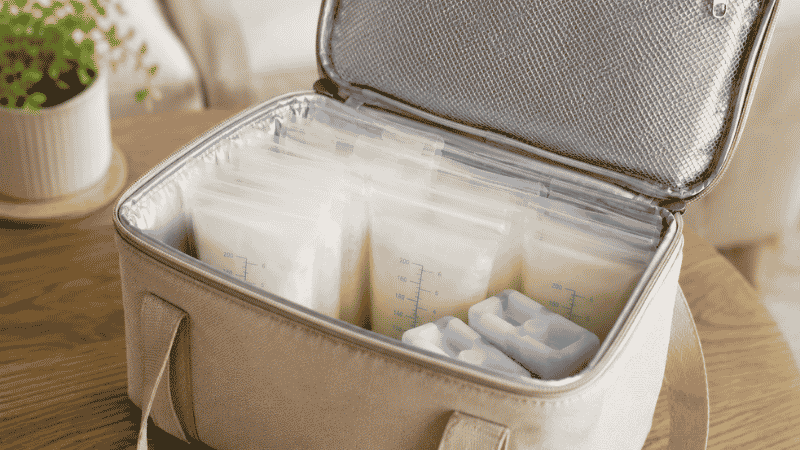
When you’re away from home: An insulated cooler bag with frozen ice packs keeps freshly expressed milk safe for up to 24 hours. This is the right solution for pumping at work, traveling, or any situation where you can’t get to a fridge immediately. Keep the milk as insulated as possible — don’t open the bag more than necessary.
How to Thaw Breast Milk Safely
This is where many parents inadvertently compromise their milk. Thawing is simple, but the wrong method can destroy nutrients or create safety risks.
The safest thawing methods:
- Overnight in the refrigerator — the most gentle method, preserves nutrients best. Plan ahead: move frozen milk to the fridge the night before you need it.
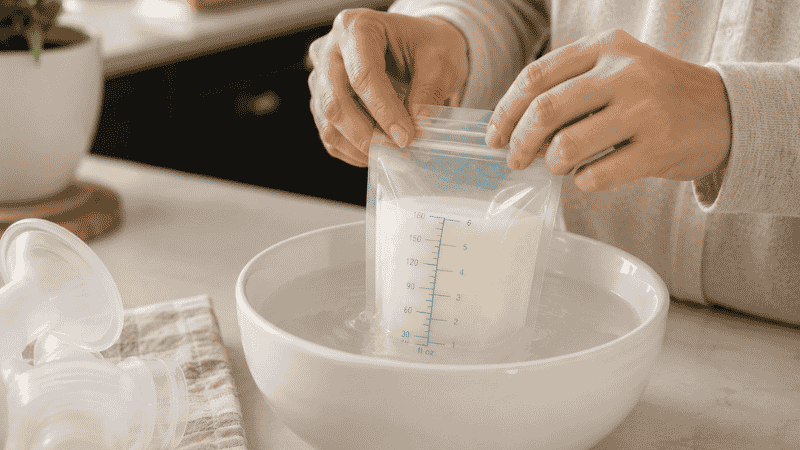
- Under warm running water — hold the sealed bag or container under a stream of lukewarm water. This works well when you need milk more quickly. The water should be warm, not hot.
- Placed in a bowl of warm water — same principle as above, slightly more hands-off. Replace the water as it cools.
What you should never do:
- Microwave breast milk. This is one of the most important rules, and it’s worth understanding why. Microwaves heat unevenly, creating “hot spots” in the milk — areas that can be hot enough to burn your baby’s mouth even if the bottle feels only warm to the touch. Beyond safety, microwaving also destroys some of the antibodies and beneficial proteins that make breast milk so valuable. No exceptions.
- Boil or heat on the stove. Same concern — excessive heat degrades the milk’s nutritional properties.
- Leave frozen milk on the counter to thaw. Room-temperature thawing creates an opportunity for bacterial growth before the milk is fully thawed.
Once thawed: Use refrigerated thawed milk within 24 hours. If you thawed it by running warm water over it and it’s now at room temperature, use it within 1 to 2 hours. Never refreeze milk that has been thawed — this is a firm rule with no exceptions.
How to Warm Refrigerated Breast Milk
Your baby doesn’t need warm milk — many babies happily take milk at refrigerator temperature or room temperature, and there’s no nutritional reason to warm it. But if your baby prefers it warm, here’s how to do it safely.
Safe warming methods:
- Place the bottle or bag in a bowl of warm (not boiling) water for a few minutes
- Hold it under warm running water
- Use a bottle warmer set to a gentle temperature — avoid any that can heat milk to boiling
Test the temperature before feeding: shake the bottle gently to distribute any warmth evenly, then drip a few drops on the inside of your wrist. It should feel neutral — neither hot nor cold. If it feels warm to you, it’s probably a touch too warm for your baby’s mouth.
A note on that separated layer: Refrigerated or thawed breast milk separates — the cream rises to the top and the thinner milk settles below. This is completely normal. Gently swirl the bottle (don’t shake vigorously, which can break down some proteins) to recombine before feeding. If it doesn’t fully mix back together after swirling, or if it smells sour or rancid, trust your nose — discard it.
Can You Mix Fresh and Frozen Breast Milk?
Yes, but with one important rule: always cool fresh milk before adding it to previously frozen or refrigerated milk. Adding warm freshly pumped milk to frozen milk causes the frozen portion to partially thaw, and that partial-thaw-then-refreeze cycle degrades quality and creates a food safety issue.
The process: pump, let the fresh milk cool in the fridge for at least 30 to 60 minutes, then add it to your frozen or refrigerated milk. You can add fresh milk to a bag you’ve already started freezing, as long as the quantity of fresh milk is less than the amount already in the bag (so it doesn’t re-thaw the existing frozen portion).
The Most Common Breast Milk Storage Mistakes (And How to Avoid Them)
Storing in the fridge door. It seems convenient, but the door is the warmest, most temperature-variable part of your fridge. Everything in the door experiences repeated temperature spikes every time the fridge opens. Move your milk to the back of a shelf.
Forgetting to label with the date. After a few weeks of pumping, it becomes genuinely hard to remember which bags were pumped when. Label immediately — before you put the container down. Keep a permanent marker right next to where you pump.
Freezing in large portions. Eight-ounce frozen bags feel efficient, but if your baby only drinks four ounces, you’ve wasted the rest — thawed milk can’t be refrozen, and leftover thawed milk must be used within 24 hours. Freeze in feeding-sized portions.
Using milk that smells “off” without knowing why. Some mothers have high levels of the enzyme lipase in their milk, which causes milk to develop a soapy or metallic smell when stored — even when it’s perfectly safe. This isn’t spoilage; it’s a natural enzymatic process. Babies usually accept it fine. If your baby refuses it, scalding fresh milk briefly before storing (heating to just under boiling, then cooling rapidly) deactivates the lipase before it can break down the fats.
Assuming frozen milk lasts indefinitely. Frozen breast milk at 0°F is safe indefinitely from a bacterial standpoint, but nutrient quality — particularly vitamin C — declines over time. The 6-month guideline exists for quality, not just safety. Use your frozen stash in order, and try to work through it within 6 months where possible.
Breast Milk Storage When You’re Traveling or Going Back to Work
Pumping at work: Express at regular intervals to maintain supply, ideally every 3 to 4 hours. Store pumped milk in a well-insulated bag with frozen ice packs. This keeps milk safe for up to 24 hours — long enough to transport home and refrigerate or freeze. The US has federal law (PUMP for Nursing Mothers Act) requiring most employers to provide reasonable break time and a private, non-bathroom space for pumping.
Air travel: The TSA allows breast milk in quantities greater than 3.4 ounces in carry-on luggage — it’s exempt from the standard liquid restrictions. Bring it in a clearly labeled bag, and expect it to be screened separately. Ice packs are also permitted. Frozen dry ice-packed milk can be stored in the freezer at your destination or moved to the refrigerator if you’ll use it within a day or two.
Power outage: If your freezer loses power, breast milk is safe as long as it remains frozen solid. If it has partially thawed but still has ice crystals, it can be refrozen — though some quality loss will occur. If it has fully thawed, treat it as thawed milk: use within 24 hours if refrigerated, or discard if it has been at room temperature for more than 2 hours.
When to Discard Breast Milk — Without Second-Guessing
- More than 4 hours at room temperature: discard
- More than 4 days in the refrigerator: discard
- More than 24 hours after thawing in the refrigerator: discard
- More than 2 hours since your baby started a feeding from the bottle: discard the remainder
- It smells strongly sour or rancid (not just slightly different — genuinely off): discard
- You can see visible contamination or unusual color: discard
Trust your instincts here. Breast milk is precious and the loss is real — but milk that has been stored improperly carries a genuine risk of making your baby ill. When in doubt, throw it out. The next pumping session will replenish the stash.
FAQ: Real Questions Parents Ask About Breast Milk Storage
Can I put warm breast milk directly in the fridge? Yes — freshly expressed milk can go straight into the fridge. You don’t need to let it cool to room temperature first. Putting warm milk in the fridge is safe; adding warm milk to already-frozen milk is not (because it partially thaws the frozen portion).
My fridge milk has been there for 5 days. Is it still safe? The CDC guideline is 4 days for freshly expressed milk. At 5 days, the risk of bacterial growth increases — especially if your fridge runs slightly warmer than 40°F or if the milk was stored in the door. The conservative answer is to discard it. If the milk smells fresh and your baby is healthy and full-term, the risk is low — but it’s genuinely not worth the risk for a newborn or a baby under 2 months.
How do I know if breast milk has gone bad? Fresh breast milk smells faintly sweet or neutral. Spoiled milk smells sour or rancid — the same way cow’s milk smells when it turns. A slightly soapy or metallic smell may be lipase (see above) and doesn’t mean the milk is unsafe. When in doubt, smell it and trust your instincts.
Can I reheat breast milk twice? No. Once milk has been warmed and offered to your baby, any leftovers must be used within 2 hours and should not be reheated again. Repeated heating further degrades nutrients and increases bacterial risk.
My baby didn’t finish the bottle. How long can I keep the leftover milk? Use it within 2 hours of when your baby started the feeding. After that, discard it — your baby’s saliva has entered the milk through the bottle nipple, which introduces bacteria.
Is it safe to transport breast milk in a regular bag without ice packs? Only for very short trips — 30 minutes or less at cool ambient temperature. For anything longer, use an insulated bag with frozen ice packs. The goal is to keep milk below 40°F if refrigerating or solidly frozen if transporting from the freezer.
Does freezing breast milk destroy its nutrients? Freezing preserves most of breast milk’s nutritional and immunological properties, though some vitamin C and some antibodies are reduced compared to fresh milk. Refrigerated fresh milk preserves more than frozen, which is why the recommendation is to use refrigerated milk first and freeze what you won’t use within 4 days. Even frozen milk is nutritionally superior to formula.
You’re Doing the Hard Work — Make Sure It Counts
Every ounce of stored breast milk represents time you spent pumping, energy your body put into production, and care you’re giving your baby even when you’re not in the same room. Following these storage guidelines is how you make sure that effort translates into safe, nourishing milk at every feeding.
The rules can feel like a lot at first. But after a week or two, they become habit — label, refrigerate, rotate, thaw gently, never microwave. You’ll stop thinking about them consciously and just do them.
What to Read Next
- How to Increase Milk Supply: Science-Backed Tips That Actually Work — Building your freezer stash starts with a strong supply — here’s how to support it
- Newborn Feeding Schedule: How Much & How Often, Week by Week — Understand how much your baby needs at each stage so you can portion your stored milk accurately
References
- Centers for Disease Control and Prevention. Proper Storage and Preparation of Breast Milk. CDC, 2022. https://www.cdc.gov/breastfeeding/recommendations/handling_breastmilk.htm
- Mayo Clinic. Breast Milk Storage: Do’s and Don’ts. Updated 2024. https://www.mayoclinic.org/healthy-lifestyle/infant-and-toddler-health/in-depth/breast-milk-storage/art-20046350
- Academy of Breastfeeding Medicine. ABM Clinical Protocol #8: Human Milk Storage Information for Home Use for Full-Term Infants, Revised 2017. Breastfeeding Medicine, 2017. doi:10.1089/bfm.2017.29047.aje
- American Academy of Pediatrics. Tips for Freezing and Refrigerating Breast Milk. HealthyChildren.org, 2023. https://www.healthychildren.org
This article is for informational purposes only and does not constitute medical advice. Always consult your pediatrician or a certified lactation consultant with specific questions about feeding or milk storage for your baby.