

You’ve memorized the numbers. Four hours on the counter. Four days in the fridge. Six months in the freezer. You’ve got them written on a sticky note next to the pump.
And then real life happens.
You pumped at 7 a.m. and forgot to put the bottle in the fridge until 10. Your power went out for three hours overnight. Your baby took two ounces from a bottle, then fell asleep — and you’re not sure how long ago that was. Your partner put fresh warm milk directly into the bag of frozen milk you’d been building all week.
Suddenly the clean numbers don’t cover your situation, and you’re standing in the kitchen at midnight trying to calculate whether the milk is still safe or whether you’re about to throw out an hour of pumping.
This guide is for exactly those moments. Not just the rules — but the reasoning behind them, so that when your situation doesn’t fit neatly into the chart, you can think it through and make a confident decision.
Key Takeaways
- The CDC breast milk storage guidelines are built around bacterial growth rates and nutrient preservation — understanding why the numbers exist helps you handle edge cases with confidence.
- The official guidelines are: 4 hours at room temperature, 4 days in the refrigerator, 6 months in the freezer for best quality (up to 12 months is acceptable).
- These guidelines are designed for healthy, full-term babies at home — premature babies, hospitalized babies, or babies with immune conditions may need stricter rules from their care team.
- The 2-hour rule for leftover milk (milk your baby has already fed from) is one of the most frequently misunderstood — saliva contamination, not just time, is the reason it’s non-negotiable.
- When in doubt: smell it, look at it, think about how it was stored — and when you’re still unsure, the cost of discarding is always less than the risk of feeding unsafe milk.
Why Breast Milk Storage Guidelines Exist: The Science in Plain English
Before getting into edge cases, it helps to understand what these guidelines are actually protecting against. There are two separate concerns at play: bacterial safety and nutritional quality. They’re not the same thing, and the rules address both.
Bacterial Safety: Why Temperature and Time Both Matter
Fresh breast milk naturally contains antibacterial properties — lactoferrin, immunoglobulins, and other compounds that actively slow bacterial growth. This is why freshly expressed breast milk can sit at room temperature for up to 4 hours safely, while regular cow’s milk would be risky in that window.
But those protective properties have limits. As time passes — especially at warmer temperatures — bacterial populations can grow past the point where those natural defenses can manage. The storage time limits in the CDC guidelines represent the points at which bacterial growth becomes a meaningful concern for infant health, based on laboratory research into human milk microbiology.
Refrigeration slows bacterial growth dramatically. Freezing effectively halts it. This is why the acceptable window extends from 4 hours to 4 days to 6 months as you move from counter to fridge to freezer.
Nutritional Quality: Why Freezer Guidelines Aren’t Forever
The 6-month freezer guideline (with 12 months as an outer acceptable limit) isn’t primarily about bacterial safety — frozen milk is technically safe indefinitely from a bacterial standpoint. It’s about nutrient preservation.
Research shows that vitamin C content in breast milk decreases over time in storage, even when frozen. Some immunologically active proteins also degrade gradually. The milk remains nutritionally superior to formula even after 6 months of freezing — but it’s not quite as rich as fresher milk. This is why the guidelines frame it as “6 months is best quality, 12 months is acceptable” rather than a hard safety cutoff.
The Official CDC Breast Milk Storage Guidelines: Full Reference
These are the current CDC-issued guidelines for healthy, full-term babies at home.
| Location | Temperature | Freshly Expressed | Thawed Milk | Leftover from Feeding |
|---|---|---|---|---|
| Room temperature | 77°F / 25°C or cooler | Up to 4 hours | 1–2 hours | 2 hours max, then discard |
| Insulated cooler + ice packs | ~59°F / 15°C | Up to 24 hours | Not recommended | Not applicable |
| Refrigerator | 40°F / 4°C or below | Up to 4 days | Up to 24 hours | 2 hours max, then discard |
| Freezer (standard) | 0°F / -18°C or below | ~6 months best; 12 months acceptable | Never refreeze | Not applicable |
The memory shortcut: 4 – 4 – 6. Four hours, four days, six months.
What the Guidelines Don’t Tell You: Real-Life Scenarios Answered
This is where most guides stop. Here’s where this one goes further.
Scenario 1: You Forgot to Refrigerate for Longer Than You Planned
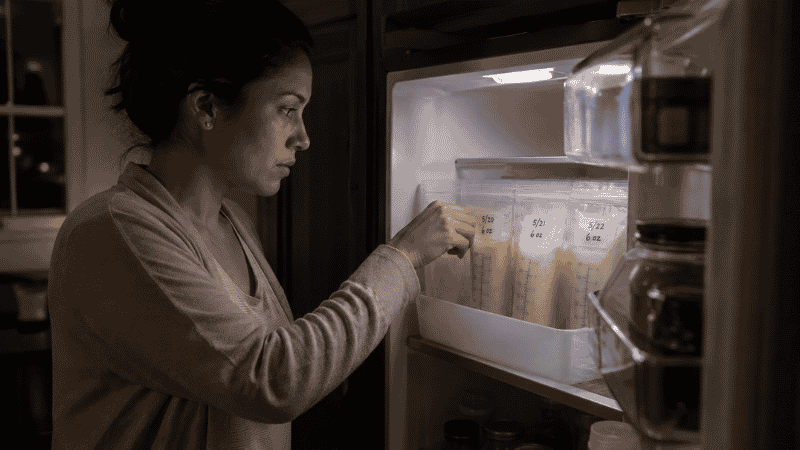
You pumped at 7 a.m., got distracted with the baby, and it’s now 11:30 a.m. The milk has been at room temperature for four and a half hours. What do you do?
The answer depends on your room temperature. The 4-hour rule assumes a room temperature of 77°F or cooler. If your kitchen runs warm — above 77°F — the window is shorter, closer to 3 to 4 hours. If your kitchen is genuinely cool (air-conditioned, below 70°F), the milk is likely still fine at 4.5 hours.
At 4.5 hours in a normal room, the risk is low for a healthy full-term baby — but the CDC guideline has been exceeded. Smell the milk. If it smells fresh, you can use it for the next feeding. If it smells even slightly off, discard it. Going forward, set a phone alarm when you finish pumping.
Scenario 2: The Power Went Out Overnight
If the power was out for less than 4 hours and your refrigerator stayed below 40°F (fridges hold temperature reasonably well when kept closed), the milk is almost certainly fine. A fridge thermometer gives you certainty here — a worthwhile $10 investment.
If the power was out for more than 4 hours and the fridge temperature rose above 40°F, treat the milk as though it was at room temperature for that duration. If it was already near its 4-day refrigerator limit, discard it. If it was freshly pumped yesterday, it’s still within a reasonable window.
For the freezer: as long as the milk remained solidly frozen (still has ice crystals throughout), it is safe. Partially thawed milk with ice crystals can be refrozen — though there is some quality loss. Fully thawed milk that has reached room temperature should be treated as thawed milk: use within 2 hours or refrigerate and use within 24 hours.
Scenario 3: You Added Warm Fresh Milk to a Frozen Bag
This is one of the most common storage mistakes, and it matters. Adding warm freshly pumped milk to a bag of frozen milk causes the outer layer of the frozen milk to partially thaw. When that layer then refreezes, it has gone through a partial freeze-thaw cycle, which compromises both safety and quality in that portion.
The fix going forward: always cool fresh milk in the refrigerator for at least 30 minutes before adding it to frozen milk. For the bag where this already happened — if the frozen milk stayed mostly frozen solid (you only added a small amount of warm milk), it’s likely fine. If a significant amount thawed and you’re unsure, err on the side of discarding.
Scenario 4: Your Baby Drank Some, Then Fell Asleep — How Long Do You Have?
The 2-hour rule for leftover milk (milk your baby has already started drinking from a bottle) is strict, and the reason matters. When your baby feeds from a bottle, saliva enters the nipple and the milk. Saliva contains bacteria and enzymes, and once they’re in the milk, the clock runs differently than for untouched stored milk.
Two hours from when your baby started feeding — not from when you first poured it. If your baby fell asleep after 20 minutes of feeding and you’re not sure whether it’s been 90 minutes or two and a half hours since you started the bottle, use your best judgment. If it’s clearly been more than two hours, discard the remainder. This rule exists specifically because of the contamination that’s already occurred.
Scenario 5: You’re Not Sure If This Milk Smells Right
Fresh breast milk has a faint sweet or neutral smell. Some variation is normal — milk from different pumping sessions can smell slightly different depending on what you ate, your hydration level, and where you are in your cycle.
A strongly sour or rancid smell is a clear signal to discard. A soapy or metallic smell is more nuanced — this is often caused by high lipase activity, an enzyme naturally present in some women’s milk that breaks down fats over time. Lipase-affected milk is not harmful, just less palatable. Many babies accept it fine; others refuse it. If lipase is a recurring issue with your stored milk, scalding fresh milk immediately after pumping (heating to just below boiling, then cooling quickly before storing) deactivates the lipase before it can alter the flavor.
Breast Milk Storage Guidelines for Special Situations
Premature or Hospitalized Babies
The guidelines above are for healthy full-term babies at home. If your baby was born early, is currently hospitalized, or has any immune system concerns, your NICU or pediatric care team will give you different — typically more conservative — guidelines. These may include shorter room-temperature windows, stricter refrigerator limits, and specific protocols around donor milk or fortifiers. Always follow your hospital’s specific instructions over general guidelines.
Pumping at Work
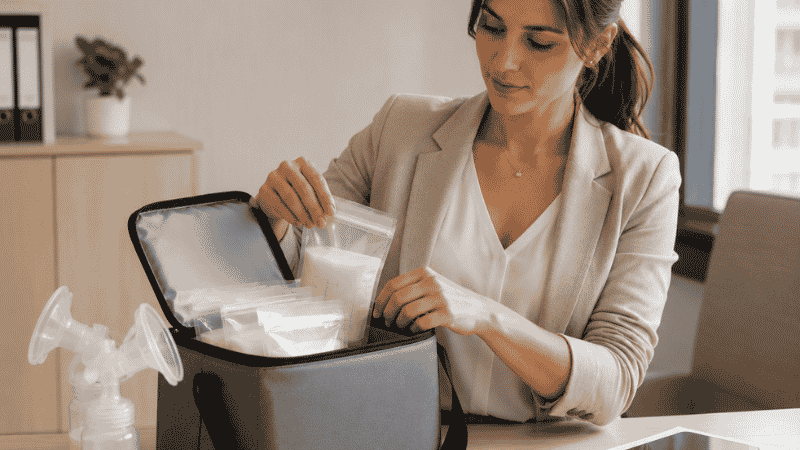
You’re legally entitled under the PUMP for Nursing Mothers Act (in the US) to break time and a private, non-bathroom space for pumping. For storage: pumped milk can go into an insulated bag with ice packs and stay there safely until you get home — up to 24 hours. At home, refrigerate or freeze right away. Label everything with the date. Keep a small permanent marker in your pump bag.
Traveling with Breast Milk
If flying: the TSA permits breast milk in quantities over 3.4 ounces in carry-on bags — it’s exempt from the standard liquid rule. Bring it in a clearly marked, insulated bag. Ice packs are also allowed. Notify the TSA officer when you reach the security checkpoint.
If driving: keep the milk in an insulated cooler with ice packs. Once you arrive at your destination, refrigerate or freeze immediately.
Donating Breast Milk
If you’re considering donating surplus milk to a milk bank, the guidelines change significantly — donor milk banks have their own screening, testing, and storage protocols. Contact an HMBANA (Human Milk Banking Association of North America) accredited milk bank for their specific requirements.
The One Rule That Catches Almost Everyone: Leftover Milk After Feeding
It’s worth dwelling on this one more time because it’s genuinely misunderstood — and because throwing out a partially drunk bottle feels like such a waste.
Once your baby has fed from a bottle, the milk that remains has been contaminated with saliva. That saliva introduces bacteria and begins an enzymatic breakdown process that continues even when the milk is refrigerated. This is categorically different from untouched stored milk. The 2-hour rule is the CDC’s guidance on how long that milk remains safe after contamination has begun.
You cannot “save” leftover milk by re-refrigerating it. The bacteria and enzymatic process don’t pause when the milk gets cold — they just slow slightly. Two hours from the start of feeding is the window. After that, discard the remainder.
To minimize waste: pour out only what you think your baby will drink, and offer more if they’re still hungry. You can always add more milk; you can’t un-contaminate what’s already been drunk from.
When to Trust Your Instincts — and When to Call Your Pediatrician
Most breast milk safety decisions can be made with the guidelines above and your own judgment. But call your pediatrician if:
- Your baby shows signs of illness after a feeding and you’re concerned about stored milk safety
- You’re unsure whether to use milk after a prolonged power outage or unusual storage situation
- Your baby is premature, immunocompromised, or has any condition that makes them higher-risk — in which case, err heavily on the side of discarding anything questionable and get guidance from your care team
- You notice something genuinely unusual about the milk — color changes beyond normal separation, visible contamination, or a smell that’s clearly wrong
For gray areas — the “probably fine but I’m not sure” situations — the principle that serves you best is: the cost of discarding one bottle is always less than the risk of feeding unsafe milk. It feels wasteful in the moment. It is the right call.
FAQ: The Breast Milk Storage Questions Parents Actually Ask
Can breast milk storage guidelines differ between sources? Slightly, yes. The CDC, AAP, and Academy of Breastfeeding Medicine all have guidelines, and there are minor variations — particularly around room temperature (some sources say up to 6 hours; CDC says up to 4). For simplicity and conservatism, use the CDC’s 4-hour room temperature guideline. It is the most widely cited and the safest choice.
Does the 4-day fridge rule start from when I expressed the milk or when I first opened the container? From when you expressed it. Label every container with the date it was pumped, not the date you opened it. If you pumped on Monday and refrigerate it, it needs to be used or frozen by Friday — whether or not you’ve opened it.
My fridge seems colder than usual. Does that extend the storage time? Not meaningfully, and it introduces a different risk — freezing temperatures in the fridge compartment can partially freeze the milk. Keep your fridge at 40°F and follow the 4-day guideline. A fridge thermometer helps confirm your temperature is actually in the safe range.
Can I mix breast milk from different pumping sessions? Yes — as long as both portions are already cooled to refrigerator temperature before combining. Never mix warm fresh milk with cold or frozen milk. Cool fresh milk in the fridge for at least 30 minutes first, then combine.
Is milk that’s been frozen for 7 months unsafe? Not necessarily unsafe — it’s beyond the “best quality” window (6 months) but within the “acceptable” window (12 months). The nutritional content, particularly vitamin C, will have decreased compared to fresher milk. It’s not dangerous; it’s just not optimal. Use it if that’s what you have.
Does breast milk need to be warmed before feeding? No. Many babies feed happily from refrigerator-cold or room-temperature milk. Warming is a preference, not a nutritional requirement. If your baby accepts cold milk, it saves time and eliminates the warming step entirely.
Knowing the Rules Means Trusting Yourself
The breast milk storage guidelines exist because someone did the laboratory research to figure out when milk stops being safe — and they wrote it down so you don’t have to guess. That’s valuable. But the guidelines can’t anticipate every scenario your actual life will produce.
What they give you, once you understand the reasoning, is a framework for thinking through the edge cases yourself. Temperature matters because it controls bacterial growth. Time matters for the same reason. Contamination from feeding changes the equation entirely. With that understanding, most situations that don’t fit the chart neatly become manageable.
You’re not just memorizing rules. You’re learning to think like someone who understands why the rules exist — which means you can handle the moments when they don’t quite cover your situation.
What to Read Next
- How to Store Breast Milk Safely: A Complete Guide for New Moms — The practical step-by-step companion to this guide: containers, labeling, thawing, and the most common storage mistakes
- How to Increase Milk Supply: Science-Backed Tips That Actually Work — Because building a freezer stash starts with having enough milk to store
References
- Centers for Disease Control and Prevention. Proper Storage and Preparation of Breast Milk. CDC, updated May 2025. https://www.cdc.gov/breastfeeding/breast-milk-preparation-and-storage/handling-breastmilk.html
- Academy of Breastfeeding Medicine. ABM Clinical Protocol #8: Human Milk Storage Information for Home Use for Full-Term Infants, Revised 2017. Breastfeeding Medicine, 2017. doi:10.1089/bfm.2017.29047.aje
- Rechtman DJ, et al. Effect of environmental conditions on unpasteurized donor human milk. Breastfeeding Medicine, 2006. doi:10.1089/bfm.2006.1.24
- American Academy of Pediatrics. Tips for Freezing and Refrigerating Breast Milk. HealthyChildren.org, 2023. https://www.healthychildren.org
This article is for informational purposes only and does not constitute medical advice. Always follow guidance from your pediatrician or lactation consultant for your baby’s specific situation.