
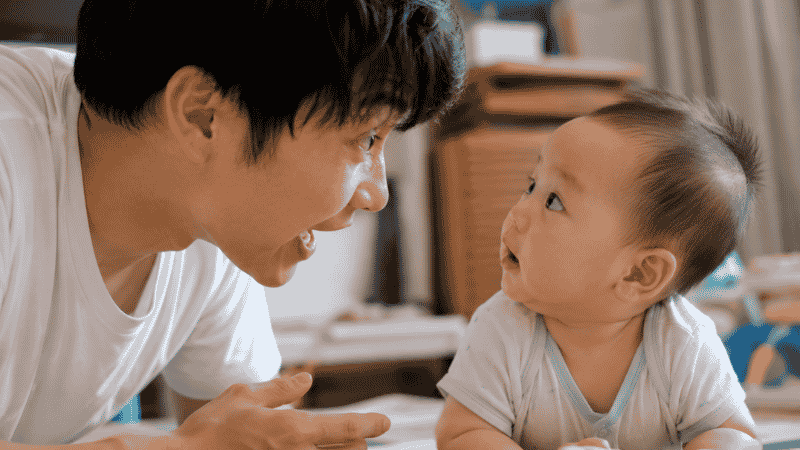
You’re sitting across from your baby, making faces, using your best animated voice, narrating every diaper change and every spoonful of food. And your baby looks at you — really looks at you — but the words just aren’t coming. Meanwhile, someone in your parent group mentions their same-aged baby just said their first word, and you come home quietly wondering: is my baby behind?
This is one of the most universal parenting worries in the first two years. Speech development is deeply personal to parents because language is how we connect — and waiting for your baby to talk back feels like an eternity when you’re in the middle of it.
Here’s what will help: understanding what speech development actually looks like from birth through 24 months, what counts as real communication before words arrive, what you can do to support language growth, and the specific signs that warrant a professional evaluation. The range of normal is genuinely wide — but knowing where the edges of that range are makes all the difference between appropriate reassurance and timely action.
Key Takeaways
- Babies begin communicating from birth — crying, making eye contact, and responding to voices are all early language foundation-building.
- Most babies say their first true words somewhere between 9 and 14 months, with the CDC noting that by 12 months, most babies use at least one or two words with meaning.
- According to the National Institute on Deafness and Other Communication Disorders (NIDCD), by 6 months most babies recognize the basic sounds of their native language and begin babbling.
- Talking to your baby constantly — narrating your day, reading aloud, responding to their sounds — is the single most evidence-based thing you can do to support language development.
- Speech delay affects approximately 1 in 5 children and responds well to early intervention — earlier evaluation is always better than waiting.
What Does “Talking” Actually Mean for a Baby?
This is worth clarifying before anything else, because parents often wait for words when meaningful communication has been happening for months.
True language development is a continuum that starts at birth and builds incrementally. “Talking” in the adult sense — using words with consistent meaning — is one point on that continuum, not its beginning. Everything that comes before words is equally important and equally developmental.
The foundations of speech include listening and turning toward sounds, making eye contact, cooing and vocalizing, imitating facial expressions, babbling with different consonant-vowel combinations, and using gesture combined with vocalization to communicate intent. A baby who is doing all of these things before their first word arrives is doing exactly what they should be doing.
When Do Babies Start Talking? The Month-by-Month Timeline
Birth to 3 Months: The Listening Phase
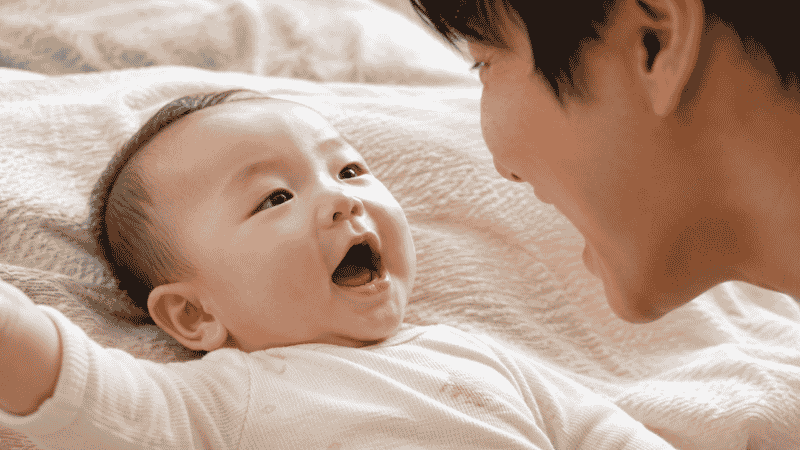
Babies arrive with remarkable auditory sensitivity. They recognize their mother’s voice — research shows that newborns prefer voices they heard in the womb. In the first weeks, your baby communicates entirely through crying (with different cries for hunger, discomfort, and overtiredness) and through facial expressions and body movements.
By 3 months, most babies begin cooing — soft, vowel-rich sounds like “ooh” and “aah” that are their first experiments with voluntary vocalization. They turn their heads toward familiar voices, make eye contact during interaction, and begin to show the social smile that is itself a form of communication.
What you’ll notice: Your baby quiets when you speak. They track your face. They begin to make soft sounds that seem to respond to your talking. This is the foundation.
4 to 6 Months: Early Babbling Begins
This is when things start to sound more speech-like. Babies begin producing babbling — repetitive consonant-vowel combinations like “ba-ba,” “da-da,” and “ma-ma.” These are not words yet — your baby is experimenting with the sounds their mouth and tongue can make, not communicating meaning. (Yes, “da-da” at 5 months is thrilling, but it’s not daddy yet. That comes later.)
By 6 months, according to the NIDCD, most babies recognize the basic sounds of their native language and have begun to filter out sounds from other languages — their auditory system is tuning itself specifically for the language they’re growing up in. They respond to their own name, change their tone of voice to express happiness or upset, and begin to show interest in back-and-forth “conversations” where they vocalize in response to your talking.
What you’ll notice: Lots of babbling, more varied sounds, clear responses to your voice, and the beginning of social turn-taking where your baby seems to “answer” you.
7 to 9 Months: More Complex Babbling
Babbling becomes more varied and speech-like. Your baby experiments with different consonants and begins to string sounds together in longer sequences. They may produce what sounds like sentences — with rising and falling intonation — even though no actual words are present yet. Developmental scientists call this jargon babbling, and it’s a sophisticated precursor to real speech.
At this stage, babies also begin to understand more words than they can produce. They respond to “no,” look for familiar objects or people when you name them, and begin to understand simple requests. Receptive language (understanding what’s said) typically develops ahead of expressive language (producing speech) — this gap is completely normal.
By 9 months, many babies begin combining syllables like “mama” or “dada” in ways that may or may not have meaning yet. Some babies begin to use these with clear intention around their parents; others are still experimenting.
What you’ll notice: More sophisticated babbling, clear comprehension of familiar words, pointing at objects and looking back at you to share attention.
10 to 12 Months: First Words Emerge
Most babies say their first true words — words used consistently and intentionally to refer to a specific thing or person — somewhere in this window, typically between 10 and 14 months. The AAP notes that at 12 months, most babies use at least one or two words with meaning.
A “word” at this age may not sound exactly like the adult version. “Ba” consistently used to mean ball is a word. “Wa-wa” consistently used to request water is a word. What matters is the consistent, intentional use of a sound to communicate a specific meaning — not perfect pronunciation.
Common first words include: names for caregivers (mama, dada, nana), names for familiar objects (ball, cup, dog), action words (up, more, no, bye), and social words (hi, bye-bye).
What you’ll notice: One or two sounds or word-like vocalizations that your baby uses consistently and intentionally in the right context.
12 to 18 Months: Vocabulary Builds
Once the first words arrive, vocabulary typically grows slowly at first — adding a word here and there over several weeks. Then, usually sometime between 16 and 24 months, many babies experience a vocabulary explosion where new words seem to arrive daily.
By 18 months, most babies use between 10 and 50 words. They also begin to understand significantly more — following two-step instructions, identifying familiar people and objects by name, and using pointing and gesture extensively to communicate.
Some babies at this stage go through a period of apparent regression — seeming to “forget” words they previously used — particularly around motor milestones like walking. This is temporary and normal; the brain appears to temporarily redirect resources toward the new physical skill.
What you’ll notice: Growing vocabulary, more intentional pointing, increased frustration when communication doesn’t work (which is actually a good sign — it means they’re trying to communicate).
18 to 24 Months: First Word Combinations
Around 18 months — and continuing into the second year — most children begin combining two words: “more milk,” “daddy go,” “big dog.” These two-word combinations are a major developmental step because they demonstrate that the child is learning grammar — the rules for combining words to create meaning.
By 24 months, most children use at least 50 words and are beginning to combine them regularly. Speech may still be difficult for unfamiliar listeners to understand, but caregivers typically understand around 50-75% of what their toddler says.
What Helps Babies Learn to Talk: Evidence-Based Approaches
Talk to Your Baby — Constantly
The most consistently supported factor in language development is the amount and quality of language babies hear. This means narrating your day, describing what you’re doing, naming objects, asking questions (and waiting as if expecting an answer), and having genuine back-and-forth “conversations” even before your baby can respond with words.
Research by Hart and Risley, published in the journal Meaningful Differences in the Everyday Experience of Young American Children, found dramatic differences in language outcomes based on the sheer quantity of words children heard from caregivers in the first three years. More language input — especially responsive, conversational language — produces stronger language outcomes.
You don’t need special activities. Narrate the grocery run. Talk through the diaper change. Comment on what you see out the window. The content matters less than the consistency and responsiveness.
Respond to Every Vocalization
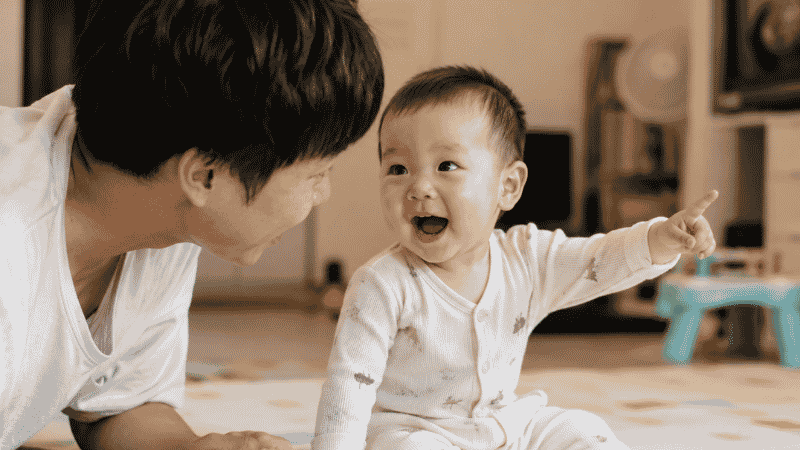
When your baby coos, babble back. When they babble, respond as if they said something meaningful. When they point, name what they’re pointing at and add a comment. This back-and-forth responsiveness is called serve and return interaction, and it’s one of the most powerful builders of language (and cognitive development more broadly).
Studies consistently show that the responsiveness of a caregiver to a baby’s vocalizations predicts language development more strongly than educational toys, screen programs, or formal instruction.
Read Together from Birth
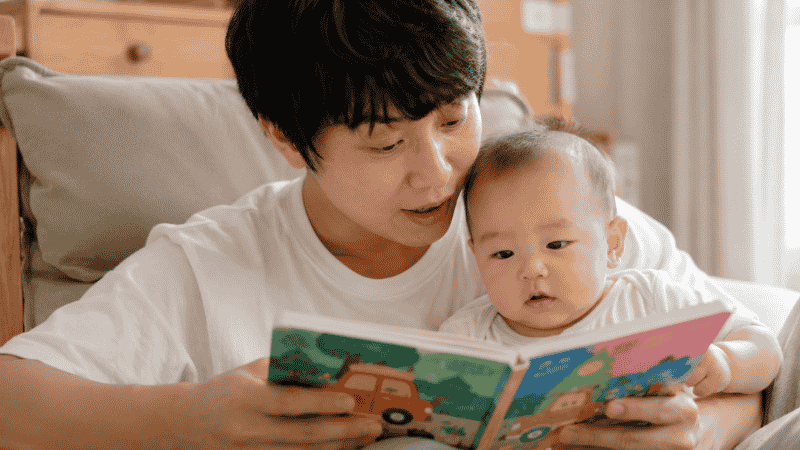
Reading aloud to babies supports language development even before they can understand the words. It exposes them to vocabulary they may not hear in everyday conversation, to the rhythms and patterns of written language, and to the experience of shared attention to a topic. The AAP recommends reading aloud to babies starting in infancy.
Board books with simple, high-contrast images work well for young babies. Letting your baby touch and explore the books is fine — the experience is as much sensory as literary at this stage.
Limit Background Screen Time
The AAP recommends avoiding screen media for children under 18 months (with the exception of video chatting with family members, which involves genuine social interaction). Background television — TV on in the room even when not being directly watched — has been associated with reduced parent-child conversation and word learning in studies of language development. The mechanism is simple: screens interrupt the back-and-forth conversational interaction that drives language growth.
If You Only Have 10 Minutes: The Simple Daily Practice
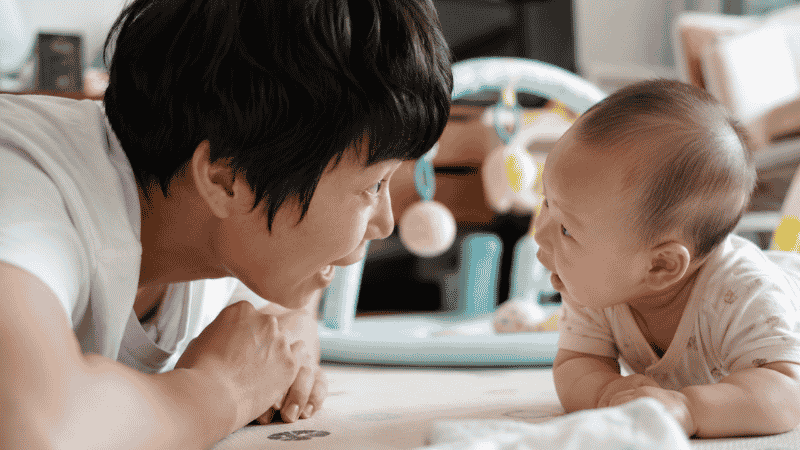
Once a day, set aside 10 minutes for pure, undistracted face-to-face interaction. No phone, no background television. Get on your baby’s level, follow their attention and interest, and narrate what they’re looking at and doing. Respond to every sound they make. This doesn’t require any special materials or preparation — just presence and responsiveness.
Many parents find that bathing, feeding, or the pre-sleep routine already provide this kind of focused interaction. The key is reducing distractions so the back-and-forth communication can happen.
Warning Signs: When to Seek a Speech Evaluation
Contact your pediatrician for a speech-language evaluation referral if your baby:
- Is not cooing or vocalizing by 3 months
- Does not babble (using consonants like b, d, m) by 6 months
- Does not respond to their name by 9 months
- Does not use any gestures (pointing, waving, reaching) by 12 months
- Has no first words by 16 months
- Does not use two-word phrases (“more milk,” “daddy go”) by 24 months
- Loses language skills they previously had at any age — this is always worth evaluating promptly
- Does not make eye contact during social interaction at any age
Early intervention for speech delay is significantly more effective than waiting. Services like Early Intervention (for children under 3 in the US) provide speech-language therapy and are available regardless of family income. Ask your pediatrician about a referral if you have any concerns.
Trust your instincts. You know your baby better than anyone. If something feels off — even if you can’t articulate exactly what — that instinct is worth a conversation with your pediatrician.
FAQ: What Parents Ask Most About Baby Talking
When should my baby say their first word? Most babies say their first true word — used consistently and intentionally — somewhere between 10 and 14 months, with 12 months being the most commonly cited average. The range of normal extends from about 9 months to 16 months. What matters more than the exact timing is the progression — babbling, then jargon, then intentional word use.
My baby says “mama” and “dada” — are those real words? It depends on how they’re being used. “Da-da-da” produced as babbling in a general way is not yet a true word. “Dada” used consistently when your baby sees or wants their father, with clear intentionality — that is a first word. The meaning and consistency matter more than the sound itself.
Can bilingual babies be speech delayed? Bilingual babies may produce words in one language and not the other, or mix words from both languages. Their total vocabulary — counting all words across both languages — typically falls within the normal range. Pure bilingualism does not cause speech delay. If you’re counting words, count words across all languages your baby hears and uses.
My baby isn’t talking but seems to understand everything. Is that normal? Receptive language (understanding) consistently develops ahead of expressive language (producing speech), and the gap can be significant. A baby who understands a great deal but isn’t producing many words yet may simply be on the expressive end of the normal range. However, if there are no words at 16 months despite clear comprehension, that’s worth a conversation with your pediatrician.
Does watching educational videos help babies learn to talk? The research on this is fairly consistent: screen-based programs, even educational ones, are less effective for language learning than live, responsive human interaction. Video chatting with grandparents or relatives who respond to your baby in real time is different from passive video watching, and has more developmental value.
My baby was talking and then stopped. Should I be concerned? Loss of previously acquired language skills — regression — should always be evaluated promptly. Brief regressions around motor milestones (like walking) or during illness are sometimes seen and are usually temporary. But persistent or significant loss of language is worth a same-day call to your pediatrician.
Every Baby Finds Their Words on Their Own Schedule
The range of normal for speech development is wide — wide enough to contain babies who say their first word at 9 months and babies who say theirs at 15 months, and both can be completely within typical development. What matters more than the exact timing is the trajectory: the gradual progression from listening, to cooing, to babbling, to jargon, to first words, to combinations.
What matters most of all is what you do in those months of waiting: talk to your baby, respond to every sound they make, read together, follow their gaze and name what they’re looking at. Language doesn’t arrive from nowhere — it grows from the thousands of small conversational exchanges that happen in an ordinary day.
You’re already doing more than you think.
What to Read Next
- When Do Babies Roll Over? A Realistic Guide to This Big Milestone — Speech development and motor milestones often influence each other — here’s what to expect from rolling, the motor milestone that often precedes sitting and crawling
- Baby Growth Spurts: When They Happen, What They Feel Like & How to Survive Them — Growth spurts often coincide with developmental leaps, including language jumps
- Newborn Baby Care: The Complete Guide for First-Time Parents — The bigger picture of baby development in the first year, from feeding to milestones
References
- National Institute on Deafness and Other Communication Disorders. Speech and Language Developmental Milestones. NIDCD, 2023. https://www.nidcd.nih.gov/health/speech-and-language
- American Academy of Pediatrics. Language Development: 8 to 12 Months. HealthyChildren.org, 2023. https://www.healthychildren.org
- Centers for Disease Control and Prevention. Important Milestones: Your Baby By Twelve Months. CDC, 2023. https://www.cdc.gov/ncbddd/actearly/milestones/milestones-12mo.html
- Hart B, Risley TR. Meaningful Differences in the Everyday Experience of Young American Children. Paul H. Brookes Publishing, 1995.
- American Speech-Language-Hearing Association. How Does Your Child Hear and Talk? ASHA, 2023. https://www.asha.org/public/speech/development/chart/
This article is for informational purposes only and does not constitute medical advice. Always consult your pediatrician with specific concerns about your baby’s speech, language, or development.