
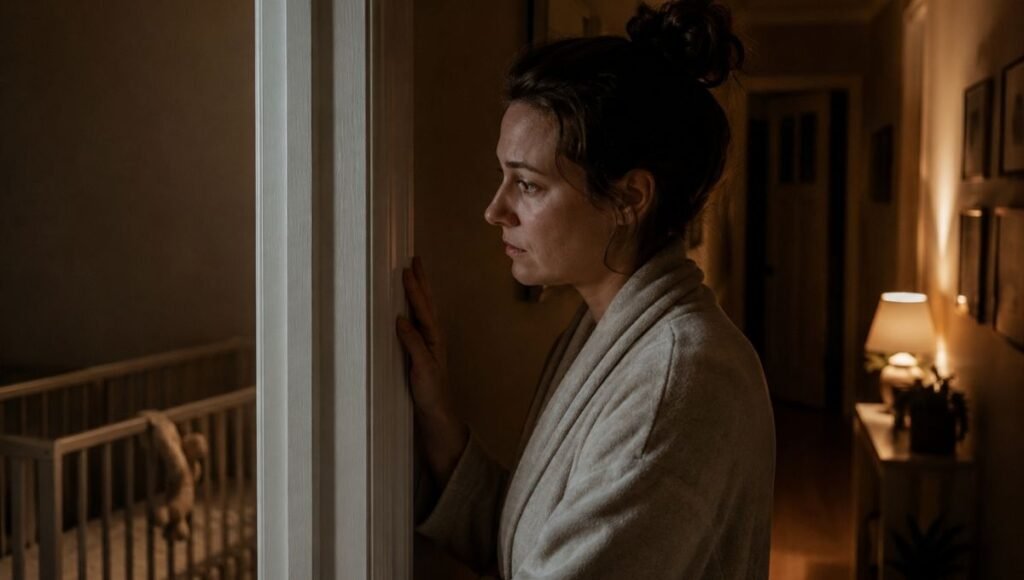
Someone on a parent forum you’re in posted that they used cry it out and their baby slept 12 hours in three days. And you thought: maybe. And then you imagined actually doing it — standing outside a closed door while your baby cried — and your entire body said no.
Or maybe you’re on the other side of this: you’ve been getting up four times a night for seven months, you’re running on empty, and you’re thinking about cry it out but you’re worried about what it might do. You’ve read things that scared you. You’ve read other things that made it sound completely fine. You don’t know who to believe.
This is the sleep training dilemma, and it’s one of the most emotionally charged decisions of early parenthood — not because the methods are complicated, but because they sit right at the intersection of your values, your exhaustion, your baby’s temperament, and your relationship with your partner who may not agree with you anyway.
This guide isn’t going to tell you which method to choose. That’s genuinely not my place. What I can give you is the honest picture of what the research actually says, a clear explanation of each major method from most to least crying involved, and the framework to make a decision you can actually follow through on.
Key Takeaways
- Sleep training is not harmful when used appropriately — multiple large studies, including a 5-year follow-up, found no long-term negative effects on attachment, emotional development, or stress levels.
- The most important factor in sleep training success isn’t which method you choose — it’s consistency. An imperfect method applied consistently outperforms a “perfect” method applied erratically.
- Sleep training is not appropriate before 4 to 6 months. Before this age, babies are not developmentally ready for self-soothing.
- According to NPR’s analysis of the research, there is no evidence that CIO is faster than gentler methods — effectiveness depends more on the baby’s temperament and the parents’ consistency than on the method.
- You do not have to sleep train. It is a choice, not a requirement. Some families find that their baby’s sleep naturally consolidates without intervention. Sleep training is a tool — available if you need it, not mandatory.
Before We Talk Methods: What Sleep Training Actually Is (And Isn’t)
Sleep training is the process of helping your baby learn to fall asleep independently — without needing external help like nursing, rocking, or being held. The goal is not to eliminate nighttime parenting or to force a baby to sleep alone forever. The goal is specifically to help your baby develop the ability to fall asleep at the start of sleep without you, so that when they surface between sleep cycles at night, they can reconnect without waking you.
That’s it. Every method on this list is trying to accomplish the same thing. They differ in how much crying happens in the process, how much parental involvement is present, and how quickly they typically work.
When to start sleep training: Most pediatricians and sleep experts recommend waiting until at least 4 to 6 months. Before 4 months, babies don’t have the neurological development to self-soothe consistently. Many experts prefer 5 to 6 months as a starting point to give the 4-month regression time to stabilize first.
Method 1: Cry It Out (Extinction Method)
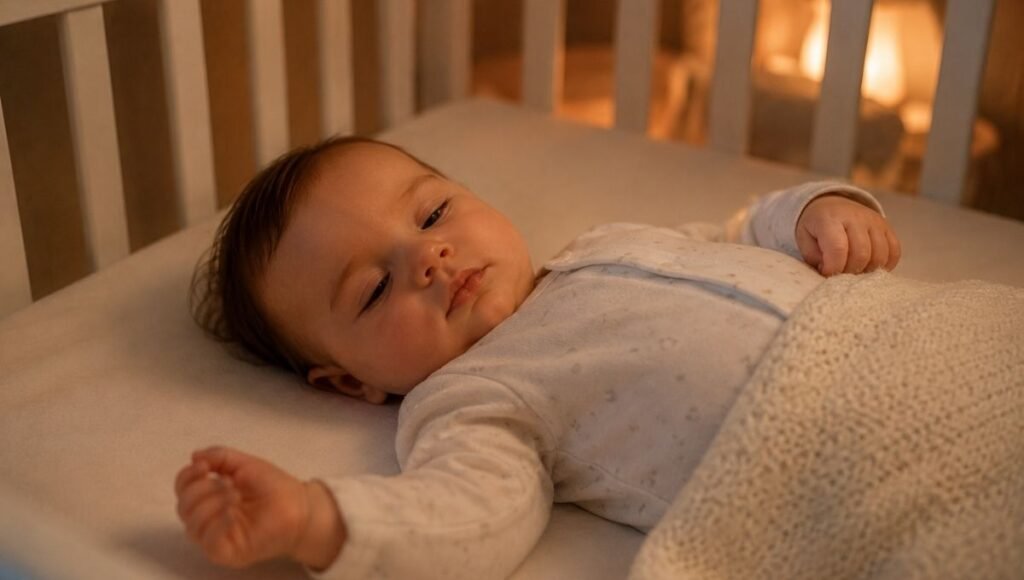
What it is: You put your baby down awake at bedtime after a consistent routine, leave the room, and don’t return until morning (or a set time). Your baby cries until they fall asleep. The next night, usually less crying. By night 3 to 5, most babies are falling asleep with little or no crying.
How it works: Without the external help they’ve been relying on (feeding, rocking, holding), your baby has no option but to practice falling asleep independently. The absence of check-ins means no re-engagement that restarts the protest cycle.
The research: Multiple large randomized controlled trials have found CIO to be safe and effective. A 2012 Australian study by Hiscock and colleagues — one of the most significant in this area — followed families for 5 years after sleep training and found no difference in emotional, behavioral, or attachment outcomes between sleep-trained children and those who weren’t. A 2016 study published in Pediatrics by Gradisar and colleagues similarly found no elevated stress hormones or attachment disruption in sleep-trained infants.
The honest picture: CIO works. The research is fairly clear on this. But “works” means achieves the goal of independent sleep — it doesn’t mean it’s easy, right for every family, or the only valid option. The crying in the early nights is real. For some parents, it’s tolerable; for others, it genuinely isn’t, and forcing yourself to do something your instincts are screaming against is a recipe for giving up inconsistently, which is worse than not starting at all.
Who it tends to work best for: Families who’ve tried gentler approaches without success, who are dealing with significant sleep deprivation, and who feel they can be consistent even through difficult early nights.
Minimum age: 5 to 6 months.
Method 2: Graduated Extinction (The Ferber Method)
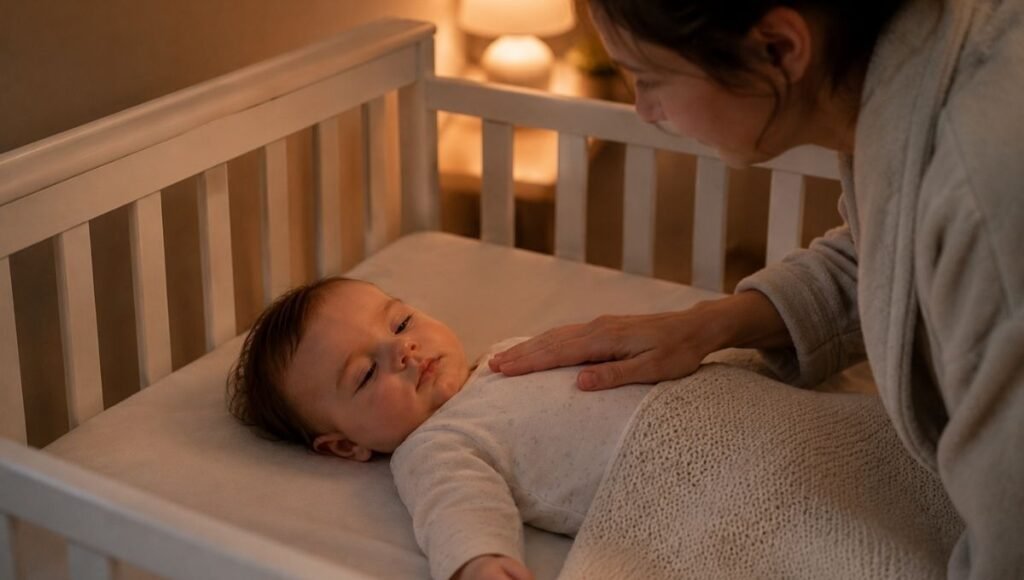
What it is: You put your baby down awake, leave the room, and return to check in at set intervals — typically 3 minutes, then 5 minutes, then 10 minutes, increasing the intervals over subsequent nights. During check-ins, you briefly reassure your baby (voice, gentle touch) but don’t pick them up or help them fall asleep.
How it works: The check-ins provide brief reassurance that you’re present without resetting the process entirely. The gradually increasing intervals build your baby’s ability to tolerate brief separations.
The research: The Ferber method is one of the most studied sleep training approaches. Research consistently shows it improves sleep with no long-lasting negative effects. One important nuance: check-ins can sometimes re-stimulate babies and extend the crying, so the Ferber method occasionally takes longer than pure CIO for some babies — though this is individual.
The honest picture: The check-ins make many parents feel better — it’s not pure abandonment; you’re showing up, you’re present. But for some babies, the brief appearances make things harder. You need to watch your specific baby: does the check-in calm them briefly, or does it spike the protest? Adjust accordingly.
Who it tends to work best for: Families who find pure CIO too difficult to sustain but who understand that check-ins need to be brief and not escalate into full comfort. Also useful for babies who respond well to brief parental reassurance.
Minimum age: 4 to 6 months.
Method 3: The Chair Method (Sleep Lady Shuffle / Camping Out)
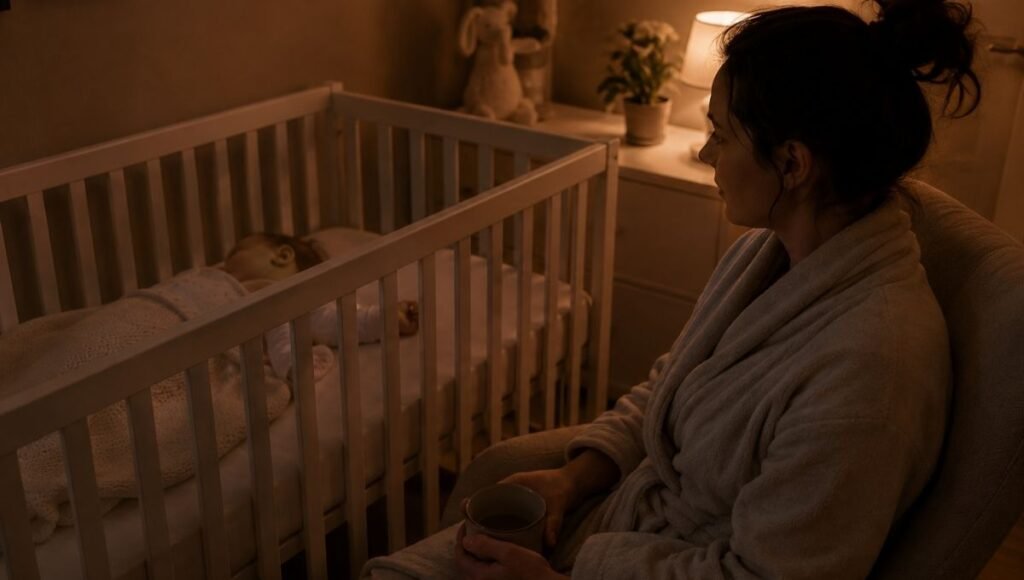
What it is: You sit in a chair next to your baby’s crib while they fall asleep. Each night, you move the chair slightly further from the crib — toward the door, then outside the door, until you’re no longer in the room. This takes roughly 2 to 3 weeks.
How it works: Your presence provides reassurance while your baby practices falling asleep without being held or fed. Gradually reducing your proximity helps them adjust without abrupt separation.
The research: The chair method (also called the Sleep Lady Shuffle) has less direct research than CIO or Ferber, but the available evidence suggests outcomes similar to other methods for improving sleep. A 2012 study found parental presence with minimal response was as effective as extinction for short-term sleep outcomes.
The honest picture: This method takes longer. Some babies find a parent nearby more stimulating than soothing — they work harder to engage you, which can extend the process. It requires genuine consistency from parents across 2 to 3 weeks, which is a different kind of difficult than 3 hard nights with CIO. If your baby escalates when you’re in the room, this method may not be the right fit.
Who it tends to work best for: Families who strongly prefer gradual approaches, who have a baby that finds parental presence genuinely calming rather than stimulating, and who are prepared for a 2 to 3 week process.
Minimum age: 4 to 6 months.
Method 4: Pick Up, Put Down (PUPD)
What it is: When your baby cries, you pick them up until they calm down — but you put them back down before they fall asleep. Repeat as many times as needed until they fall asleep in the crib.
How it works: You’re never ignoring your baby’s cries, but you’re consistently returning them to the crib awake so they practice the final step of falling asleep independently.
The research: The pick up put down method has limited formal research compared to other methods. It’s based on sound sleep association principles (the baby needs to be awake when they hit the mattress) but can be physically exhausting and sometimes backfires — some babies become more stimulated with each pick-up cycle.
The honest picture: PUPD sounds ideal — respond to crying, but still teach independent sleep. In practice, it often works best with younger babies (4 to 5 months) and can become counterproductive with older ones who become more activated by being picked up. Many families who try it find it unsustainable after 30+ repetitions in a single bedtime.
Who it tends to work best for: Younger babies (4 to 6 months) and families who want to respond to every cry but still work toward independent sleep. Not typically recommended as a first-line approach for babies over 6 months.
Minimum age: 4 months.
Method 5: The No-Cry Approach
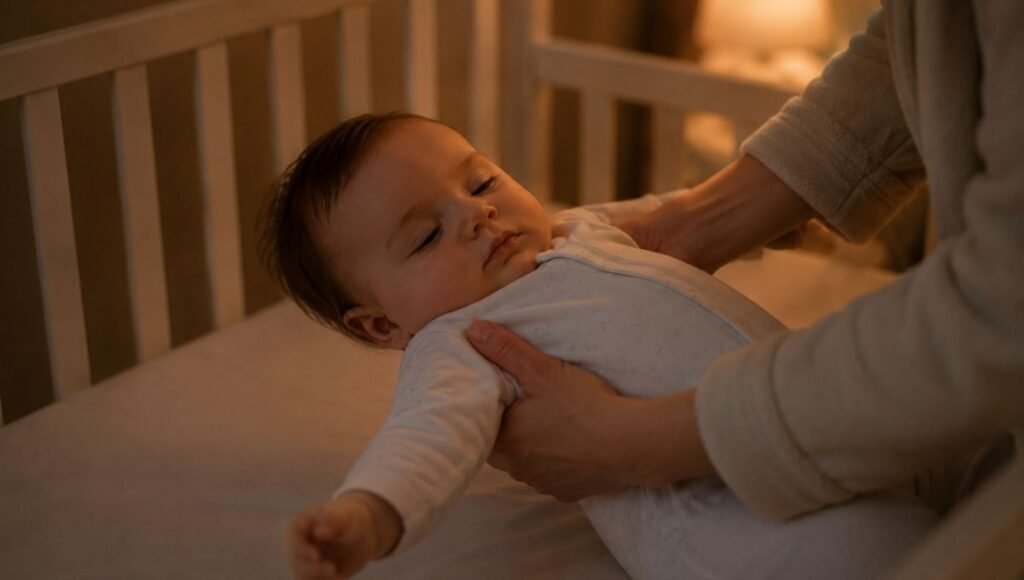
What it is: A collection of strategies that avoid leaving your baby to cry — including gradual nursing/feeding withdrawal at bedtime, shortening nursing to sleep by increasing degrees, fading the motion of rocking, and building drowsy-but-awake habits very gradually over weeks.
The research: Bedtime routine studies consistently show that consistent, predictable routines improve sleep even without formal sleep training. Researchers have found that both gentle approaches and more direct extinction methods can be equally effective for helping most babies and parents get more sleep.
The honest picture: No-cry approaches work. They take longer — often significantly longer — than methods that involve more crying, and they require sustained consistency over weeks to months. For many families, this is the right pace. For families in acute sleep deprivation, the timeline may be difficult to sustain.
Who it tends to work best for: Families who are philosophically opposed to any crying-based approach, babies under 5 months, and families with enough flexibility to work gradually over a longer timeframe.
Minimum age: Can begin building foundations from birth with routines and drowsy-but-awake habits.
The Question Nobody Wants to Ask: Is Cry It Out Actually Harmful?
Let me address this directly because it’s the real fear underneath most of the searching.
The concern: that leaving a baby to cry damages their attachment to you, elevates their cortisol (stress hormone) in harmful ways, or causes lasting psychological harm.
The evidence: Researchers concluded that “behavioral sleep techniques have no marked long-lasting effects (positive or negative).” The 5-year follow-up study by Hiscock found no difference in emotional health, behavior, or the parent-child relationship between families who used CIO and those who didn’t.
The nuance worth knowing: most research has been done on neurotypical, full-term babies in stable home environments. Less is known about effects on highly sensitive babies, premature infants, or babies in households with other significant stressors. And while the evidence for safety is substantial, the research base isn’t infinite — which is why some practitioners remain cautious about recommending CIO universally.
My honest editorial take: The fear that CIO will damage your relationship with your baby is not supported by the research. But the question of whether it’s right for your baby, your family, and your mental health is one only you can answer. A method you can do consistently — whatever that method is — will produce better outcomes than a “better” method you can’t follow through on.
When to Start Sleep Training: The Honest Timeline
| Age | What’s Appropriate |
|---|---|
| 0–3 months | Focus on safe sleep, consistent routines, drowsy-but-awake. No formal sleep training. |
| 4 months | Drowsy-but-awake placement, consistent routine. Very gentle approaches only. |
| 5–6 months | All methods appropriate. Many experts prefer this as the starting window. |
| 6–9 months | Prime window for most approaches. Baby has the developmental maturity to self-soothe. |
| 9–12 months | Still appropriate, though separation anxiety can complicate the process temporarily. |
| 12+ months | Sleep training remains possible; toddler dynamics make it different but still achievable. |
If You’ve Tried and It Isn’t Working
Sleep training fails most often for one of a few reasons:
Inconsistency. Starting the method, then abandoning it after 20 minutes of crying, then starting again — this teaches your baby that crying long enough eventually gets the response they want. Inconsistency produces more crying, not less. If you can’t be consistent, it’s better to not start than to start and stop repeatedly.
The wrong age. Starting before 4 to 5 months often doesn’t work because the baby isn’t developmentally ready. Give it a month and try again.
A nap schedule issue. Overtired or undertired babies don’t sleep-train well. Make sure the daytime schedule is appropriate for the age before focusing on night.
A medical issue. Ear infections, reflux, and teething can make sleep training feel impossible because the baby is genuinely in discomfort. Rule out medical causes if multiple attempts haven’t worked.
Wrong method for this baby. Some babies are highly stimulated by parental check-ins; others genuinely need the reassurance. Pay attention to what your specific baby responds to.
Warning Signs: When Not to Sleep Train (or When to Pause)
- Your baby is under 4 months old
- Your baby is ill, teething actively, or recovering from illness
- You’ve recently had a significant schedule disruption (travel, new childcare, family change)
- Your baby is not gaining weight appropriately — night feeds may still be nutritionally necessary
- You’re not in a place to be consistent — starting sleep training during a particularly difficult week and giving up increases future resistance
FAQ: The Sleep Training Questions Parents Actually Ask
Is cry it out safe? Research shows that both the cry it out method and the Ferber method are safe and effective ways to support healthy sleep habits when used appropriately. Several large studies have found that sleep training methods including extinction and graduated extinction can improve sleep without long-term negative effects on a child’s emotional development, attachment, or stress levels. This doesn’t mean it’s right for every family — but it does mean the fear of permanent damage isn’t supported by current evidence.
When should I start sleep training? Most experts recommend 5 to 6 months as the optimal starting window. 4 months is the earliest most methods are developmentally appropriate, and waiting until after the 4-month regression has stabilized (often around 5 months) typically produces better results.
What if I try CIO and I can’t handle it? Stop, recover, and try a gentler approach — or try again in a few weeks. An honest self-assessment about what you can actually sustain is more useful than committing to a method you’ll abandon mid-process. Gentle sleep training takes longer but produces the same outcome.
My partner wants to CIO but I don’t. What do we do? This is genuinely one of the harder parts of sleep training. Start with agreement on the goal (independent sleep), and look for a method that both of you can follow through on — even if it’s not either person’s first choice. A method both parents support and will stay consistent with is better than the “ideal” method that only one parent can maintain.
Can I sleep train if I’m breastfeeding? Yes. Sleep training addresses sleep associations, not feeding. You can continue breastfeeding while sleep training — you may need to shift when nursing happens in the bedtime routine (before the bath rather than immediately before sleep, so nursing isn’t the last thing before the crib).
What’s the fastest sleep training method? There’s a popular belief that cry it out is the fastest way to teach babies to sleep independently. But there’s no evidence that’s true. What works depends on the parents and the baby — it’s a personalized formula.
The Method That Works Is the One You Can Actually Do
Sleep training conversations online are full of certainty. CIO advocates who say anything gentler is ineffective. Attachment parenting advocates who say any crying is harmful. Neither of these is fully supported by the research, and both are unhelpful to parents trying to make a real decision.
The honest truth is that multiple methods work, the differences in long-term outcomes are minimal, and the most important variable is consistency. Your baby’s temperament matters. Your values matter. Your capacity to follow through on something — even when it’s hard — matters most of all.
Whatever you choose, you’re making a thoughtful decision for your family. That’s exactly what good parenting looks like.
What to Read Next
- The 4-Month Sleep Regression: Why It Happens, How Long It Lasts & How to Cope — Before sleep training, understanding why sleep got worse is the first step. This covers the neurological shift that makes sleep training possible
- Sleep Regression Ages: Every Stage Explained — Know which regression you’re in before deciding whether to sleep train or wait it out
- Baby Sleep Schedule by Age: What to Expect Month by Month — A solid age-appropriate schedule is the foundation that makes any sleep training approach more likely to work
References
- Gradisar M, et al. Behavioral interventions for infant sleep problems: A randomized controlled trial. Pediatrics, 2016. doi:10.1542/peds.2015-1486
- Hiscock H, et al. Long-term mother and child mental health effects of a population-based infant sleep intervention: Cluster-randomized, controlled trial. Pediatrics, 2008. doi:10.1542/peds.2007-3783
- Mindell JA. Empirically supported treatments in pediatric psychology: Bedtime refusal and night wakings in young children. Journal of Pediatric Psychology, 1999.
- NPR Health. Sleep Training Truths: What Science Can (And Can’t) Tell Us About Crying It Out. July 2019. https://www.npr.org/sections/health-shots/2019/07/15/730339536/sleep-training-truths-what-science-can-and-cant-tell-us-about-crying-it-out
- American Academy of Pediatrics. Getting Your Baby to Sleep. HealthyChildren.org, 2023. https://www.healthychildren.org
This article is for informational purposes only and does not constitute medical advice. Always consult your pediatrician before beginning any sleep training approach.