
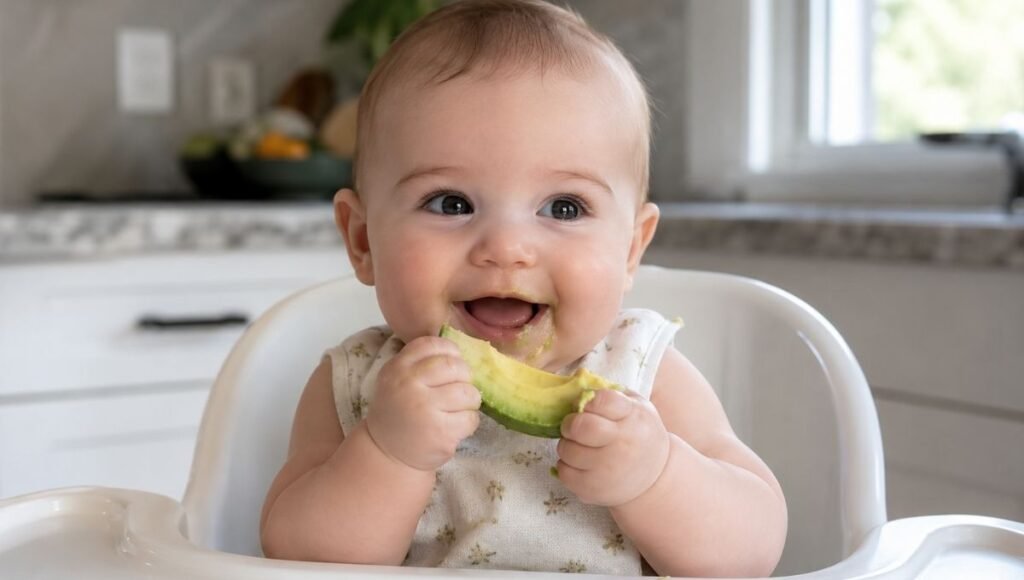
You’ve seen the photos. A six-month-old holding a strip of avocado with both fists, face completely smeared, looking absolutely delighted with herself. And you thought: that’s adorable. And also: is that safe? And also: should I be doing that?
If you’ve been in any new parent group in the last few years, baby-led weaning has probably come up — possibly with the particular intensity that surrounds any parenting approach that people feel strongly about. Some parents swear by it. Others tried it and found it terrifying. A few haven’t started solids yet and are quietly wondering whether they’re already behind.
Here’s what this guide is going to do: give you the honest, research-backed picture of what baby-led weaning actually is, what the AAP says about it, how it compares to traditional spoon-feeding, and how to start it safely if you decide it’s right for your family. Without the evangelical tone that sometimes surrounds BLW communities. Without the fear-mongering that sometimes surrounds the critics. Just the information, with some warmth around it.
Key Takeaways
- Baby-led weaning (BLW) means your baby self-feeds soft finger foods from the start of solids — skipping purées and letting them explore real food from day one.
- The AAP considers BLW a valid approach to introducing solids and has found it carries a similar choking risk to traditional spoon-feeding when done safely.
- Most babies are ready to start BLW around 6 months — when they can sit with minimal support, have good head control, and show interest in food.
- Gagging is normal. Choking is not. Knowing the difference is the most important safety knowledge you need before you start.
- Breast milk or formula remains your baby’s primary nutrition source through 12 months regardless of which solid food approach you choose.
What Is Baby-Led Weaning, Exactly?
Baby-led weaning (BLW) is an approach to introducing solid foods where your baby feeds themselves soft finger foods from the very beginning — rather than being spoon-fed smooth purées by a caregiver. The word “weaning” in this context means transitioning away from an all-milk diet, not stopping breastfeeding.
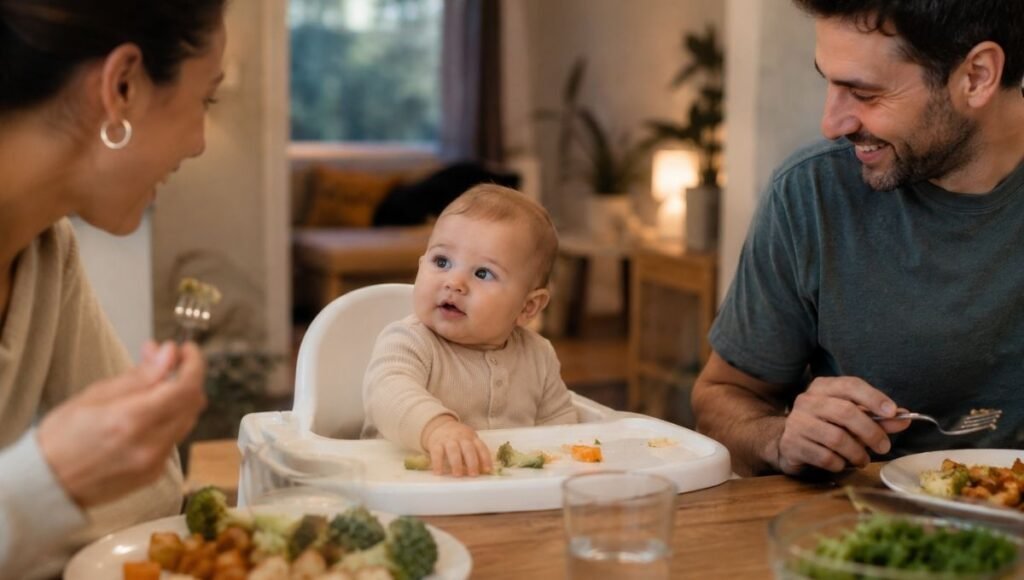
In practice, it looks like this: you sit your baby in a high chair at mealtimes, place appropriately prepared soft foods in front of them, and let them pick it up, explore it, bring it to their mouth, and eat it — or not eat it — entirely on their own terms. You don’t put the food in their mouth. You don’t direct them toward particular pieces. You just offer, supervise, and let them lead.
This is different from traditional weaning, which typically starts with smooth purées on a spoon and gradually moves toward lumpier textures and then finger foods over several months. BLW skips that progression and goes straight to soft finger foods from the start.
My honest editorial take: BLW isn’t a revolution in infant feeding, and it isn’t dangerous pseudoscience. It’s one valid approach among several, and the best approach is the one that fits your baby, your family, and your comfort level. Anyone who tells you there’s only one right way to introduce solids to a baby is oversimplifying.
When Should You Start Baby-Led Weaning?
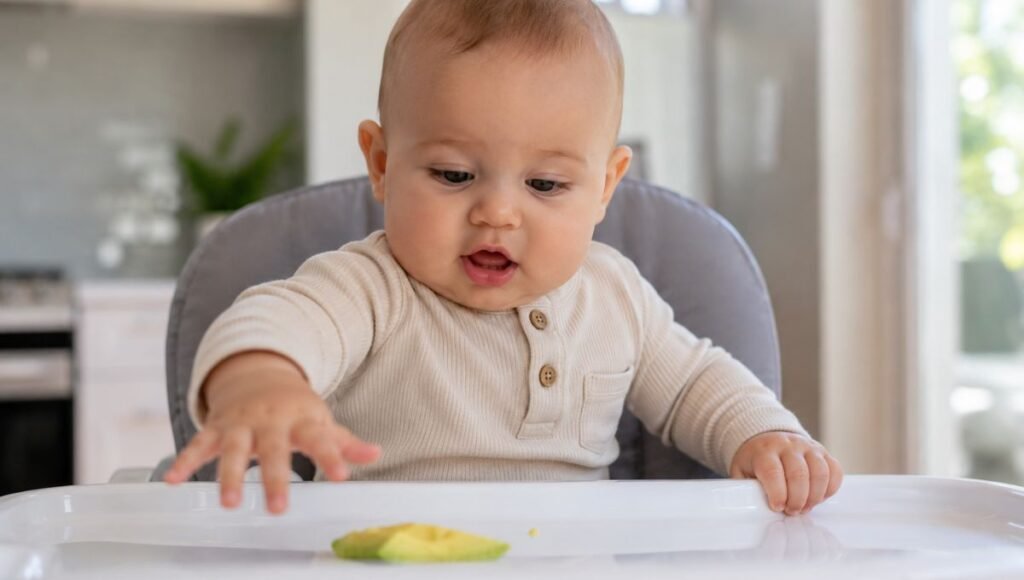
<cite index=”31-1″>The AAP recommends starting solids when your baby is around 6 months old, though individual development plays a role.</cite>
The key isn’t the calendar date — it’s the developmental readiness signs. Your baby is likely ready to start solids (BLW or otherwise) when they:
- Can sit up with minimal support and hold their head steady without it bobbing
- Have lost the tongue-thrust reflex (the automatic pushing-out motion that protects newborns from choking on non-liquid substances)
- Can reach for objects and bring them to their mouth with reasonable coordination
- Show genuine interest in food — watching you eat, reaching toward your plate, opening their mouth when they see food
Do not start before 4 months. Before this age, the digestive system and oral motor skills simply aren’t ready for solids in any form. Starting too early doesn’t give your baby a head start — it creates unnecessary choking risk and digestive stress.
<cite index=”31-1″>Research points to a critical window between approximately 6 and 8 months when babies are most developmentally open to and capable of learning to eat. Introducing babies to a wide variety of food flavors, colors, and textures during this period may help them eat more fruits and vegetables later on.</cite>
This is worth knowing: 6 months isn’t just an arbitrary guideline. There’s a genuine developmental window when babies are wired to explore new textures and flavors. Missing it by a month or two isn’t a disaster, but it’s a real consideration.
Is Baby-Led Weaning Safe? The Honest Answer
This is the question underneath every other BLW question. And it deserves a direct answer.
Yes — when done correctly, BLW is safe. <cite index=”37-1″>A study determined that babies are not at higher risk of choking from baby-led weaning when compared to traditional purées.</cite> <cite index=”32-1″>Research has not shown a baby-led weaning approach to be associated with a higher risk of choking than other weaning methods.</cite>
The critical qualifier is “when done correctly.” Safety in BLW comes down to two things: food preparation and supervision.
Gagging vs. Choking: The Most Important Distinction You’ll Learn
Before your baby takes their first bite of solid food, you need to understand this distinction clearly. Many parents confuse gagging with choking — and the responses are completely different.
Gagging is normal, protective, and loud. Your baby’s gag reflex is positioned much further forward on their tongue than an adult’s, which means it triggers early and often when they’re learning to manage solid food. A gagging baby makes noise — coughing, sputtering, sometimes dramatic retching. Their color stays normal. They are not in danger. Gagging is their airway doing exactly what it’s supposed to do.
Choking is silent, or nearly so. A choking baby cannot cough effectively, cannot make noise, and may change color — going red or blue. This is an emergency.
The reason this matters: if you see your baby gagging dramatically and immediately intervene — reaching into their mouth, flipping them over, patting their back — you’re more likely to cause a problem than prevent one. A gagging baby needs you to stay calm, stay seated, and let them work through it.
Take a certified infant CPR and first aid course before you start solids. This is not optional safety advice — it’s the single most important preparation you can do.
The Food Safety Rules That Actually Matter
<cite index=”35-1″>The AAP advises against giving a child 12 months or younger any food that’s considered a choking hazard.</cite> Foods to avoid entirely in the first year:
- Whole grapes, cherry tomatoes, or berries (cut into quarters if offering)
- Raw hard vegetables (carrots, apple, celery — always cook until fork-tender)
- Nuts and seeds (whole or in large pieces)
- Popcorn
- Large chunks of meat or cheese
- Anything round and firm that could block the airway
The texture test: food should be soft enough that you can mash it between your thumb and forefinger with light pressure. If it requires real force to squash, it’s not ready for your baby.
How to Prepare BLW Food: Shapes, Sizes, and Textures
Food preparation is where BLW gets practical — and where a lot of first-time parents feel most uncertain. Here’s the framework that actually works.
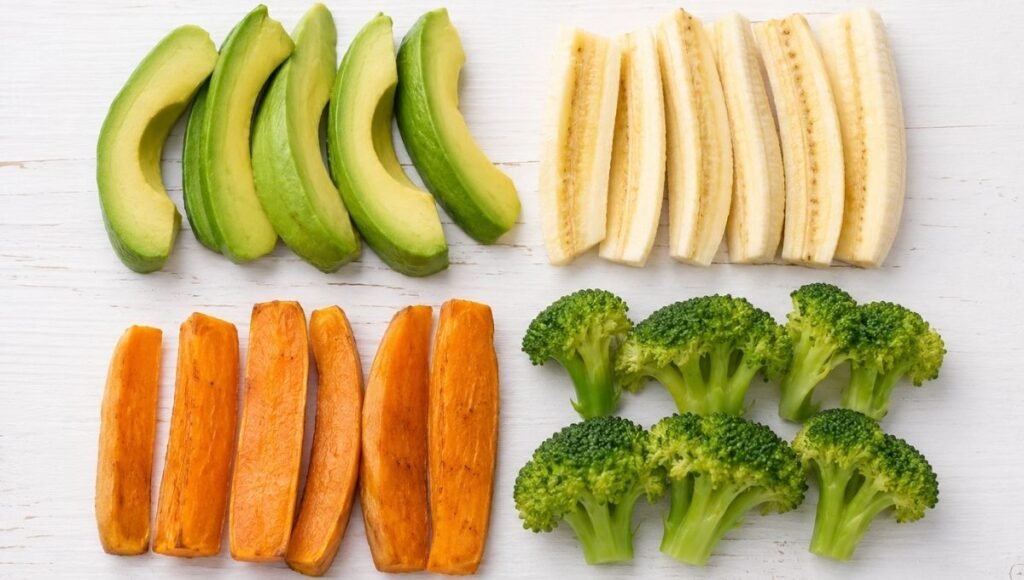
Shape for grip, not for bite-size. Counter-intuitively, BLW food for young babies should be larger than you might expect — about the size of an adult finger or a thick french fry. Young babies use a palmar grasp (the whole fist) rather than a pincer grip, so they need something long enough to stick out of their fist. A piece the size of a grape or a small cube is actually harder for a young baby to manage than a longer strip.
As your baby develops their pincer grip (typically around 8 to 9 months), you can move toward smaller pieces that they pick up between thumb and forefinger.
The iron priority. The AAP specifically recommends leading with iron-rich foods when starting solids — not rice cereal, which used to be the standard first food recommendation but has since been largely replaced. Iron needs increase significantly around 6 months as stores from birth begin to deplete. Good iron-rich first foods: soft cooked meat, lentils, fortified foods, tofu, egg yolk.
A practical first foods list:
- Soft fruits: ripe banana spears, avocado strips, ripe mango or peach wedges (skin removed)
- Soft cooked vegetables: steamed broccoli florets (the floret end is great for grip), baked sweet potato sticks, zucchini spears, butternut squash strips
- Proteins: well-cooked shredded chicken or beef, soft tofu strips, hard-boiled egg cut in quarters, flaked salmon
- Grains: soft-cooked pasta (penne or rigatoni work well for grip), soft bread strips
How to Actually Start: Your First BLW Meal
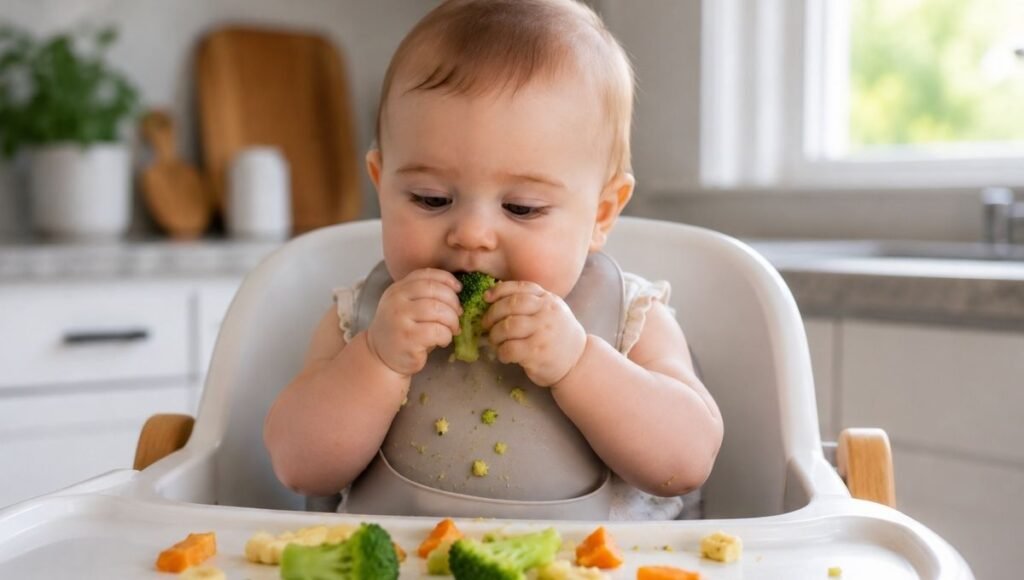
The first BLW meal doesn’t need to be elaborate. Here’s what to do.
Set up for success. High chair with footrest (feet flat on a surface helps babies stabilize for eating), bib with a pocket to catch dropped food, a mat under the chair for your sanity. Silicone suction bowls are optional but reduce the number of times you chase food across the floor.
Offer during family mealtimes. One of BLW’s genuine advantages is that it integrates your baby into family meals naturally. Babies learn to eat partly by watching other people eat — your baby sitting at the table with you, seeing you eat the same foods you’re offering them, is a legitimate developmental tool.
Start with one meal per day. There’s no need to offer three solid meals immediately. One meal per day is plenty for the first few weeks. Breast milk or formula remains the primary nutrition source — the early weeks of BLW are about exploration, not caloric intake.
Offer, then step back. Place food on the tray. Let your baby pick it up, examine it, lick it, drop it, throw it, or eat it. Do not place food in their mouth. Do not guide their hand. The whole point is that they lead.
Expect most of it to end up on the floor. For the first several weeks, swallowing is almost secondary to exploring. Your baby is learning what food is — what different textures feel like, how to manipulate objects in their mouth, what happens when they bite down. A meal where nothing was actually swallowed is still a successful learning experience.
BLW vs. Purées: Do You Have to Choose?
No. This is worth saying clearly because the online BLW community can sometimes give the impression that purées are developmental harm.
Many families do what’s sometimes called “combination feeding” — offering both purées and finger foods, or doing BLW for some meals and spoon-feeding for others. <cite index=”36-1″>The AAP notes that you can flex the baby-led concept to fit your family.</cite>
A baby who gets soft finger foods at dinner and purée pouches on the go is not doing BLW “wrong.” A baby who is spoon-fed purées for three months and then transitions to finger foods is not developmentally disadvantaged. The evidence for BLW’s benefits is real — exposure to varied textures and flavors, development of self-regulation, positive mealtime associations — but the evidence doesn’t suggest that purées cause harm.
My take: Be flexible. If your baby is loving self-feeding, lean into it. If they’re struggling with the motor demands of finger foods at 6 months, there’s nothing wrong with offering some purées while their skills develop. Feed your baby, not the method.
Introducing Allergens: The Guidance Has Changed
This is one area where the advice has shifted significantly in the last decade, and many parents are still working from outdated information.
<cite index=”34-1″>Until recently, the AAP recommended avoiding allergenic foods for the first few years of life. However, according to the AAP’s 2019 review, the latest research shows that early introduction of common food allergens such as peanuts and eggs may actually prevent food allergies.</cite>
The current guidance: introduce the top allergens (peanut, egg, tree nuts, dairy, wheat, soy, fish, shellfish, sesame) around the time you start solids — not after a waiting period. For BLW, this means these foods should be among the early offerings, not something you cautiously save for later.
How to introduce allergens safely:
- Offer one new allergen at a time
- Do it on a day when your baby is healthy and you can observe for 2 to 4 hours afterward
- Start with a small amount (a taste on the end of a spoon, a small piece)
- Common signs of reaction: hives, swelling of lips or face, vomiting, difficulty breathing — seek immediate care if these appear
If your baby has severe eczema or a known food allergy, consult your pediatrician before starting allergen introduction — they may recommend a different protocol or allergy testing first.
When It’s Not Going Well: The BLW Troubleshooting Parents Actually Need
My baby isn’t interested in food at all. Some babies at 6 months show almost no interest in solids and spend mealtimes mostly throwing things. This is completely normal. Keep offering. Keep sitting them at the table with you. The interest usually develops over 2 to 4 weeks of exposure. If there’s still no engagement by 7 to 8 months, mention it at your next well-child visit.
My baby gags every single meal and I’m terrified. Gagging is the most common reason parents abandon BLW. Knowing the distinction between gagging (normal, protective, loud) and choking (emergency, silent) is crucial. If your baby is making noise and pink, they’re fine. Take a breath with them.
My baby isn’t actually swallowing anything. For the first 2 to 4 weeks, minimal swallowing is expected. The phrase “food before one is just for fun” captures the early BLW period — the nutritional heavy lifting is still being done by breast milk or formula. Actual caloric intake from solids increases gradually over weeks and months.
I’m the only adult at meals and can’t manage the anxiety. BLW requires you to be present and calm during meals. If the anxiety of watching your baby eat is making meals miserable for both of you, a combination approach — some spoon-feeding, some finger foods — is a completely valid middle ground. There’s no prize for doing this the hard way.
Warning Signs: When to Call Your Pediatrician
Call immediately if during or after a meal:
- Your baby is silently distressed — no cough, no cry, color is changing
- You see signs of allergic reaction — hives, lip/face swelling, difficulty breathing, significant vomiting
- Your baby loses consciousness
- Any episode that resolves but worries you — always better to check
Mention at your next well-child visit if:
- Your baby shows no interest in solid foods by 7 to 8 months
- Your baby consistently gags to vomiting at every meal
- Your baby seems to be having difficulty swallowing even soft foods
- You have any concern about feeding development or weight gain
FAQ: What Parents Actually Ask About Baby-Led Weaning
Does baby-led weaning cause more choking? No. Multiple studies, including a 2016 AAP-published randomized trial, found that BLW does not increase choking risk compared to traditional spoon-feeding when appropriate foods are offered and safety guidelines are followed.
Do babies need teeth to do BLW? No. <cite index=”32-1″>Babies can chew well enough for solid foods with just their gums, as long as food is prepared soft enough.</cite> Gums are surprisingly effective at mashing soft food.
What if my baby is premature? Premature babies typically need to wait longer before starting solids and should be assessed using their corrected age rather than chronological age. Always consult your pediatrician before starting solids with a premature baby.
Can I do BLW if I’m still breastfeeding? Absolutely — BLW was actually developed in a context where most families were breastfeeding. Continue breastfeeding on demand. Breast milk remains the primary nutrition source through 12 months.
My baby is 7 months and I haven’t started solids yet. Is it too late? Not at all. The window for introducing solids extends beyond 6 months — starting at 7 months is entirely reasonable. There’s no developmental emergency. Begin when both you and your baby feel ready.
The Mess Is the Point

Here’s the thing nobody tells you about BLW before you start: the mess is not a side effect of the method. The mess is the method. A baby who is squishing avocado through their fingers, smearing banana on the tray, dropping broccoli over the side of the high chair — that baby is learning. About texture, temperature, color, weight. About how food behaves when you grip it versus when you release it. About what tastes good and what doesn’t.
The mess is evidence of exploration. And exploration is how your baby learns to eat.
Put down a mat. Buy a good bib with a pocket. Accept that some meals will end with sweet potato in your hair. And know that every one of those chaotic, messy, not-very-much-was-actually-swallowed meals is building the foundation for a child who knows how to feed themselves.
What to Read Next
- Newborn Feeding Schedule: How Much & How Often, Week by Week — Before solids, this is your complete guide to how much breast milk or formula your baby needs in the first months
- How to Increase Milk Supply: Science-Backed Tips That Actually Work — If you’re breastfeeding while starting BLW, milk supply questions often come up — this covers the evidence
- Baby Milestones by Month: What to Expect in the First 12 Months — Starting solids is one milestone in a bigger developmental picture — this guide maps out what else is happening at 6 months
References
- American Academy of Pediatrics. Baby-Led Weaning: Is It Safe? HealthyChildren.org, 2023. https://www.healthychildren.org/English/ages-stages/baby/feeding-nutrition/Pages/baby-led-weaning-is-it-safe.aspx
- Rappaport L, MS, RD. Cited in: Baby Led Weaning: First Foods, When to Start. The Bump, April 2025. https://www.thebump.com/a/baby-led-weaning
- Brown A, Jones SW, Rowan H. Baby-led weaning: The evidence to date. Current Nutrition Reports, 2017. doi:10.1007/s13668-017-0201-2
- Fangupo LJ, et al. A Baby-Led Approach to Eating Solids and Risk of Choking. Pediatrics, 2016. doi:10.1542/peds.2016-0772
- American Academy of Pediatrics. Preventing Allergies: Start Solids Early. HealthyChildren.org, 2019. https://www.healthychildren.org/English/ages-stages/baby/feeding-nutrition/Pages/Preventing-Food-Allergy.aspx
This article is for informational purposes only and does not constitute medical advice. Always consult your pediatrician before starting solids, particularly if your baby has any health concerns or risk factors for food allergies.