
Dry, rough patches on a baby’s cheeks. Constant rubbing around the face. Scratching that seems worse at night. These are often the first signs parents notice before realizing they’re dealing with baby eczema. Although flare-ups can look alarming, the condition is common and usually improves with consistent daily care.
This guide explains how to recognize the symptoms, understand what causes flare-ups, avoid common triggers, and build a simple skincare routine that helps protect your baby’s skin. It also covers when moisturizers are enough, when prescription treatment may be needed, and the warning signs that deserve a call to your pediatrician. Small, consistent habits—not a cabinet full of skincare products—often make the biggest difference.
Quick Answer
Baby eczema (atopic dermatitis) is a common inflammatory skin condition caused by a weakened skin barrier. It is not contagious, and it is not caused by anything you did wrong as a parent. A few first steps that help right away:
- Use lukewarm water for baths, never hot.
- Apply a thick, fragrance-free moisturizer within 3 minutes of bathing, while skin is still damp.
- Remove common irritants like fragranced products and harsh laundry detergents.
- Expect flare-ups to come and go — eczema often improves over time, but rarely disappears in a straight line.
- Contact your pediatrician if symptoms look infected, are severe, or aren’t responding to consistent care.
The sections below walk through each of these in more depth, starting with how to recognize eczema in the first place.
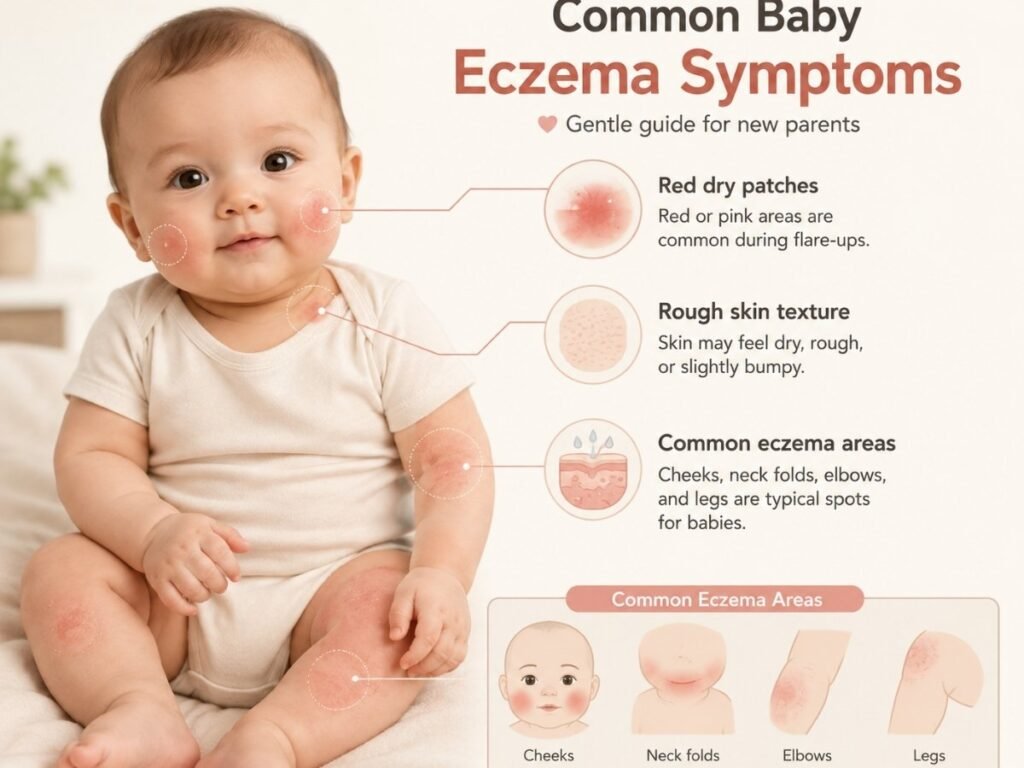
What Does Baby Eczema Look Like?
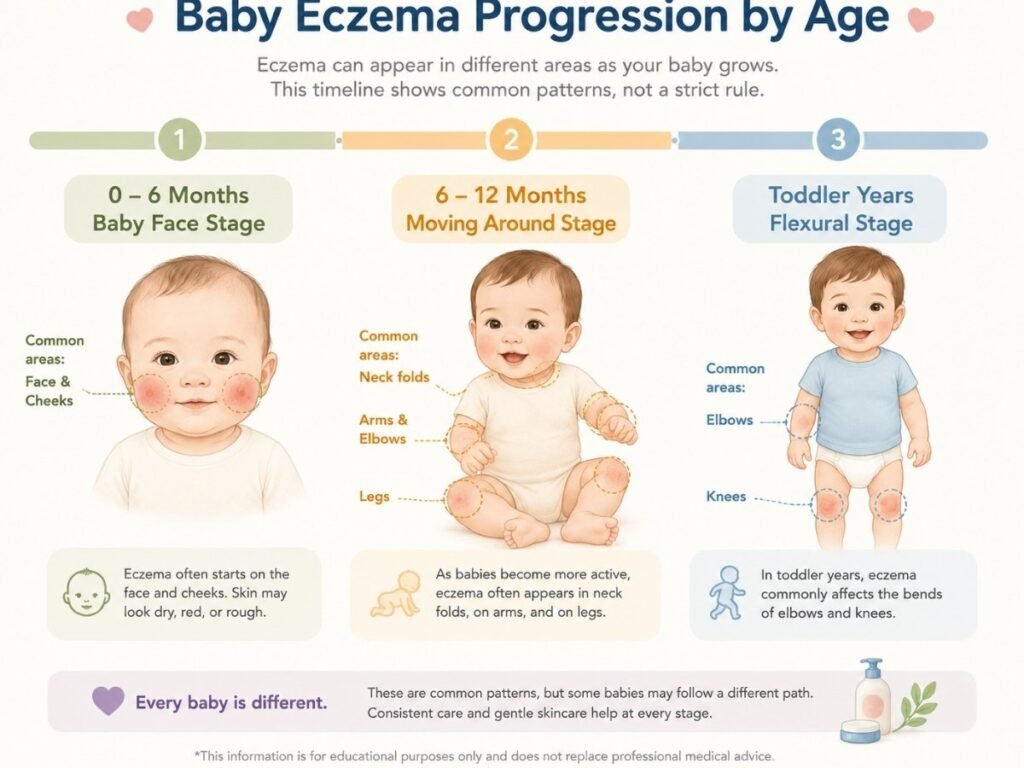
Redness often appears on the cheeks first, then may spread to the face, neck folds, or the outside of the arms and legs. As babies grow and become more active, the rash commonly develops in the creases of the elbows and knees, where skin is exposed to more rubbing and movement.
Common signs of baby eczema
- Dry, rough, or scaly patches
- Redness, especially on the cheeks or face
- Visible itching — rubbing, scratching, or fussiness during flare-ups
- In more severe cases, cracking, oozing, or areas that bleed slightly
Where eczema appears at different ages
It’s surprisingly common for eczema to start on a baby’s cheeks in the first few months, largely because saliva, friction from feeding, and an immature skin barrier all overlap in that area. As babies get older and start crawling or become more mobile, eczema often shifts toward the bends of the elbows and knees, where skin folds and friction come into play differently.
| Severity | What It Looks Like |
|---|---|
| Mild | Occasional dry patches, mild redness, little to no itching disruption |
| Moderate | More widespread dryness, noticeable redness, regular scratching or discomfort |
| Severe | Cracked, oozing, or bleeding skin, disrupted sleep, signs of possible infection |
Correctly identifying eczema helps parents choose the right care approach instead of treating the wrong skin condition. If what you’re noticing looks more like general dryness without redness or itching, it may simply be baby dry skin, which responds well to routine moisturizing without necessarily being eczema.
Baby Eczema vs. Cradle Cap vs. Heat Rash vs. Drool Rash
A dry patch on the cheek isn’t always eczema, just as redness around the mouth isn’t always caused by teething. Knowing the differences can help you choose the right care from the start and avoid treatments that aren’t likely to help.
Eczema vs cradle cap
Cradle cap appears as greasy, yellowish scales, usually on the scalp, and typically isn’t itchy the way eczema is. It tends to resolve on its own with gentle washing, while eczema needs ongoing moisture and barrier support.
Eczema vs heat rash
Heat rash shows up as small, pink bumps in areas where sweat gets trapped, like neck folds or under clothing, and usually clears once your baby cools down. Eczema, by contrast, is drier and rougher in texture and doesn’t resolve simply by adjusting temperature.
Eczema vs drool rash
Drool rash appears around the mouth and chin, often linked to teething, and tends to look wet or chapped rather than dry and scaly. It’s genuinely common for parents to mistake a teething-related drool rash for eczema, since both can cause redness in the same general area — the key difference is that drool rash is localized to where saliva collects, while eczema tends to spread more broadly.
| Condition | Appearance | Itchy? | Common Location |
|---|---|---|---|
| Eczema | Dry, rough, red patches | Yes, often significantly | Cheeks, neck folds, elbows, knees |
| Cradle cap | Greasy, yellow scales | Rarely | Scalp |
| Heat rash | Small pink bumps | Sometimes mildly | Neck folds, underarms, covered skin |
| Drool rash | Wet-looking, chapped redness | Mildly | Around mouth and chin |
Different baby skin conditions require different care strategies, making accurate identification essential before you settle on a routine.
Why Is My Baby Prone to Eczema?
“Why my baby?” In most cases, the answer has little to do with anything you did. Babies who develop eczema are often born with a skin barrier that loses moisture more easily and is more sensitive to everyday irritants, making flare-ups more likely from an early age.
How the baby skin barrier works
A healthy skin barrier holds moisture in and keeps irritants out. In babies with eczema, this barrier doesn’t function quite as effectively, which means moisture escapes more easily and outside irritants can penetrate more readily, leading to dryness, inflammation, and itching.
Genetics and eczema risk
Family history plays a meaningful role — babies with a parent or sibling who has eczema, asthma, or seasonal allergies tend to have a higher likelihood of developing it themselves. This genetic link is one of the most well-established factors in eczema research.
One of the most common worries new parents carry is wondering, “Did I do something wrong?” Eczema is not caused by poor hygiene, parenting mistakes, or a single food exposure. It’s rooted in skin barrier biology and genetics, factors entirely outside a parent’s control.
Baby eczema usually develops because some babies have a more sensitive skin barrier, not because parents caused it.
What Makes Baby Eczema Worse?
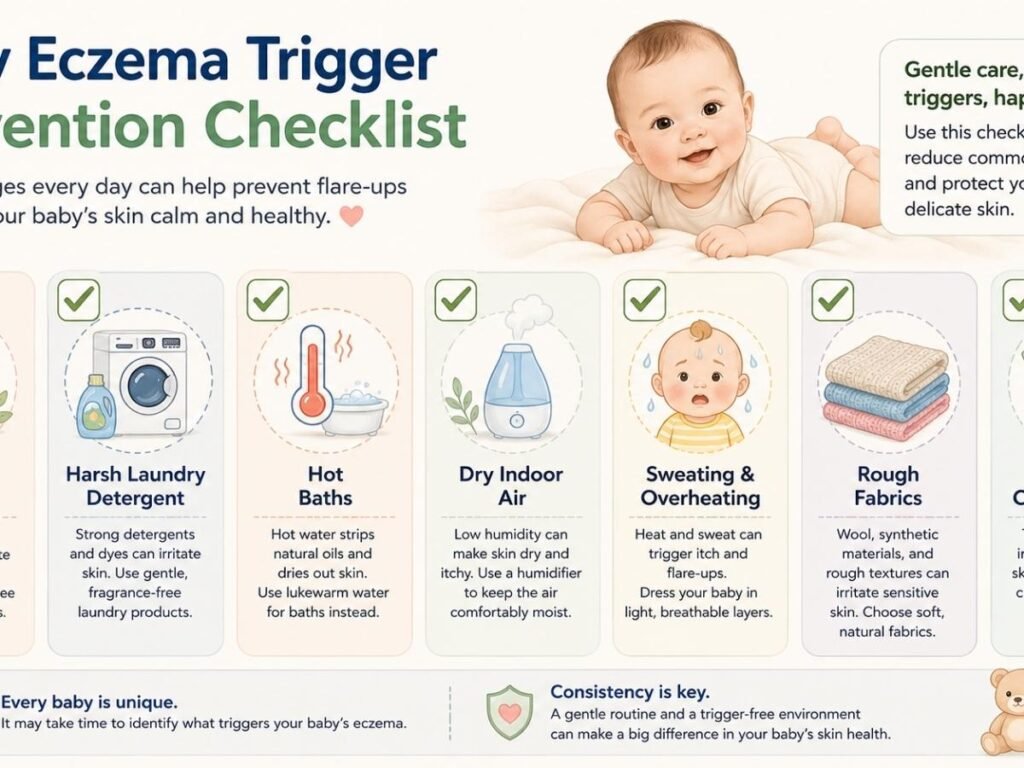
Flare-ups don’t happen at random. A hot bath, dry winter air, sweaty clothing, or everyday irritants can quickly turn calm skin into a red, itchy flare. These triggers don’t cause eczema, but they often make sensitive skin much harder to manage.
Household triggers
Dry indoor air, especially during winter heating season, pulls moisture from the skin and often coincides with more frequent flare-ups. Overheating and sweating can also aggravate already-sensitive skin.
Clothing and laundry triggers
Rough fabrics, tight seams, and scratchy tags can all irritate eczema-prone skin. Laundry detergents with fragrance or dye are a frequent hidden trigger, since residue stays in contact with skin all day.
Seasonal flare-up triggers
Many parents notice their baby’s eczema getting noticeably worse in winter, when indoor heating dries out the air, or shortly after switching to a new soap, detergent, or lotion. That timing isn’t a coincidence — it’s one of the more predictable patterns in eczema management.
Baby eczema trigger checklist
- Switch to fragrance-free laundry detergent
- Choose soft, breathable fabrics like cotton
- Use a humidifier during dry winter months
- Avoid scented lotions, soaps, and bubble baths
- Keep bath water lukewarm, not hot
- Trim baby’s nails to reduce scratching damage
Avoiding triggers helps reduce flare-ups, but eczema management still requires consistent skin barrier care underneath it all — trigger avoidance alone rarely solves eczema on its own.
How to Build a Baby Eczema Care Routine
Daily care helps keep the skin hydrated, strengthens its natural barrier, and reduces the chance of flare-ups before they become harder to manage.
Daily Skin Barrier Care
Bathe your baby every one to two days rather than daily, using lukewarm water and a gentle, fragrance-free cleanser. Over-washing can strip natural oils and make dryness worse. Apply moisturizer generously, at least once and ideally twice a day.
One of the most common mistakes parents make is applying too little moisturizer, using just a thin layer that absorbs within minutes. Eczema-prone skin typically needs a noticeably thicker layer than most parents expect — enough that it leaves a visible sheen for a minute or two after applying.
The 3-Minute Soak and Seal Method
This simple routine helps lock moisture into the skin right when it’s most absorbent.
- Give your baby a short lukewarm bath, around 5–10 minutes.
- Pat the skin gently dry with a soft towel — don’t rub.
- Apply a thick, fragrance-free moisturizer within 3 minutes of finishing the bath, while skin is still slightly damp.
- Dress your baby in soft, breathable clothing.
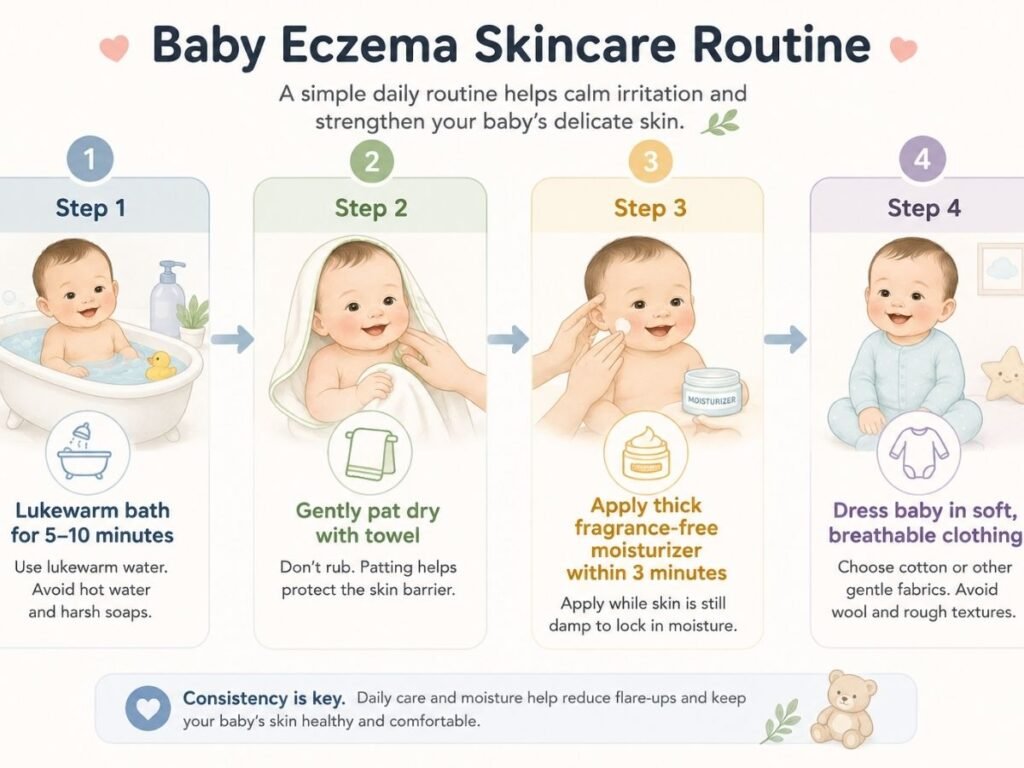
Bath → Seal → Dress → Protect checklist
- Lukewarm bath, no longer than 10 minutes
- Pat dry gently, don’t rub
- Moisturize within 3 minutes, while skin is still damp
- Dress in soft, breathable fabric
- Reapply moisturizer to particularly dry areas throughout the day
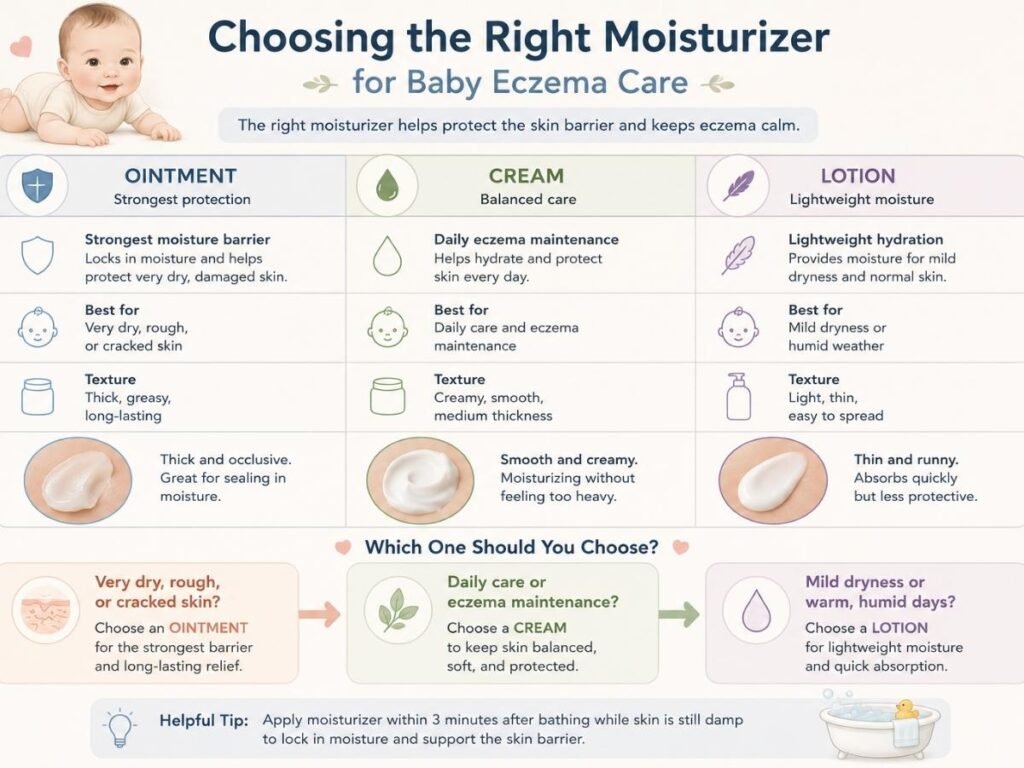
Choosing Ointment vs Cream vs Lotion
| Type | Moisture-Locking Ability | Texture | Best For |
|---|---|---|---|
| Ointment | Strongest | Thick, greasy | Very dry or flare-prone skin |
| Cream | Moderate | Thick but absorbs more | Daily maintenance |
| Lotion | Weakest | Light, absorbs fast | Mild dryness, less effective for eczema |
Thicker ointments can feel greasy and less pleasant to apply, but they generally provide the strongest barrier protection, which matters more than how quickly a product absorbs. Fragrance-free formulas matter across all three types, since fragrance is one of the more common irritants for sensitive skin.
Managing Severe Flare-Ups When Moisturizers Are Not Enough
Signs of a stronger flare include bright redness, cracking, bleeding, or itching intense enough to disrupt sleep. At this stage, moisturizer alone often isn’t enough to control the inflammation, and that’s a normal part of eczema, not a sign your routine has failed.
It’s a common source of frustration to try one cream after another without real improvement, when the actual issue is that inflammation at this stage typically needs a different type of treatment altogether, rather than a different brand of moisturizer. Constantly switching products can also introduce new irritants before you’ve given anything time to work. This is usually the point where a doctor-guided plan, rather than more product experimentation, moves things forward.
A consistent skincare routine is the foundation of baby eczema management, even when flare-ups occasionally need more support than moisturizer alone.
Are Steroid Creams Safe for Babies With Eczema?
Yes, when used as directed, topical steroid creams are a safe and standard part of eczema treatment for babies. Doctors recommend them because they directly reduce the inflammation that moisturizer alone can’t resolve during a flare-up.
Why moisturizers may not always be enough
Moisturizer supports the skin barrier and helps prevent flare-ups, but it doesn’t reduce active inflammation once a flare has taken hold. Topical steroids work differently — they calm the immune response causing the redness and swelling, which is why the two are often used together rather than as substitutes for each other.
Common steroid myths
| Concern | Reality |
|---|---|
| “Steroids will thin my baby’s skin” | Low-strength options like hydrocortisone, used short-term as directed, carry minimal risk of this |
| “My baby will become dependent on it” | Used correctly for limited periods, dependence isn’t a typical outcome |
| “It’s safer to avoid steroids altogether” | Untreated inflammation can make eczema harder to control over time |
Hydrocortisone, the mildest steroid option, is generally considered appropriate for short-term use on babies when recommended by a pediatrician. Correct use means the right amount, applied for a limited duration, under medical guidance rather than open-ended use.
It’s understandable to feel hesitant about using a steroid cream on your baby’s skin, but avoiding an appropriate treatment out of that fear can sometimes let eczema become more difficult to manage than it needs to be. When used correctly, topical steroids can be a safe and effective way to control eczema inflammation.
Is Baby Eczema Caused by Food Allergies?
Food allergies and eczema are often mentioned together, so it’s easy to see why many parents connect the two. Most babies with eczema don’t have a food allergy, and changing a baby’s diet isn’t usually the first step unless other allergy symptoms are also present.
Breastfeeding and maternal diet
For some breastfeeding babies, certain foods in a mother’s diet may contribute to flare-ups, but this isn’t universal, and unnecessary dietary restriction can affect a mother’s nutrition without improving her baby’s skin.
Formula and eczema
Occasionally, switching formulas is discussed if there’s a suspected sensitivity, but this decision is best made with a pediatrician rather than through trial and error, since formula changes don’t address skin barrier issues on their own.
When to discuss allergies with a doctor
Signs worth raising with your pediatrician include eczema that worsens consistently and predictably after specific foods, along with other allergy symptoms like hives, swelling, or digestive changes. This pattern, sometimes referred to as the atopic march, describes how eczema, food allergies, and other allergic conditions can sometimes appear together over time.
Many parents remove foods from their own or their baby’s diet at the first sign of eczema, hoping for quick improvement, but often see little change because skin barrier care remains the priority regardless of diet. Food changes should be based on evidence of allergy rather than fear or guesswork.
Will My Baby Outgrow Eczema?
Eczema becomes easier to manage as children grow, and flare-ups often become less frequent over time. Every child follows a different path, but it’s common for symptoms to improve during the preschool and early school years rather than continue at the same intensity.
Typical baby eczema timeline
Eczema commonly starts between 2 and 6 months of age. Many children see gradual improvement over the following years, though some continue to have occasional flare-ups, especially during weather changes or illness, well into childhood.
What “outgrowing eczema” really means
Outgrowing eczema doesn’t always mean it disappears completely — for many children, it means the skin becomes less reactive overall, transitioning into occasional sensitivity rather than frequent flare-ups. It’s normal for symptoms to improve for months and then return during a particularly dry season or after an illness.
If you’re wondering whether there’s light at the end of the tunnel, the honest answer is: for most children, yes, though the path there isn’t always a straight line. Continued gentle skincare, even during periods of clear skin, tends to support that improvement rather than working against it.
Many children improve as their skin matures, but early consistent care helps reduce discomfort and flare-ups along the way.
Common Baby Eczema Mistakes Parents Make
Small changes in a daily routine can make a bigger difference than many parents expect. A few common mistakes may keep eczema from improving or trigger flare-ups more often, even with a good skincare routine.
Baby eczema mistakes to avoid
- Searching for one “miracle” product instead of building a consistent routine
- Applying too little moisturizer, or only during visible flare-ups
- Stopping care as soon as skin clears, rather than maintaining it
- Constantly switching products before giving one time to work
- Avoiding recommended treatments, like steroid creams, out of fear
- Restricting diet without evidence connecting it to flare-ups
- Assuming “natural” or DIY products are automatically safer for sensitive skin
Trial and error, product fatigue, and a sense of guilt when flare-ups return are all extremely common parts of the eczema experience, not signs that something is being done wrong. Consistent habits usually matter more than constantly searching for new solutions, even when progress feels slow.
It’s also worth noting that persistent irritation isn’t always eczema-related — in newborns especially, ongoing peeling that doesn’t respond to moisturizer may simply reflect normal newborn skin peeling as skin adjusts after birth, rather than a flare-up needing more aggressive treatment.
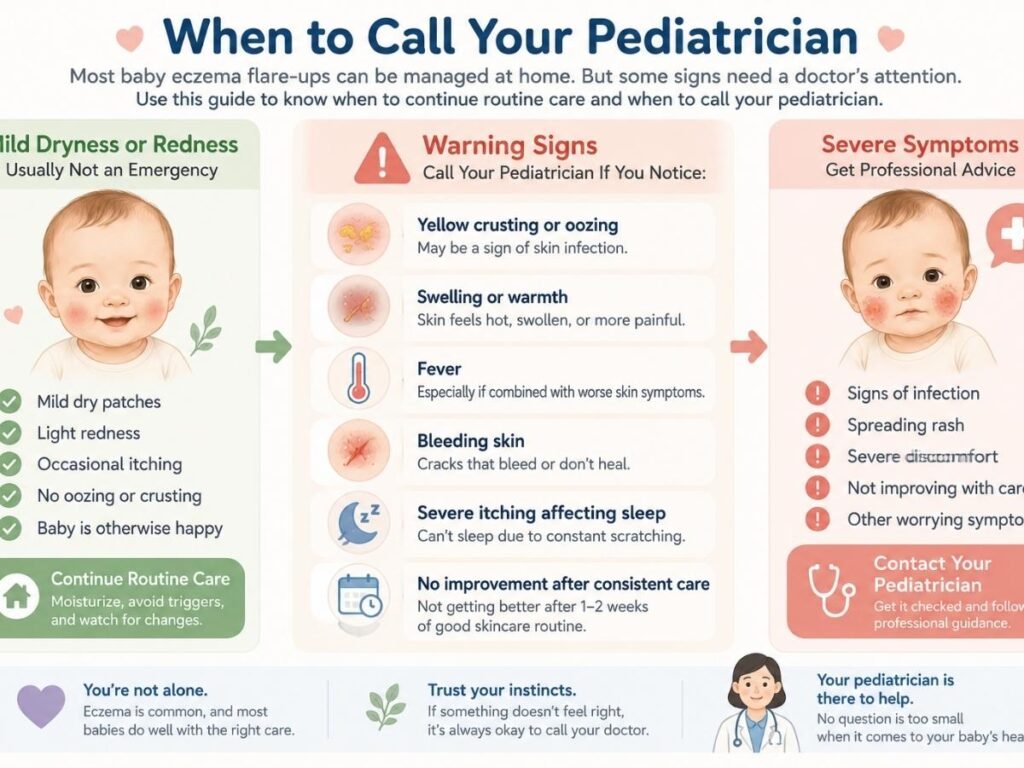
When Should You Call Your Pediatrician?
When daily care no longer seems to be enough, it’s time to take a closer look. Symptoms that become more severe, don’t improve, or show signs of infection should be evaluated by a pediatrician.
Signs your baby needs medical evaluation
- Yellow crusting or oozing, which can indicate infection
- Swelling or warmth around affected skin
- Fever alongside a skin flare
- Itching severe enough to disrupt sleep regularly
- Bleeding or open skin
- No noticeable improvement after several weeks of consistent routine care
Seeking medical help at these signs isn’t a last resort — it’s simply part of responsible eczema management, the same way you’d check in about any other ongoing health concern. A pediatrician can also refer you to a dermatologist if eczema proves difficult to control with standard treatment, which is a normal next step rather than a sign of a worst-case scenario.
Skin irritation in the diaper area sometimes gets mistaken for a separate eczema flare, when it’s really a distinct issue — understanding how to prevent diaper rash can help you tell the two apart and avoid treating one as the other.
Knowing when to seek medical help prevents severe eczema from becoming harder to manage down the line.
FAQ
At what age does baby eczema usually start, and when will my baby outgrow it?
Eczema commonly begins between 2 and 6 months of age. Many children see significant improvement by school age, though the timeline varies, and some continue to have occasional sensitivity into later childhood.
What does it actually mean when someone says a cream “worked” for baby eczema?
Usually it means the cream supported the skin barrier well enough to reduce dryness and prevent a flare during consistent use — not that it cured eczema permanently. Eczema management is ongoing rather than a one-time fix, even with an effective product.
How do I manage severe baby eczema when regular moisturizers aren’t helping?
At this stage, moisturizer alone often isn’t enough to control active inflammation, and a doctor-guided plan, potentially including a topical steroid, is typically the more effective next step rather than trying additional moisturizer brands.
How can I clear my baby’s eczema flare-up and keep it from coming back?
Treating an active flare usually involves a doctor-recommended treatment for the inflammation itself, followed by returning to consistent daily moisturizing and trigger avoidance to reduce the chance of recurrence.
Is it safe to use over-the-counter hydrocortisone cream on my baby’s eczema?
Hydrocortisone is generally considered safe for short-term use on babies, but it’s best used with a pediatrician’s guidance on amount and duration, particularly for a baby’s first flare-up.
Should I change my diet while breastfeeding or switch formulas if my baby has eczema?
Not automatically. Diet changes are worth discussing with a pediatrician only if there’s a clear, consistent pattern between specific foods and flare-ups, rather than as an immediate first response to eczema.
What is the “Soak and Seal” method for baby eczema, and how do I do it correctly?
It involves a short lukewarm bath, gently patting the skin dry, and applying a thick moisturizer within 3 minutes while skin is still damp. This timing helps lock in moisture more effectively than moisturizing on fully dry skin.
How can I deal with the emotional stress and guilt caused by my baby’s eczema?
Remind yourself that eczema stems from skin barrier biology and genetics, not parenting choices. Focusing on a consistent, manageable routine — rather than searching for a perfect fix — tends to ease both the skin symptoms and the stress that comes with them.
🏠 Behind This Guide
Few things worry new parents more than seeing red, dry patches on their baby’s skin and not knowing whether they’re looking at baby eczema or something else. The uncertainty often leads to late-night searches, conflicting advice, and a growing collection of products that promise quick results.
This guide brings together the questions parents ask most—from recognizing the first signs to building a daily routine that actually works. Every section focuses on practical care that fits into everyday life, helping you understand what matters, what doesn’t, and when it’s time to ask your pediatrician for help.
Baby eczema rarely improves because of one perfect cream. It usually gets better through small, consistent habits repeated every day.
If this guide helps you feel a little more confident the next time a flare-up appears, then it has done exactly what it was written to do.
👶 Continue Learning About Baby Skin Care
Caring for your baby’s skin doesn’t stop with eczema. These practical guides can help you better understand other common newborn skin conditions and build a simple daily care routine with confidence.
• Baby Dry Skin — Learn how to tell the difference between normal dry skin and eczema, plus simple ways to keep your baby’s skin soft and hydrated.
• Newborn Skin Peeling — Discover why peeling skin is common after birth, when it’s completely normal, and when it may need extra attention.
• How to Treat Cradle Cap — Find safe, gentle ways to loosen cradle cap scales and keep your baby’s scalp healthy.
• How to Prevent Diaper Rash — Reduce irritation with everyday diaper care tips that help protect your baby’s delicate skin.
• Newborn Baby Care — Explore essential newborn care tips, from bathing and skincare to building healthy daily routines.
❤️ A Final Note
Every parenting journey begins with small, informed decisions—not perfect ones.
At Kindyly, we believe trustworthy advice should be simple, practical, and easy to use in everyday life. That’s why every guide we publish is designed to help new parents understand the basics, avoid common mistakes, and feel more confident as their baby grows.
Our goal is simple: helping families raise happy, healthy babies with confidence, one trusted guide at a time.