
If you are reading this at 3:14 AM with a sleeping baby on your chest—terrified to move because you know the second their back hits the bassinet, those eyes will pop wide open—welcome to the club. My phone is usually at 4% battery right about now, and I’ve probably spent the last hour googling “how much caffeine is too much for breastfeeding.” You are in the thick of it, and it’s exhausting.
The search for a newborn sleep schedule usually starts in a moment of pure desperation. We want a chart. We want a “7:00 AM wake up, 9:00 AM nap” guarantee. But here is the honest truth from one tired parent to another: newborns don’t care about clocks; they care about “rhythms.”

Understanding that rhythm won’t give you a perfect 12-hour stretch tonight (I wish!), but it will give you something better—sanity. Let’s talk about what sleep actually looks like in these first few weeks and how to build a routine that survives real life.
The Myth of the “Schedule”: Why We Call it a Rhythm
Most articles show you these beautiful, color-coded tables with hourly slots. In reality, newborns have tiny tummies and absolutely zero sense of day or night. Instead of a rigid schedule that will just make you feel like a failure when it falls apart at 10:00 AM, think of your day as a repeating loop: Eat, Wake, Sleep.
In the first month, your “rhythm” is all about managing wake windows. This is that tiny sliver of time your baby can handle being awake before they hit a “meltdown point.” For a newborn, this is usually only 45 to 60 minutes. By the time you’ve changed a diaper and finished a feed, your window is basically over.
Practical Guidance: Newborn Sleep by the Weeks
Weeks 1-2: The Sleepy Haze
In the first fortnight, your baby might seem like a champion sleeper. I remember thinking, “This isn’t so bad!” as my son slept through a loud Netflix binge and a barking dog. This is just the “recovery phase.”
- The Goal: Just survive. Focus on recovery and feeding. Don’t worry about “bad habits” yet—they don’t exist at this age.
- Parent Reality: This is when you and your partner should start “shift sleeping.” If my husband handled the 9 PM to 2 AM window while I slept in the guest room with earplugs, I felt like a functional human the next day.
Weeks 3-4: The Wake-Up Call
Around week three, many babies “wake up” to the world. They become more alert, more prone to overstimulation, and—honestly—way more fussy.
- The Goal: Start helping them figure out that the sun means “up” and the moon means “sleep.” Keep the house bright and noisy during the day, and pitch black and boring at night.
- The Routine: Start a 5-minute “bedtime” cue. It doesn’t matter if it’s at 11 PM. A quick wipe-down, a fresh diaper, and the same song every night can eventually signal that the “long” sleep is coming.
Real-Life Example: A “Typical” 24 Hours (The Messy Version)
Meet Jen and Marcus. They tried a strict newborn sleep schedule from a book and felt like they were failing by day four. Their daughter, Maya, wouldn’t nap at 1:00 PM as the book suggested; she just screamed.
“We stopped looking at the wall clock and started looking at Maya’s eyebrows,” Jen says. “We noticed that whenever the skin around her eyebrows turned slightly red, she was about 5 minutes away from a meltdown. If we put her down right then—even if it was 12:15 PM—she’d drift off. Suddenly, the screaming stopped.”
Things That Can Help (Softly)
You don’t need a nursery full of $300 gadgets to get a baby to sleep, but a few tools definitely helped me get an extra 30 minutes of shut-eye:
- The “Transition” Swaddle: Newborns have an annoying “startle reflex” where their arms jerk. A snug swaddle, like the Sleepea or the Halo SleepSack, mimics the womb and keeps those jumpy arms still.
- White Noise Machines: The womb is loud! A consistent white noise machine (the Hatch Rest is great because you can control it from your phone) masks the sound of you accidentally dropping a spoon.
- Blackout Curtains: These are a game-changer for daytime. If I can make the room dark, my baby’s brain produces melatonin much more easily.
Common Mistakes: The “Too Quiet” Trap
One of the biggest mistakes I made with my first was being way too quiet during the day. I’d tiptoe around and hiss at the cat for meowing. Big mistake.
The Real-Life Fix: Run the dishwasher and let the sun shine in during the day. Save the “library silence” for 2:00 AM. This is the fastest way to fix day/night confusion, where babies want to party all night and sleep all day.
Safety First: Safe Sleep Foundations
While we are all desperate for sleep, keeping your baby safe is the number one priority. In 2026, the gold standard remains the “ABC” of safe sleep:
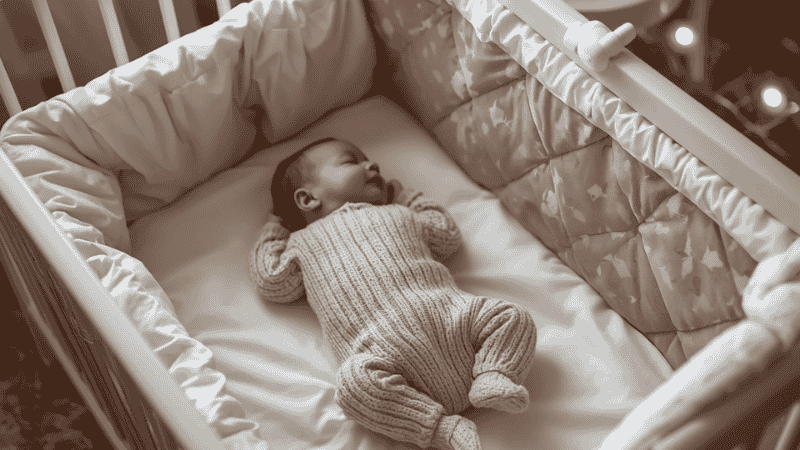
- Alone: No pillows, blankets, or stuffed animals in the sleep space.
- Back: Always place your baby on their back to sleep.
- Crib: Use a firm, flat mattress in a safety-approved crib or bassinet.
When to Consult Your Pediatrician
Sleep issues are normal, but sometimes they can be a sign of something else. Call your doctor if:
- Your baby is consistently sleeping through feedings and is difficult to wake.
- You notice signs of reflux (excessive spitting up, arching back, or screaming in pain when laid flat).
- Your baby has fewer than 6 wet diapers in 24 hours.
- You feel overwhelmed by feelings of sadness or anxiety (Postpartum depression/anxiety is common and treatable—please reach out).
FAQ: Your Quick Sleep Questions
Can newborns sleep too much? In those first few weeks, yes. Most pediatricians want you to wake a sleepy baby every 3 hours to eat until they’re back at their birth weight. It feels criminal, but it’s important for their growth!
When does “sleeping through the night” actually happen? Clinically, “sleeping through the night” is often just a 6-hour stretch. Most babies hit this between 3 and 6 months. For now, a 3-hour stretch is a win.
Is it okay if my baby only sleeps on me? This is a “contact nap.” They feel safest when they smell you. To move them to a bassinet, try the “bottom-first” landing—lay their feet down first, then their head—to avoid triggering the startle reflex.
What is the ideal room temperature for sleep? Most experts recommend keeping the room between 68–72°F (20–22°C). A slightly cool room is safer and helps babies sleep more soundly.
A Final Thought for the Tired Parent
If your newborn sleep schedule currently feels like a series of chaotic naps and caffeine-fueled vigils, you aren’t doing anything wrong. You are navigating the “fourth trimester.”
Take a deep breath. This phase is intense, but it is short. Soon, those wake windows will stretch out, the social smiles will arrive, and you will eventually see the other side of a 6-hour sleep block. Until then, hold that baby, take the shifts, and remember: you’re doing an amazing job.

Hi, this is a comment.
To get started with moderating, editing, and deleting comments, please visit the Comments screen in the dashboard.
Commenter avatars come from Gravatar.