
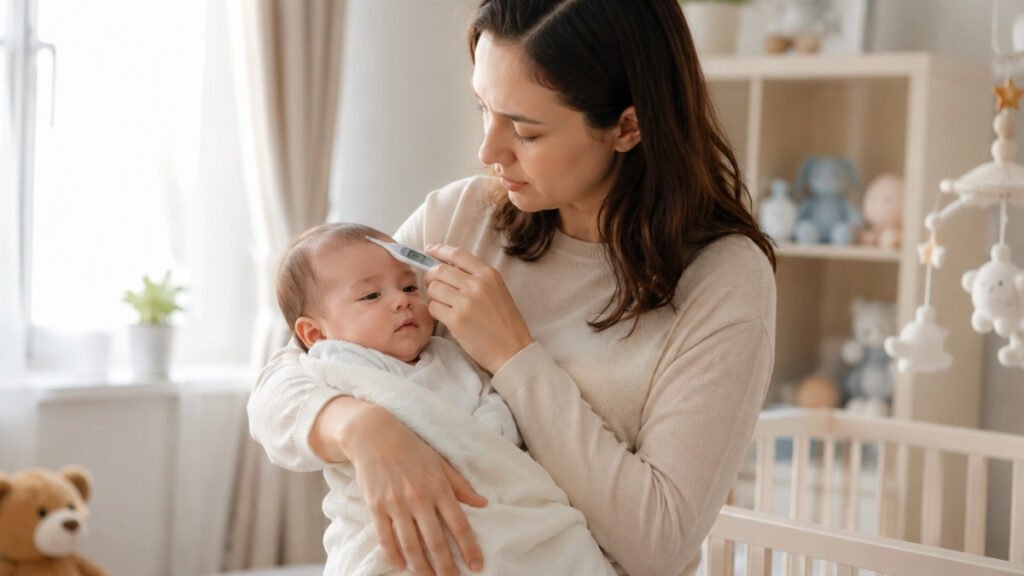
The first time your baby develops a fever, it’s easy to focus on the number on the thermometer. In reality, pediatricians often care just as much about how your baby is acting—whether they’re feeding, staying hydrated, and responding normally. In many cases, fever in babies is a normal response to an infection rather than a medical emergency.
This guide explains what counts as a fever, when to call a doctor, how to take an accurate temperature, and the safest ways to care for your baby at home. You’ll also learn how to use fever medicine correctly and avoid common myths that can lead to unnecessary worry.
Quick Answer
A rectal temperature of 100.4°F (38°C) or higher is considered a fever in babies. Here’s what matters most in the first few minutes:
- Babies younger than 3 months with any fever need immediate medical evaluation — this age group doesn’t wait until morning.
- Older babies can often be cared for at home if they’re alert, feeding reasonably well, and show no danger signs.
- Treat your baby’s overall comfort — not just the number on the thermometer.
- Watch behavior, hydration, and breathing as closely as the temperature reading itself.
The rest of this guide explains why each of these points matters and what to do next.
What Temperature Is Considered a Fever in Babies?
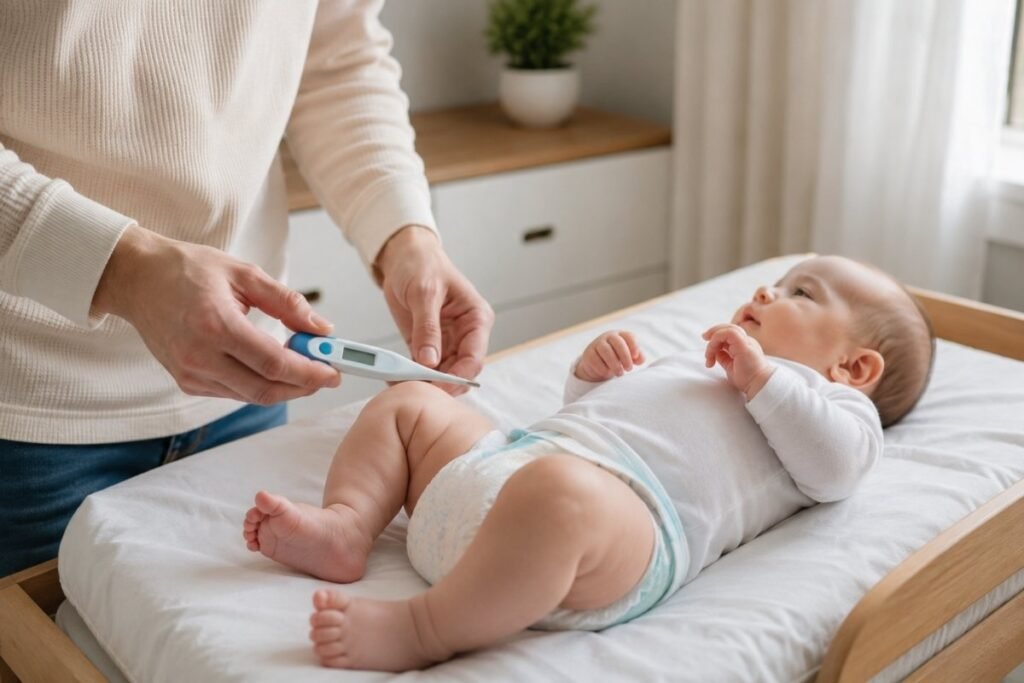
Knowing whether your baby actually has a fever is the first step before deciding what to do next. For babies, the answer depends on both the temperature reading and how it was measured. A rectal temperature of 100.4°F (38°C) or higher is considered a fever, while readings taken from the ear, forehead, or armpit may have different thresholds.
Normal Temperature vs. Fever
A healthy baby’s temperature naturally fluctuates throughout the day, often running slightly higher in the late afternoon and evening than in the early morning. This is completely normal and isn’t cause for concern on its own.
| Measurement Method | Normal Range | Fever Threshold |
|---|---|---|
| Rectal | 97.9–100.3°F (36.6–37.9°C) | 100.4°F (38°C) or higher |
| Oral | 95.9–99.5°F (35.5–37.5°C) | 100°F (37.8°C) or higher |
| Armpit (axillary) | 94.5–99.1°F (34.7–37.3°C) | 99°F (37.2°C) or higher |
| Ear (tympanic) | 96.4–100.4°F (35.8–38°C) | 100.4°F (38°C) or higher |
Does Every High Temperature Mean Serious Illness?
Not at all. A fever itself is usually a symptom, not the illness — it’s a sign your baby’s immune system has detected something and is responding to it. It’s surprisingly common for parents to panic over a temperature that’s only a few tenths of a degree above normal, when a baby who’s otherwise playful, feeding, and alert rarely needs urgent intervention for that alone. The number matters less than how your baby is acting alongside it.
Knowing the correct fever threshold is the first step before deciding what to do next.
When Should You Worry About a Fever in Babies?
Not every fever is an emergency, even if the number on the thermometer looks high. The decision depends more on your baby’s age, symptoms, and overall condition than the temperature alone. Here’s when a fever needs immediate medical attention—and when it’s usually safe to monitor your baby at home.

Babies Younger Than 3 Months
Any fever of 100.4°F (38°C) or higher in a baby under 3 months requires immediate medical evaluation, often in an emergency room rather than a next-day appointment. Newborns’ immune systems haven’t matured enough to reliably fight off infections on their own, so what looks like a mild fever can occasionally signal something more serious. If you’re navigating this stage generally, it helps to get comfortable with the basics of newborn baby care early on, since fever response is just one part of a much broader routine in these first months.
Babies 3–6 Months
Fever in this age range still warrants a same-day call to your pediatrician, especially if it’s accompanied by poor feeding, unusual fussiness, or fewer wet diapers than normal.
Babies Older Than 6 Months
At this stage, a fever alone — without other concerning symptoms — is often manageable at home with monitoring, as long as your baby remains alert and is drinking fluids reasonably well.
| Age | Fever Response |
|---|---|
| Under 3 months | Any fever = seek immediate medical care |
| 3–6 months | Call your pediatrician the same day |
| Over 6 months | Monitor at home if alert and feeding well; call if danger signs appear |
Beyond age, certain symptoms always warrant urgent attention regardless of the exact temperature:
- Difficulty breathing or unusually fast breathing
- Lethargy — hard to wake, or unusually limp and unresponsive
- Poor feeding or refusing fluids for several hours
- Signs of dehydration, such as noticeably fewer wet diapers
- A seizure
- A purple or unexplained rash
Many parents find themselves fixating on whether the number is “high enough” to worry about, when in reality, a baby’s overall behavior tells you far more than the thermometer does. A baby at 101°F who’s smiling and drinking normally is generally in a very different category from a baby at the same temperature who’s limp and won’t feed.
Your baby’s age and overall condition are often more important than the temperature alone.
How to Check Your Baby’s Temperature Accurately
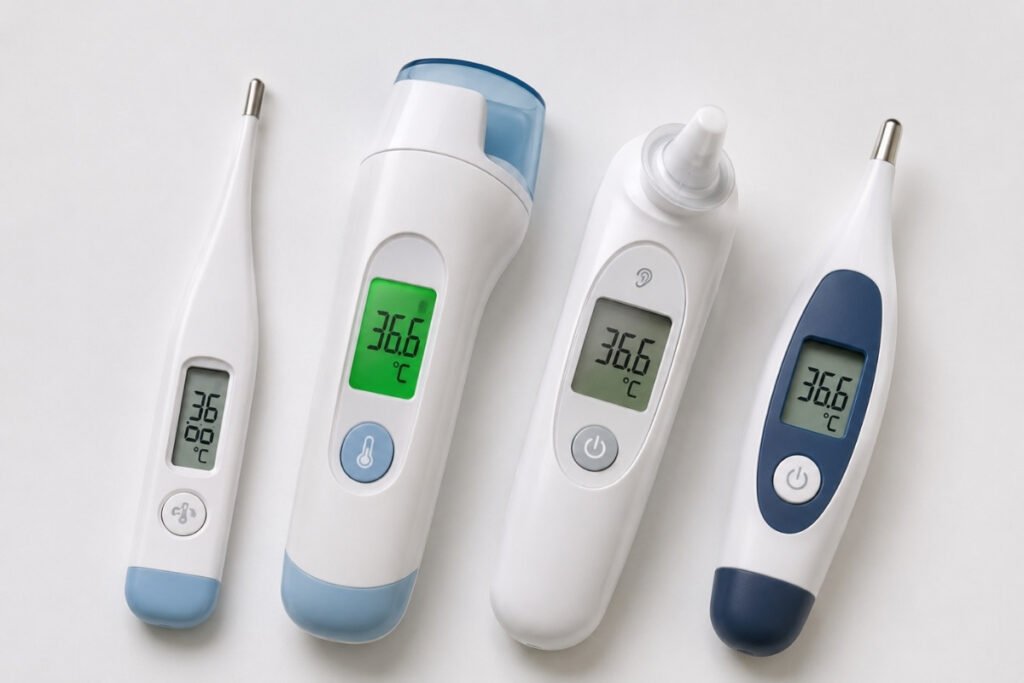
For babies, especially those younger than 3 months, a rectal temperature provides the most accurate result and is considered the medical standard for confirming a fever. Ear, forehead, and armpit readings can be useful, but they may be less accurate depending on your baby’s age and the device.
Which Thermometer Is Best?
| Thermometer Type | Accuracy | Best Age Range | Notes |
|---|---|---|---|
| Rectal digital | Most accurate | 0–3 years | Preferred for infants, especially under 3 months |
| Forehead (temporal) | Moderate | 3 months+ | Convenient but can be affected by room temperature |
| Ear (tympanic) | Moderate | 6 months+ | Less accurate in smaller ear canals |
| Armpit (axillary) | Least accurate | Any age | Useful for quick screening, not for confirming a true fever |
Step-by-Step Rectal Temperature Guide
- Clean the thermometer tip with rubbing alcohol or soap and water, then rinse.
- Apply a small amount of lubricant, like petroleum jelly, to the tip.
- Lay your baby on their back with knees gently bent toward the chest.
- Insert the tip about half an inch to one inch, holding it gently in place.
- Wait for the reading — most digital rectal thermometers beep within 10–20 seconds.
- Remove gently and clean the thermometer again before storing.
Correct temperature-taking checklist
- Thermometer tip is clean before each use
- Small amount of lubricant applied for rectal readings
- Baby is held still and calm during measurement
- Reading is recorded with time and method used
- Same method used for follow-up readings when tracking a fever
It’s genuinely common for parents to get different readings from different thermometers used back to back, which understandably causes confusion. Rectal and forehead readings, for example, can differ by close to a full degree, so switching methods mid-illness can make a fever look like it’s changing more dramatically than it actually is. Sticking with one method for comparison over the course of an illness gives a much clearer picture than switching between devices.
Accurate temperature measurement prevents unnecessary panic and inappropriate treatment.
What Causes Fever in Babies?
When a baby develops a fever, the cause is usually a common viral infection. However, because young infants are also at higher risk for serious bacterial infections, it’s important to know when a fever needs medical attention.
Common Causes by Age
| Cause | Typical Symptoms Alongside Fever |
|---|---|
| Common cold or viral illness | Runny nose, cough, mild fussiness |
| Ear infection | Ear tugging, fussiness, disrupted sleep |
| Urinary tract infection | Fever without obvious cold symptoms, fussiness during diaper changes |
| Roseola | High fever for 3–5 days, followed by a rash as the fever breaks |
| Vaccination | Mild fever within 24–48 hours of a shot, usually short-lived |
Can Teething Cause a Fever?
This is one of the most persistent misconceptions in baby care. Teething can cause mild irritability, drooling, and slightly elevated temperature, but it does not cause a true fever of 100.4°F or higher. If your baby is teething and running a genuine fever, something else is likely the cause, and it’s worth looking into it separately rather than attributing it to new teeth. For a closer look at what teething actually does and doesn’t cause, it helps to understand common baby teething symptoms so you’re not missing something else going on.
Fever Without Cough or Runny Nose
Many parents find it unsettling when a fever appears with no other obvious symptoms, but this is fairly common in early viral illness — the fever often shows up a day or two before other symptoms, like a cough or rash, become noticeable. Urinary tract infections can also present this way, particularly in babies under a year old, which is one reason unexplained fevers in younger infants are taken seriously by pediatricians.
Many baby fevers are caused by common viral infections, but some require prompt medical evaluation.
How to Care for a Baby With a Fever at Home
If your baby doesn’t need emergency care, home treatment is usually simple. Focus on comfort, hydration, and monitoring symptoms, rather than trying to bring the fever down immediately.
Keeping Your Baby Comfortable
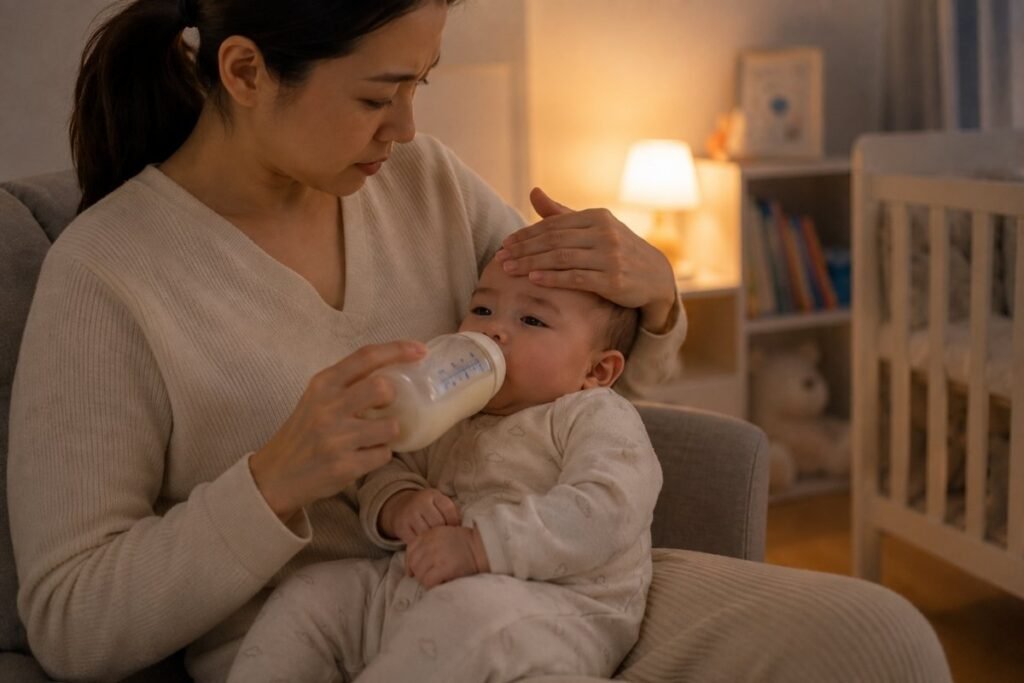
Dress your baby in light, breathable clothing and keep the room at a comfortable temperature — overdressing or bundling up a feverish baby can actually trap heat rather than help. A lukewarm damp cloth on the forehead can offer comfort, but there’s no need to actively try to “cool down” a baby who isn’t uncomfortable.
Preventing Dehydration
Offer breast milk, formula, or water more frequently than usual, in smaller amounts if your baby seems less interested in larger feeds. Watch wet diaper counts as a practical hydration gauge — a noticeable drop from your baby’s normal pattern is worth mentioning to your pediatrician.
Caring for Your Baby Overnight
It’s one of the most common overnight worries: should you wake your sleeping baby to check their temperature or give medication? In most cases, if your baby is sleeping peacefully, it’s better to let them rest — sleep supports recovery, and waking a comfortable baby to take a reading rarely changes the care plan. The exception is if your baby was showing any of the emergency signs mentioned earlier before falling asleep, in which case closer monitoring is warranted. Keeping the rest of your baby’s sleep environment consistent with general safe sleep for babies guidance also matters during illness, since a fever doesn’t change the fundamentals of safe sleep positioning.
Example: A 7-month-old with a mild fever
It’s 2 a.m., and your 7-month-old wakes up feeling warm. A rectal temperature reads 101.5°F (38.6°C). Your baby drinks a bottle, makes eye contact, smiles occasionally, and has several wet diapers during the day.
In this situation, keeping your baby comfortable, offering fluids, and monitoring for worsening symptoms is often appropriate. You do not need to wake your baby repeatedly just to check their temperature if they are sleeping comfortably and breathing normally.
Example: A 6-week-old with a fever
Your 6-week-old has a rectal temperature of 100.4°F (38°C) but otherwise seems calm and feeds normally.
Even though your baby doesn’t appear seriously ill, any fever in an infant younger than 3 months requires prompt medical evaluation because newborns have a higher risk of serious bacterial infections.
Remember: Focus on how your baby is acting—not just the temperature. Age, alertness, feeding, breathing, and wet diapers are often more important than the number on the thermometer.
Home fever care checklist
- Dress baby in light, breathable clothing
- Offer fluids more frequently, in smaller amounts if needed
- Track wet diapers to monitor hydration
- Keep the room at a comfortable, moderate temperature
- Let your baby sleep if they appear peaceful and were showing no danger signs
- Recheck temperature periodically, using the same measurement method each time
The goal of home care is keeping your baby comfortable while watching closely for worsening symptoms.
Baby Fever Medicine Safety: Tylenol vs. Motrin
Fever medicine should be used to ease your baby’s discomfort, not to force the number on the thermometer back to “normal.” A comfortable, feeding baby with a mild fever doesn’t necessarily need medication at all.
When Should You Give Fever Medicine?
Consider medication if your baby seems genuinely uncomfortable, fussy, or is struggling to feed or sleep because of the fever — not simply because the reading crossed a specific threshold.
Tylenol vs. Motrin
| Acetaminophen (Tylenol) | Ibuprofen (Motrin) | |
|---|---|---|
| Minimum age | 2 months+ (with medical guidance) | 6 months+ |
| Dosing basis | Weight-based, not age-based | Weight-based, not age-based |
| Frequency | Every 4–6 hours as needed | Every 6–8 hours as needed |
| Key caution | Follow weight-based dosing precisely | Not recommended under 6 months or if dehydrated |
Always confirm exact dosing with your pediatrician or the dosing chart that comes with the medication, since amounts are based on your baby’s weight rather than a general age range. Never give aspirin to a baby or young child, as it’s linked to a rare but serious condition called Reye’s syndrome. Alternating between acetaminophen and ibuprofen is sometimes recommended by a pediatrician for specific situations, but it isn’t something to start on your own without guidance, since dosing schedules can easily get confused.
Many parents assume the goal is getting the number down as fast as possible, when the more useful goal is easing discomfort so your baby can rest, drink fluids, and feel more like themselves. A baby who’s playing and feeding at 101°F doesn’t necessarily need medicine just because the fever is technically present.
Always choose fever medicine based on your baby’s age, weight, and symptoms — not the thermometer alone.
Common Baby Fever Myths Parents Should Ignore
You’ve heard about treating a baby’s fever is true. Some long-standing advice is outdated and may even make your baby less comfortable. Knowing what to avoid is just as important as knowing what to do.
| Myth | Fact |
|---|---|
| “Fever will damage the brain if it gets too high” | Fevers from common illness, even ones that feel high, don’t cause brain damage on their own |
| “Bundle baby up to sweat the fever out” | Extra layers can trap heat and make baby more uncomfortable |
| “Rub baby down with alcohol to cool them off” | Alcohol rubs are unsafe and can be absorbed through the skin |
| “An ice bath brings the fever down fastest” | Ice baths can cause shivering, which raises body temperature further, and are not recommended |
| “Every fever needs to be treated with medicine” | Mild fevers in a comfortable baby often don’t require medication at all |
Many of these remedies were passed down from previous generations before there was a clearer understanding of how fever actually works as part of the immune response, rather than something to aggressively fight. It’s worth double-checking any home remedy suggested by well-meaning family members against current guidance before trying it.
Evidence-based care is safer than relying on outdated fever remedies.
Essential Baby Fever Care Kit
The middle of the night is the worst time to discover you’re missing a thermometer or infant fever medicine. Keeping a few essentials at home helps you respond quickly and care for your baby with confidence.
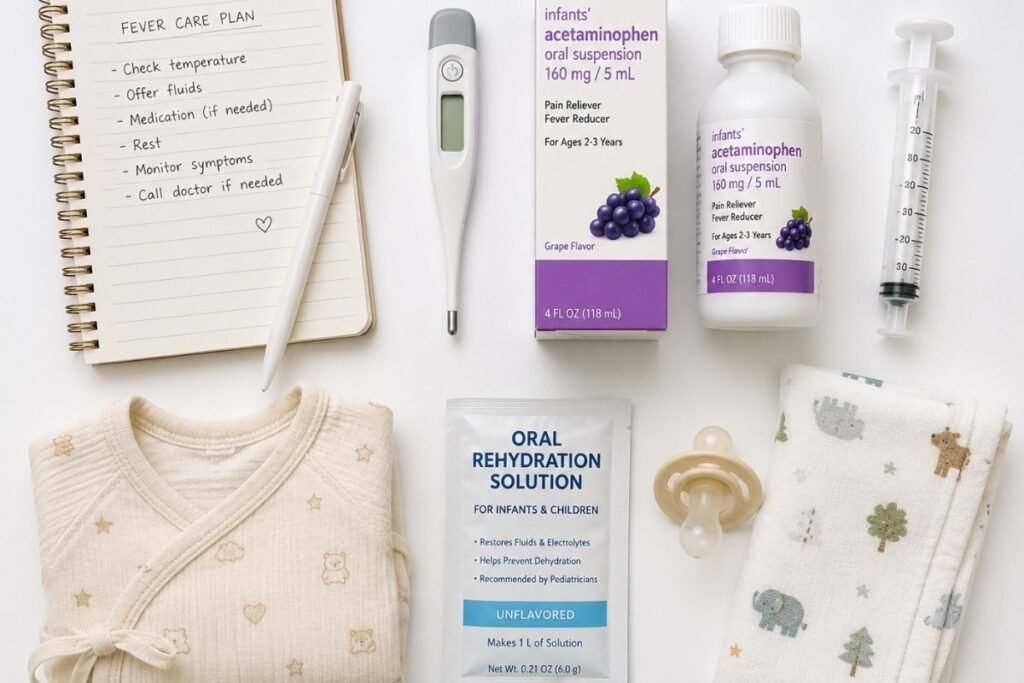
| Item | Why It Helps |
|---|---|
| Digital rectal thermometer | Most accurate readings, especially for babies under 3 months |
| Infrared forehead thermometer | Faster, less invasive option for quick checks once baby is older |
| Infant acetaminophen | On hand for discomfort, used only with correct weight-based dosing |
| Oral dosing syringe | Ensures accurate medication amounts, more reliable than kitchen spoons |
| Oral rehydration solution | Helps replace fluids if feeding is reduced during illness |
| Temperature log (notebook or app) | Tracks readings over time so you can spot patterns and share them with your pediatrician |
| Lightweight sleepwear | Keeps baby comfortable without overheating during a fever |
Keeping these items stocked ahead of time — rather than searching for them at 2 a.m. — tends to make the whole experience feel more manageable, since you’re not scrambling while also trying to comfort a fussy baby.
Having the right supplies ready helps parents respond calmly when fever develops.
FAQ
When is a baby’s fever considered an emergency that requires an ER visit?
Any fever in a baby under 3 months requires immediate medical evaluation. At any age, a fever accompanied by difficulty breathing, lethargy, a seizure, or a purple rash also warrants emergency care right away.
Why does any fever in a newborn under 3 months require immediate hospitalization or medical evaluation?
A newborn’s immune system hasn’t fully matured, which makes it harder for their body to fight off infections that an older baby would handle without difficulty. Because of this, doctors evaluate fevers in this age group promptly rather than waiting to see if symptoms develop further.
Should I wake my baby up overnight to check their temperature or give fever medication?
If your baby is sleeping peacefully and showed no emergency signs beforehand, it’s generally fine to let them rest rather than waking them. Sleep supports recovery, and a comfortable baby usually doesn’t need to be disturbed just to confirm a number.
What is the difference between Tylenol and Motrin for babies, and at what age can they be given?
Acetaminophen (Tylenol) can be used from 2 months with medical guidance, while ibuprofen (Motrin) is intended for babies 6 months and older. Both are dosed by weight rather than age, so confirming the exact amount with your pediatrician matters more than the product choice itself.
How do I know if my baby is dangerously lethargic versus just tired from a fever?
A tired baby with a fever will usually still respond to you, make eye contact, and wake up when you interact with them, even if they’re less playful than usual. A lethargic baby is difficult to wake, unusually limp, or doesn’t respond normally — that distinction is a sign to seek care promptly.
What is the most accurate way to take a baby’s temperature at home?
A rectal reading with a digital thermometer is the most accurate method, particularly important for babies under 3 months where precise readings guide urgent care decisions.
What could cause a sudden fever in a baby with no other cold or flu symptoms?
Viral illnesses often start with fever before other symptoms appear, and urinary tract infections can also present with fever alone, especially in babies under a year old. An unexplained fever, particularly one that persists, is worth mentioning to your pediatrician.
How can I keep my baby comfortable during a fever without over-medicating them?
Light clothing, a comfortable room temperature, and plenty of fluids often ease discomfort without medication. Reserve fever reducers for when your baby seems genuinely uncomfortable, rather than using them automatically whenever a fever is present.
Final Thoughts
Seeing a fever in your baby can be frightening, especially the first time. The good news is that fever in babies is usually a normal response to an infection, not a medical emergency. By focusing on your baby’s age, overall behavior, and warning signs—not just the number on the thermometer—you’ll be better prepared to make the right decisions. With accurate temperature checks, safe home care, and knowing when to call your pediatrician, you can handle the next fever with more confidence and a little less worry.
🏠 Behind This Guide
Every baby’s fever feels different, but the questions parents ask are often the same. That’s why this guide focuses on the information you’ll need most—what counts as a fever, when to call a doctor, and how to care for your baby safely at home.
This guide is built around three essentials:
- 🌡️ Know the Temperature — Understand what counts as a fever and how to measure it accurately.
- 👶 Recognize Warning Signs — Learn when a fever needs medical attention and when home care is enough.
- 💙 Care With Confidence — Follow simple, evidence-based steps to keep your baby comfortable and safe.
Because the goal isn’t to eliminate every fever.
It’s to help you respond calmly, confidently, and know when your baby needs extra care.
👶 Continue Learning About Baby Care
A fever is just one part of caring for a growing baby. These beginner-friendly guides can help you feel more confident through the first months, from everyday care to common health concerns and safe sleep.
- Newborn Baby Care: The Complete Guide for First-Time Parents — Learn the daily essentials of feeding, bathing, diapering, and caring for your newborn with confidence.
- Baby Teething Symptoms: What’s Real, What’s a Myth & How to Actually Help — Understand what teething really causes, what it doesn’t, and safe ways to comfort your baby.
- Baby Ear Infection Symptoms: How to Tell If Your Baby Has One — Recognize the early signs of an ear infection and know when it’s time to call your pediatrician.
- Safe Sleep for Babies: The Complete AAP-Based Guide — Create a safe sleep environment and follow the latest recommendations to reduce sleep-related risks.
- How to Swaddle a Baby: Step-by-Step Guide for New Parents — Learn how to swaddle your baby safely, when to stop, and common mistakes to avoid.
❤️ A Final Note
Every parenting journey begins with small, informed decisions—not perfect ones.
At Kindyly, we believe trustworthy advice should be simple, practical, and easy to use in everyday life. That’s why every guide we publish is designed to help new parents understand the basics, avoid common mistakes, and feel more confident as their baby grows.
Our goal is simple: helping families raise happy, healthy babies with confidence, one trusted guide at a time.