
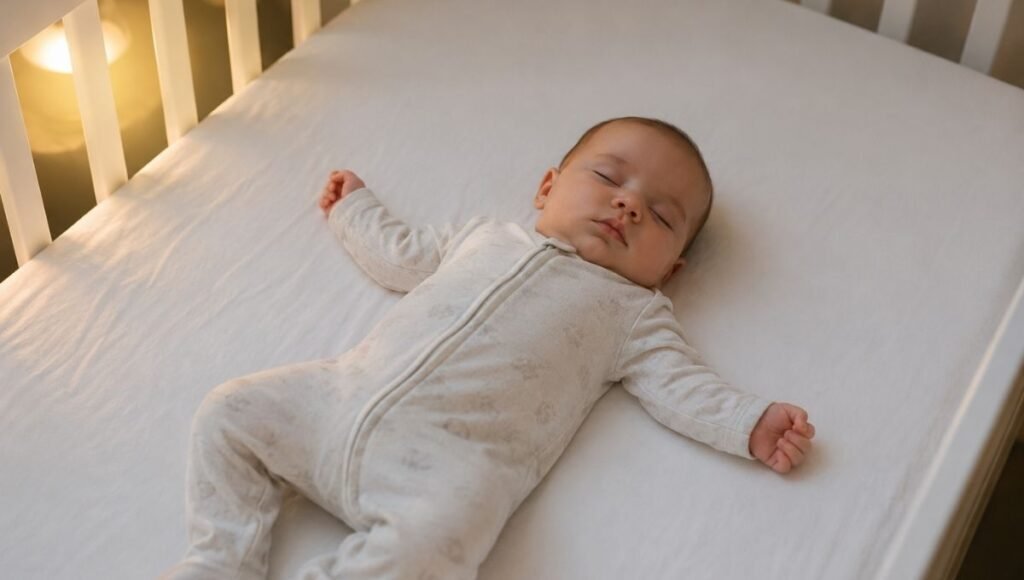
You set up the nursery exactly like the pictures online. The crib is beautiful. The bumper pads match the bedding. There’s a stuffed animal in the corner because it seemed sweet. And then you start reading about safe sleep — really reading — and you realize you need to take half of it out.
This is a disorienting experience. Nobody tells you when you’re registering for baby gifts that the crib bumper you picked so carefully might actually be dangerous. The conversation around safe sleep has changed significantly in the last decade, and what was considered fine when your parents had babies — or even what well-meaning family members are still advising — is often no longer in line with current guidance.
This guide is built on the 2022 AAP safe sleep recommendations, which represent the most current evidence-based consensus on reducing the risk of sleep-related infant death. We’ll cover what the guidelines actually say, the reasoning behind them, and — critically — the questions parents actually struggle with but often feel embarrassed to ask. The ones about bed-sharing. About what to do when your baby only sleeps on their stomach. About the head-flattening anxiety. About what to do when grandma thinks you’re being ridiculous.
Key Takeaways
- According to the CDC, approximately 3,400 babies in the US die each year from sleep-related causes — including SIDS, accidental suffocation, and entrapment. The vast majority are preventable.
- The 2022 AAP guidelines represent the most significant update to safe sleep recommendations in nearly two decades.
- The core framework remains: alone, on their back, in a safe sleep space — but the 2022 update added important nuances about room-sharing, breastfeeding, and pacifier use.
- Many of the products marketed as sleep aids — inclined sleepers, positioners, crib bumpers, weighted sleep sacks — are not recommended and some have been linked to infant deaths.
- Once your baby can roll independently in both directions, you no longer need to reposition them if they roll during sleep.
The ABCs of Safe Sleep (And Why Each One Matters)
Safe sleep guidance is sometimes summarized as the ABCs: Alone, Back, Crib. It’s a useful starting point — but the reasoning behind each letter is what makes the advice stick.
A — Alone in Their Sleep Space
“Alone” means your baby sleeps in their own sleep space without other people or soft objects sharing that space. It does not mean isolated in another room. The 2022 AAP guidelines actually recommend room-sharing — your baby in their own sleep surface in the same room as you — for at least the first 6 months, ideally the first year. Room-sharing without bed-sharing reduces SIDS risk by as much as 50%, according to AAP data.
What “alone” is specifically protecting against: soft objects and loose bedding that can press against a baby’s face, and bed-sharing surfaces that are too soft or too warm and can trap a baby in a dangerous position.
This is why the crib bumper — decorative, soft, often matching the crib set — needs to go. There is no evidence that crib bumpers prevent injury, and they create a suffocation risk. They have been linked to infant deaths. The 2022 AAP guidelines recommend removing them entirely.
B — Back for Every Single Sleep
Every nap. Every night sleep. Every sleep in every location. Back sleeping is the single most impactful safe sleep recommendation made by the AAP, and it’s been so since 1992. Since the “Back to Sleep” campaign launched in the US, the rate of SIDS has dropped by more than 50%.
The mechanism: when a baby is placed on their back, their airway is protected. If they spit up, the esophagus is below the trachea in the back-lying position, which means spit-up is more likely to be swallowed or cleared naturally rather than blocking the airway. When a baby is on their stomach, the opposite is true — and a baby who can’t yet lift or turn their head cannot clear their own airway if something obstructs it.
The important update: Once your baby can roll independently in both directions — tummy to back and back to tummy — you don’t need to roll them back over when they move onto their stomach during sleep. A baby who can roll themselves there can manage their airway. Always start them on their back; let them move from there.
C — Crib (or Bassinet, or Play Yard)
“Crib” means a safety-approved sleep surface: firm, flat, and designed specifically for infant sleep. This includes full-size cribs, mini cribs, bassinets, and portable play yards — all of which are subject to safety standards from the Consumer Product Safety Commission (CPSC).
Firm and flat. These two words do a lot of work. Firm means the surface doesn’t conform to the shape of the baby’s head or body — a baby placed face-down on a soft surface can sink into it. Flat means not inclined — inclined sleepers, even at a slight angle, allow a baby’s head to fall forward in a way that can compress the airway. This is why inclined infant sleepers (including many popular products) were recalled starting in 2019 after being linked to infant deaths.
The surface should be covered only with a fitted sheet designed for that specific product. Nothing else in the sleep space.
The Full 2022 AAP Safe Sleep Checklist
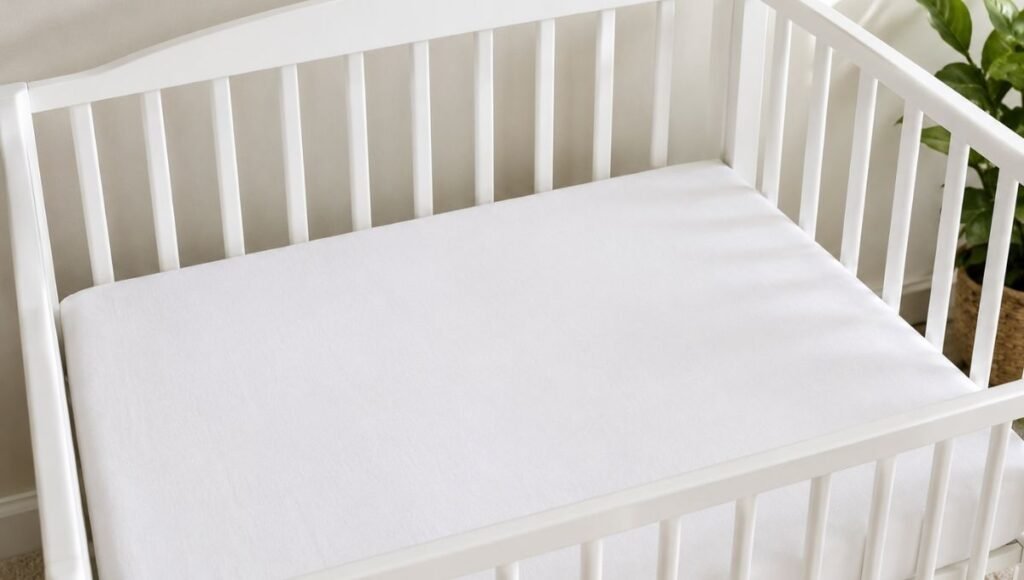
The 2022 update was the most substantial revision to AAP safe sleep guidelines since 2016. Here’s what the complete current recommendations look like:
The sleep environment:
- Always place baby on their back for every sleep
- Use a firm, flat, non-inclined sleep surface
- Use a crib, bassinet, or portable play yard that meets CPSC safety standards
- Use only a fitted sheet — no bumpers, pillows, loose blankets, positioners, or soft toys
- Room-share (baby in their own sleep surface in your room) for at least 6 months, ideally 12
Temperature and covering:
- Keep the room at a comfortable temperature — not too warm
- Signs of overheating: sweating, hot chest, flushed skin
- Use a sleep sack (wearable blanket) instead of loose blankets if warmth is needed
- Do not cover your baby’s head during sleep
Feeding and pacifier:
- Breastfeeding is associated with reduced SIDS risk — the AAP recommends it
- Offer a pacifier at nap time and bedtime — it’s associated with reduced SIDS risk
- If breastfeeding, wait until nursing is established (around 3 to 4 weeks) before introducing a pacifier if you choose to use one
Substances and environment:
- Do not smoke during pregnancy or allow smoking around your baby
- Do not use alcohol or sedating medications when you are the primary caregiver for a sleeping infant
- Avoid cannabis, opioids, and other substances that impair arousal or reaction time
The Hard Questions: What Parents Actually Want to Know
My baby only falls asleep on their stomach. What do I do?
This is one of the most common concerns parents bring to pediatricians, and it’s worth answering directly rather than just repeating the guideline.
The back-sleeping recommendation applies to placement — where you put your baby down — not to where they end up if they can roll. If your baby can roll both ways independently, stomach sleeping that they arrive at on their own is considered acceptable.
For babies who can’t yet roll: if they will only settle on their stomach, this is a sleep association problem, not an immovable reality. Work on back-sleeping placement from the beginning: offer a pacifier, swaddle, use white noise, try placing your baby in the crib slightly drowsy rather than fully asleep. Most babies who are introduced to back sleeping from birth accept it much more readily than babies who are started stomach-down and then switched.
If your baby consistently wakes the moment you put them on their back in the crib: this is usually about the sleep association (being held, being rocked) rather than the position itself. The position feels unfamiliar partly because the comfort-to-crib transfer disturbed them, not purely because of the orientation.
Is bed-sharing ever safe?
The AAP’s position on bed-sharing is clear: they do not recommend it under any circumstances in the first year. The risk is highest for infants under 4 months, premature infants, and infants of parents who smoke, have consumed alcohol, or take sedating medications.
That said, bed-sharing is a choice many families make. If this is your situation, these factors meaningfully reduce (though do not eliminate) the risk: firm mattress, no soft bedding near the baby, no alcohol or sedating substances in the adults sharing the bed, no smoking, and a baby who is healthy and full-term.
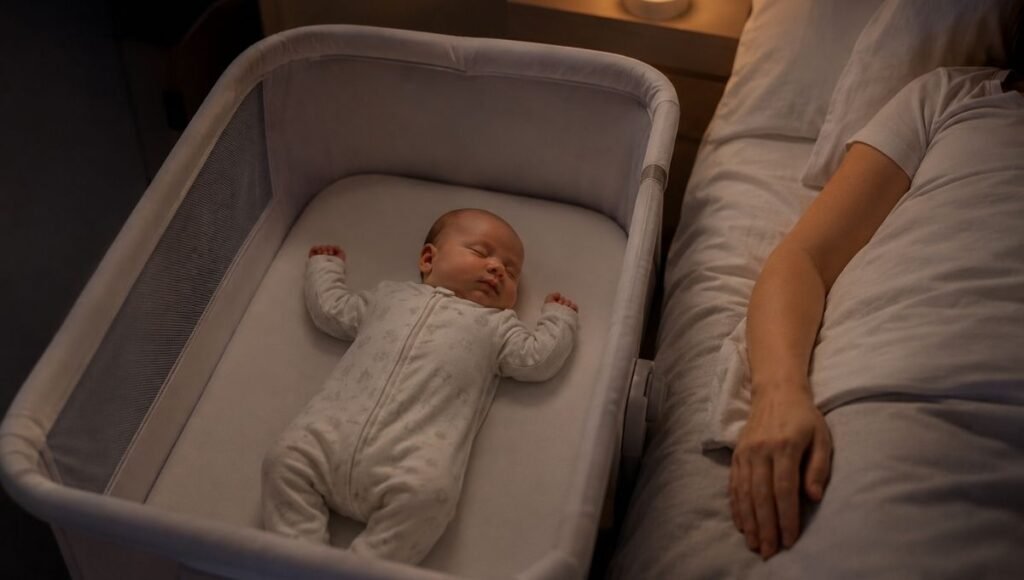
The safest option for parents who want proximity is a bedside bassinet or a co-sleeper designed to attach to an adult bed — these allow you to be immediately next to your baby without sharing the sleep surface.
My baby’s head is getting flat on one side. Is that from back sleeping?
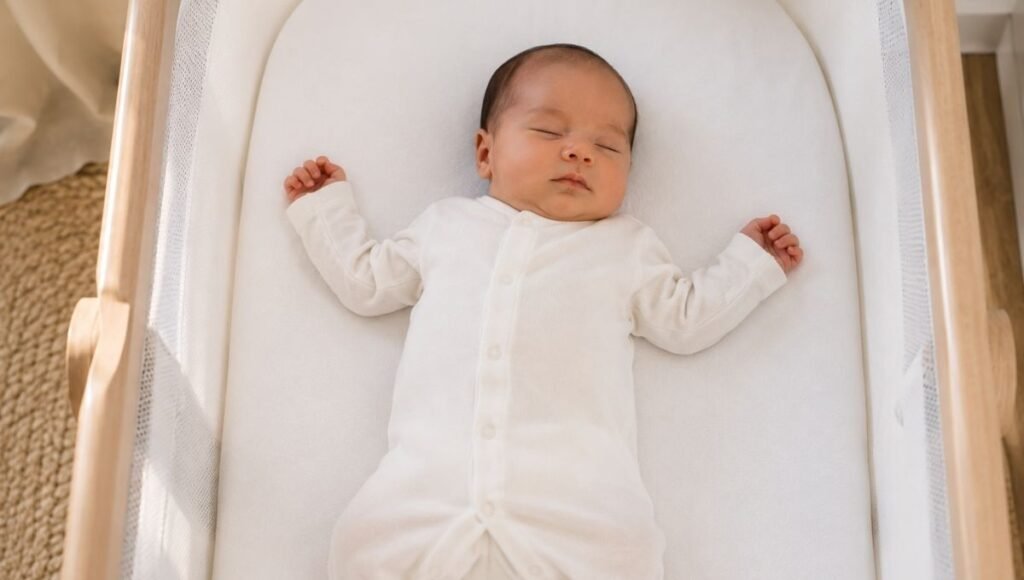
Positional plagiocephaly — flattening of the skull from consistent pressure in one spot — is associated with extended time in one position. It has increased since back-sleeping became standard, but it’s manageable and almost always resolves.
The answer is not to switch to stomach sleeping. It’s tummy time during awake, supervised periods — which builds the neck and shoulder muscles that help babies move their heads freely, redistributes skull pressure, and prepares them for rolling. The AAP recommends starting tummy time from the first day home.
If you notice significant flattening or your baby always turns their head the same direction, mention it at your next well-child visit. Some babies benefit from physical therapy for torticollis (neck muscle tightness); some benefit from a repositioning helmet in more significant cases. These are manageable.
What about swaddling?
Swaddling is appropriate for newborns and is associated with improved sleep and reduced startle reflex. The safety rules: always place a swaddled baby on their back, ensure the swaddle allows the hips to flex (tight straight-leg swaddling is associated with hip dysplasia), and stop swaddling as soon as your baby shows signs of rolling — typically around 2 to 4 months. A baby who rolls while swaddled cannot push up or reposition, which creates a suffocation risk.
My mother-in-law says we slept with blankets and we were fine. How do I handle this?
My honest editorial take: This is genuinely one of the harder parts of new parenthood — maintaining evidence-based safe sleep practices when surrounded by well-meaning family members who raised children under different guidelines.
The direct answer: infant sleep safety recommendations have changed substantially based on research into the causes of infant sleep death. The practices that felt normal a generation ago were associated with infant deaths that were then attributed to other causes or simply not understood. “We did it and you turned out fine” is survivorship bias, not evidence of safety.
A useful framing: “The AAP updated these guidelines in 2022 based on new research. We’re following the current recommendations because we want to give [baby] the safest sleep possible.” This is not a critique of past practices — it’s a statement about what the current evidence says.
Products to Avoid: What’s Not Safe (Even If It’s Marketed as Baby-Safe)
This section matters because the safe sleep product space is genuinely confusing. Many items are marketed specifically to parents of newborns and positioned as helpful, despite not being recommended or having documented safety concerns.
Do not use:
- Inclined sleepers (any angle, including slight inclines) — recalled and linked to infant deaths
- Crib bumpers (including mesh/breathable versions) — no safety benefit, suffocation risk
- Sleep positioners or wedges — not recommended, linked to deaths
- Weighted swaddles or weighted sleep sacks over 10% of baby’s body weight — insufficient evidence of safety, potential harm
- Soft-sided sleep surfaces (adult beds, sofas, recliners, car seats used as sleep surfaces outside of travel) — not safe sleep surfaces
- Nursing pillows as sleep surfaces — not designed for unsupervised sleep
A word on weighted sleep sacks: The AAP’s 2022 update specifically noted that weighted infant products are not recommended due to insufficient safety evidence. These products are widely marketed and have genuine appeal — parents report that babies sleep better in them. But the evidence base for safety doesn’t yet support their recommendation.
Safe Sleep When You’re Away from Home
Travel: A portable play yard with a firm, flat insert mattress is the safest option for travel. Bring a fitted sheet that fits the play yard specifically. Do not use the built-in bassinet attachments on play yards for babies who have outgrown the weight limit — these are typically rated for babies under 15 pounds.
At grandparents’ house: If grandparents will be caring for your baby overnight, a clear conversation in advance — plus a portable play yard they can use — goes a long way. Frame it as what your pediatrician recommends rather than a personal criticism of their home setup.
Daycare: In the US, federally funded childcare programs are required to follow AAP safe sleep guidelines. If your child’s care provider is placing babies on their stomachs or allowing soft bedding in sleep spaces, you have the right to request compliance with safe sleep standards.
Warning Signs: When to Call Your Pediatrician
- Your baby seems to have difficulty breathing or unusual breathing sounds during sleep
- Your baby appears blue or gray around the lips
- Your baby is very difficult to rouse from sleep
- You have questions about a specific sleep product and whether it’s safe — your pediatrician is the right resource
- You’re struggling to maintain back sleeping due to your baby’s strong preference — this is worth discussing rather than giving up on the guideline
FAQ: Safe Sleep Questions Parents Ask Most
Is it okay to let my baby sleep in a swing? Not for unsupervised sleep. Swings are not approved sleep surfaces — the inclined position and soft seat can cause a baby’s head to fall forward in a way that restricts the airway. Supervised napping in a swing for brief periods while you’re watching is generally considered lower risk, but the AAP recommends moving a sleeping baby to a flat surface when they fall asleep in a swing.
When can I put a blanket in my baby’s crib? The AAP recommends keeping soft bedding out of the sleep space for the first year. After 12 months, the risk decreases significantly as babies have greater head control and can reposition themselves. A sleep sack is the recommended alternative for warmth during the first year.
Does breastfeeding really reduce SIDS risk? Yes — breastfeeding is independently associated with reduced SIDS risk across multiple studies, even when controlling for other factors. The mechanism isn’t fully understood but may relate to immune factors in breast milk, arousal patterns in breastfed babies, or the feeding frequency itself. The AAP includes breastfeeding in its safe sleep recommendations for this reason.
Can I use a pacifier if I’m breastfeeding? Yes, with timing. The AAP recommends waiting until breastfeeding is well-established — around 3 to 4 weeks — before introducing a pacifier if you’re breastfeeding, to avoid potential nipple confusion. After that, a pacifier at nap and bedtime is associated with reduced SIDS risk and is recommended.
My baby rolled onto their stomach in the night. Do I need to roll them back? Only if they can’t roll in both directions independently. Once a baby can roll both ways on their own, they have the motor control to manage their airway position. Always place them on their back to start; let them move from there.
Safe Sleep Is Not Complicated — It’s Just Different From What We Expected
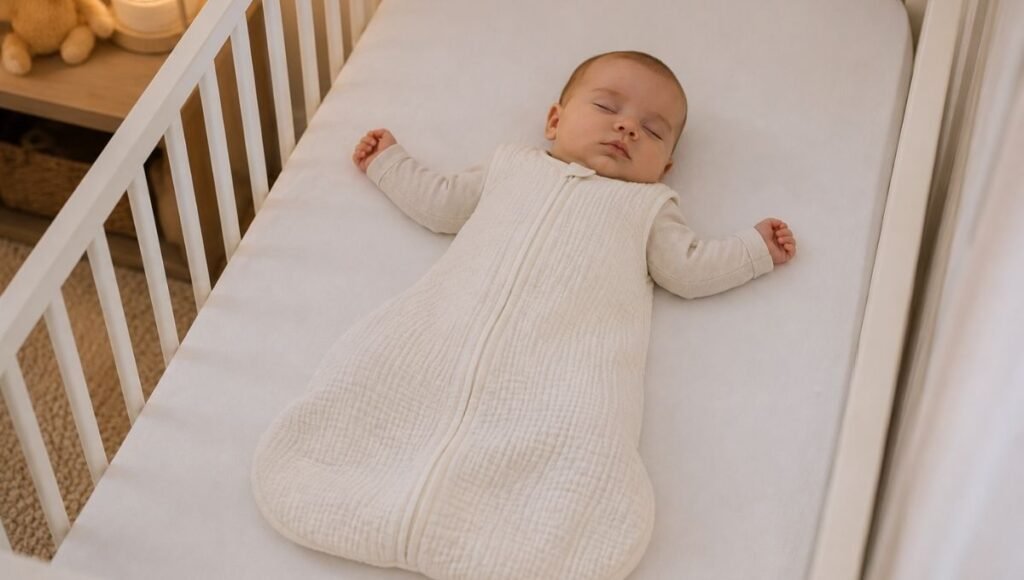
Most of the safe sleep recommendations come down to the same few principles, repeated across contexts: back, firm, flat, alone in their own space, room temperature comfortable, no soft objects. The complications arise when those principles run into reality — a baby who hates the crib, a family member with different expectations, a well-marketed product that sounds helpful.
The good news is that the evidence is clear enough to navigate those complications. The rules aren’t arbitrary. Every one of them emerged from research into what actually causes sleep-related infant deaths — and what actually prevents them.
You’re doing the right thing by reading this. That attention to your baby’s safety is exactly what makes the difference.
What to Read Next
- Baby Sleep Schedule by Age: What to Expect Month by Month — Once the sleep environment is safe, the next question is when and how much — this guide covers both
- The 4-Month Sleep Regression: Why It Happens, How Long It Lasts & How to Cope — The developmental shift that disrupts safe sleep routines for almost every family
- When Do Babies Sleep Through the Night? — The research-backed answer to the question every new parent is quietly asking
References
- Centers for Disease Control and Prevention. Providing Care for Babies to Sleep Safely. Updated February 2025. https://www.cdc.gov/sudden-infant-death/sleep-safely/index.html
- Moon RY, Carlin RF, Hand I, et al. Sleep-Related Infant Deaths: Updated 2022 Recommendations for Reducing Infant Deaths in the Sleep Environment. Pediatrics, 2022. doi:10.1542/peds.2022-057990
- American Academy of Pediatrics. How to Keep Your Sleeping Baby Safe: AAP Policy Explained. HealthyChildren.org, 2022. https://www.healthychildren.org/English/ages-stages/baby/sleep/Pages/A-Parents-Guide-to-Safe-Sleep.aspx
- National Institute of Child Health and Human Development. Safe to Sleep® Public Education Campaign. NICHD, 2023. https://safetosleep.nichd.nih.gov/
This article is for informational purposes only and does not constitute medical advice. Always consult your pediatrician with specific concerns about your baby’s sleep safety or health.