

There’s a question that every new parent gets asked at some point, usually by someone who has forgotten what it was like.
“Is the baby sleeping through the night yet?”
And you smile. You say something vague. Because the honest answer — “no, and also I’m not sure I remember what sleeping through the night feels like anymore” — is not the one anyone actually wants to hear at a dinner party.
The thing is, this question is doing something quietly damaging. It implies there’s a normal timeline. That other babies are sleeping through and yours isn’t, yet. That you’re waiting for something most families have already figured out. And then you do the thing we all do: you go online at 2 a.m. and read stories about four-month-olds sleeping 10-hour stretches, and you feel vaguely like a failure.
Here’s what this guide is for. Not to give you another checklist, not to sell you a sleep training course, but to give you the actual data on when babies sleep through the night — including the parts of the research that most articles bury or ignore — and what it means for your specific situation right now.
Key Takeaways
- “Sleeping through the night” for babies is typically defined as 5 to 6 consecutive hours — not the 8 to 10 hours adults mean by the phrase.
- A landmark study published in Pediatrics found that at 6 months, 57% of babies were still not sleeping 8 consecutive hours. At 12 months, 43% still weren’t. You read that right.
- Most babies show meaningful sleep consolidation between 3 and 6 months, with significant individual variation.
- The single factor most consistently associated with earlier sleep consolidation is the ability to fall asleep independently — not formula vs. breast milk, not weighted sleep sacks, not a magic schedule.
- Sleep regressions — at 4 months, 8–10 months, and 12 months — mean that a baby who was sleeping well can suddenly stop. This is normal, not a permanent setback.
First, Let’s Talk About What “Sleeping Through the Night” Actually Means
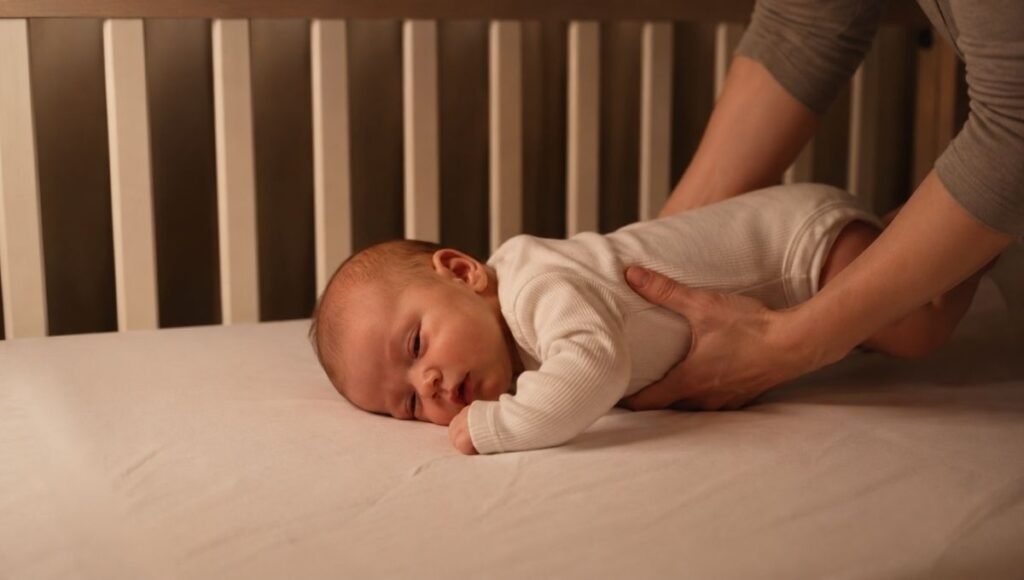
Because the definition matters more than most people realize.
When pediatricians and sleep researchers talk about sleeping through the night, they usually mean a 5 to 6 hour stretch. Not 8 hours. Not 10 hours. Five to six continuous hours, typically counted from around midnight to 5 a.m., which is the period researchers have used as a benchmark in most infant sleep studies.
That’s it. That’s the clinical definition. And against that benchmark, many babies reach it much earlier than parents expect — often by 3 to 4 months.
The 8-to-10-hour expectation is an adult expectation layered onto a baby reality. And when parents are measuring against the wrong standard, they’re always going to feel like they’re failing. A baby who reliably gives you one 5–6 hour stretch per night is, by every clinical definition, sleeping through the night. That might not solve your exhaustion, but it’s not the developmental failure it can feel like.
The Research Nobody Talks About (But Should)
Here’s the data that genuinely changed how I think about this.
A study published in the journal Pediatrics — conducted by Marie-Hélène Pennestri and colleagues at McGill University, looking at over 700 infants — found the following:
- At 6 months of age, 38% of babies were not sleeping even 6 consecutive hours. More than half — 57% — weren’t sleeping 8 hours.
- At 12 months old, 28% of infants still weren’t sleeping six hours straight. And 43% weren’t managing 8 hours.
Let that sit for a second. Nearly half of one-year-olds are not sleeping 8 hours straight. At a year old.
This matters because it tells you something important: if your baby isn’t sleeping through the night at six months, or eight months, or even ten months, you are not outside the normal range. You are solidly, data-backed, peer-reviewed normal.
A separate study from the University of Canterbury, published also in Pediatrics, tracked 75 healthy, full-term newborns through their first year and found that the most rapid increase in uninterrupted sleep happened between one and four months. By five months, about half of babies were sleeping from 10 p.m. to 6 a.m. But by 12 months, one in four still wasn’t.
My editorial take: The cultural narrative around infant sleep has created a standard that most babies don’t meet — and then parents internalize the gap as their fault. It isn’t. The data is clear. Wide variation is normal. The question isn’t whether your baby is sleeping through the night by a specific date; it’s whether they’re moving in the right direction.
When Do Babies Actually Start Sleeping Longer Stretches?
The honest timeline, not the optimistic one:
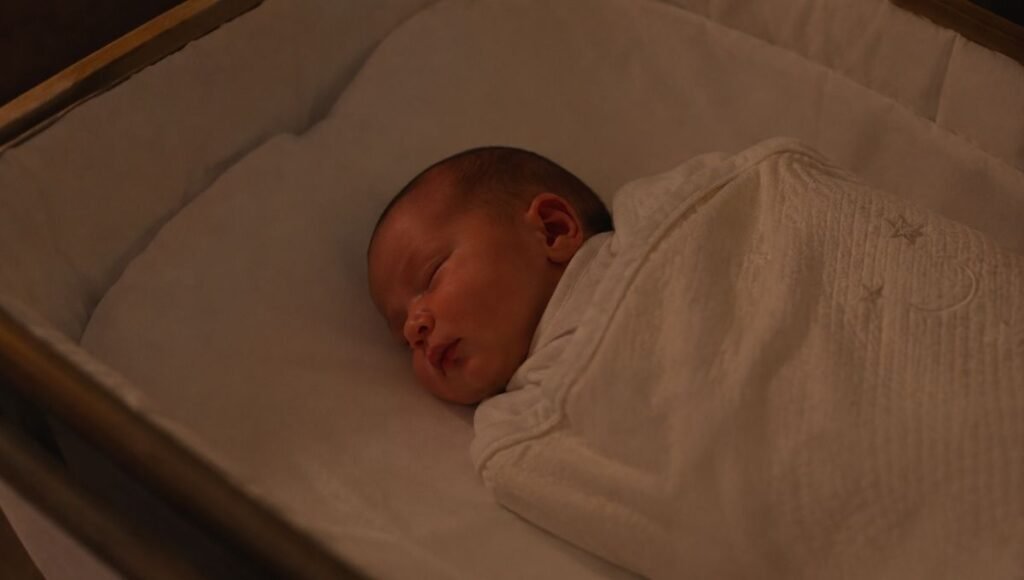
Newborn to 8 weeks: Sleep is fragmented by biological necessity. Newborns have tiny stomachs — they need to eat every 2 to 3 hours. Their circadian rhythms aren’t established. Melatonin production is minimal and inconsistent. There is no “sleeping through the night” at this stage, and anyone who tells you there should be is working from incomplete information or extremely lucky genetics.
2 to 3 months: This is when many babies start producing a longer stretch — often the first stretch of the night, typically 3 to 5 hours. It doesn’t feel like sleeping through the night because they’re still waking twice or more after that first stretch, but it’s real progress happening.
3 to 6 months: The window where sleep consolidation meaningfully begins for many families. Some babies surprise everyone and start doing 6-hour stretches. Others are still waking twice a night at 5 months and then seemingly overnight figure it out at 6 months. The range during this period is genuinely enormous.
6 to 9 months: For babies who haven’t consolidated yet, this is the period where most eventually do. But this is also when the 4-month regression has often already disrupted things, and the 8-to-10-month regression (tied to separation anxiety and motor milestones like crawling and pulling up) arrives. Sleep can feel like two steps forward, one step back.
9 to 12 months: By here, the majority of babies are giving parents at least one reliable long stretch. But as the Pediatrics data shows, a meaningful minority are still waking at 12 months — and that’s within the normal range.
What Actually Affects When Your Baby Sleeps Through
There’s a lot of noise about this. Formula vs. breast milk. Sleep sacks. White noise machines. The correct room temperature. Room-sharing. Co-sleeping. Every parenting corner of the internet has a theory.
Here’s what the research most consistently points to:
The Ability to Fall Asleep Independently
This is, far and away, the factor that matters most for sleep consolidation. A baby who can fall asleep on their own at bedtime — who doesn’t need to be nursed, rocked, or held to sleep — is far more likely to connect sleep cycles through the night without waking you.
The mechanism is simple. We all briefly wake between sleep cycles. Adults have learned to roll over and fall back asleep without fully regaining consciousness. Babies haven’t learned this yet — unless they’ve been given the opportunity to practice it.
If your baby falls asleep in your arms or at the breast every night, they’re not learning what the beginning of sleep feels like on their own. When they surface at the end of a sleep cycle, they’re in a different situation than when they went to sleep — and they need your help to recreate the conditions. That’s not a character flaw or a failure of parenting. It’s just the mechanics of how sleep association works.
Circadian Rhythm Development
Before about 3 months, babies don’t have a fully functioning circadian rhythm. They don’t naturally produce melatonin at night the way older babies and adults do. Exposure to natural light during the day and consistent darkness at night from the newborn period forward supports the development of this rhythm — but you can’t force it before it’s biologically ready.
Total Daily Sleep Needs
An overtired baby sleeps worse, not better. This seems counterintuitive but is one of the most consistent findings in infant sleep research. A baby who is hitting age-appropriate total sleep (14 to 17 hours for a newborn, 12 to 16 hours for a 4–12 month old) is more able to consolidate sleep than one who is chronically undertired or chronically overtired.
Formula vs. Breast Milk
This one is worth addressing directly because it comes up constantly. The persistent belief that formula-fed babies sleep longer is only partly supported by evidence, and the effect size is much smaller than the cultural narrative suggests. Formula takes longer to digest, which may slightly extend stretches in the early weeks. But beyond the first few months, feeding method is not a reliable predictor of when babies sleep through. Plenty of breastfed babies are excellent sleepers. Plenty of formula-fed babies wake repeatedly at 10 months.
What to Do Right Now: The Things That Help
You can’t force your baby to sleep through the night. But you can create the conditions that make it more likely, sooner.
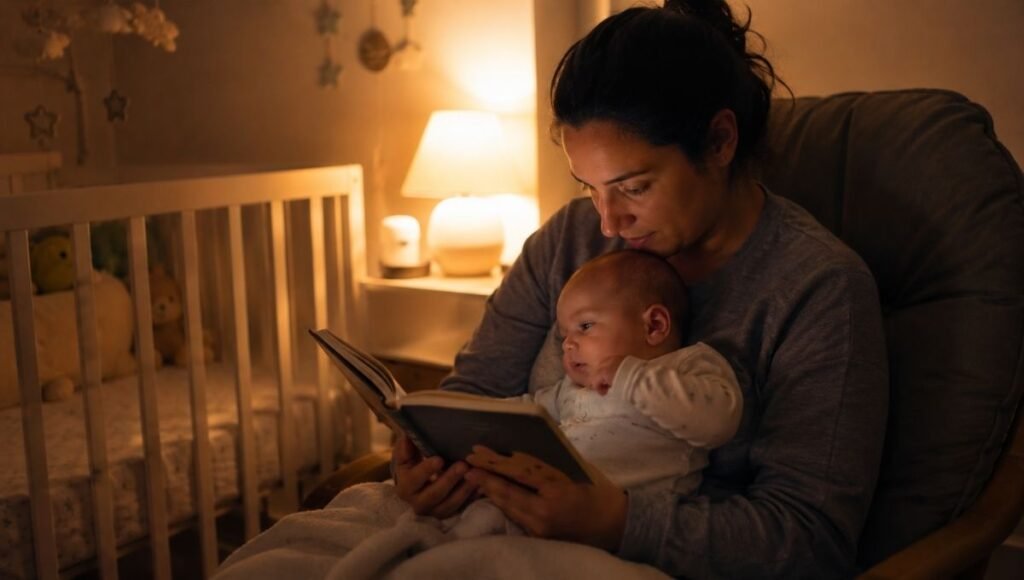
Establish a consistent, predictable bedtime routine. Not elaborate — predictable. The same sequence of 3 to 4 things before sleep every night (bath, feed, book, song, dark room) tells your baby’s nervous system what’s coming. Predictability is calming. Calming is sleep-supportive.
Work toward drowsy-but-awake. Put your baby in their sleep space when they’re drowsy but not yet fully asleep. This is the single most practical step toward independent sleep skills. It doesn’t have to be perfect tonight. It can start with almost-all-the-way-asleep and gradually become more awake over days and weeks.
Make sure they’re getting enough daytime sleep. An overtired baby is harder to settle and wakes more at night. This feels like madness but is well-supported by sleep research. Protect naps.
Create a sleep-supportive environment. Full darkness and a consistent white noise source mask household sounds and provide an auditory cue for sleep. This won’t fix a developmental issue, but it removes environmental obstacles.
If nothing is working at 5+ months: Consider whether the sleep associations at bedtime are the root cause. A single session with a pediatric sleep consultant — or an honest conversation with your pediatrician — can help you identify what’s actually driving the wake-ups and whether a more structured approach makes sense for your family.
The Sleep Regression Reality Check
Just when you think you’ve got it — around 3 months, maybe 4, your baby is doing a 5-hour stretch and you’re cautiously optimistic — the 4-month sleep regression arrives.
Or you survive that, get to 6 months with something that resembles sleep, and then the 8-to-10-month regression hits. Your baby, who was sleeping through, suddenly isn’t again.
This is not going backwards. It’s development. Motor milestones (crawling, pulling up) and cognitive leaps (object permanence, separation anxiety) are neurologically demanding in ways that genuinely disrupt sleep. Most regressions resolve within 2 to 6 weeks if the underlying sleep skills are solid. The parents who get through them fastest are usually the ones whose babies had already built some independent sleep ability before the regression hit.
Warning Signs: When to Talk to Your Pediatrician
Variation in when babies sleep through is wide and normal. But some situations warrant medical attention:
- Your baby is not gaining weight appropriately and is waking very frequently — frequent waking can sometimes be hunger-driven in ways that indicate a feeding issue worth evaluating
- Your baby shows unusual breathing during sleep — pauses, labored breathing, consistent snoring or snorting
- Your baby seems excessively difficult to rouse, lethargic, or sleeps an unusual amount during the day
- You’re concerned about sleep apnea — it’s rare in infants but exists, and a pediatrician can assess
- Your own mental health is significantly impaired by sleep deprivation — postpartum depression and anxiety are real, are worsened by sleep loss, and deserve their own care
FAQ: What Parents Actually Ask About Sleeping Through the Night
What counts as sleeping through the night for a baby? Clinically, a 5-to-6-hour stretch. Not 8 hours, not 10. Most infant sleep research uses “midnight to 5 a.m.” as the benchmark. A baby reliably giving you that stretch has, by definition, met the milestone.
My 6-month-old still wakes twice a night. Is something wrong? Probably not. Research shows that at 6 months, more than half of babies aren’t sleeping 8 consecutive hours. Two wake-ups at 6 months is common and within the normal range. If they’re gaining weight, developing well, and you’re managing, this is a timing issue — not a problem to fix urgently.
Does formula help babies sleep longer? Marginally, possibly, in early infancy — formula digests more slowly than breast milk, which may extend the first stretch slightly. The effect is much smaller than commonly believed, and by 4 to 6 months, feeding method is not a reliable predictor of sleep. Don’t switch feeding approaches primarily for sleep.
My baby slept through at 3 months but stopped at 4 months. Why? Almost certainly the 4-month sleep regression, which is tied to a permanent neurological shift in how babies cycle through sleep. It’s the most significant of the sleep regressions and can take 2 to 6 weeks to stabilize. It doesn’t mean your baby has “forgotten” how to sleep — it means their sleep architecture matured and they need to learn to navigate the new version.
Is it safe to let my baby sleep through without a nighttime feed? Once your baby has regained birth weight and your pediatrician has confirmed they’re gaining appropriately, most healthy babies past 4 to 6 months don’t need to eat at night. Whether they want to is a different question. If your baby is waking out of habit or sleep association rather than genuine hunger, nighttime feeds may be sustaining the waking rather than addressing a real need. This is worth discussing with your pediatrician.
My 10-month-old has never slept through. Should I be worried? At 10 months, you’re in the upper but still normal range for sleep consolidation. The McGill study found that 28% of 12-month-olds still weren’t sleeping 6 consecutive hours. If your baby is otherwise healthy and developing well, this is most likely a sleep skill issue rather than a medical one — though ruling out medical causes with your pediatrician is reasonable if waking is very frequent.
The Night You Stop Waiting
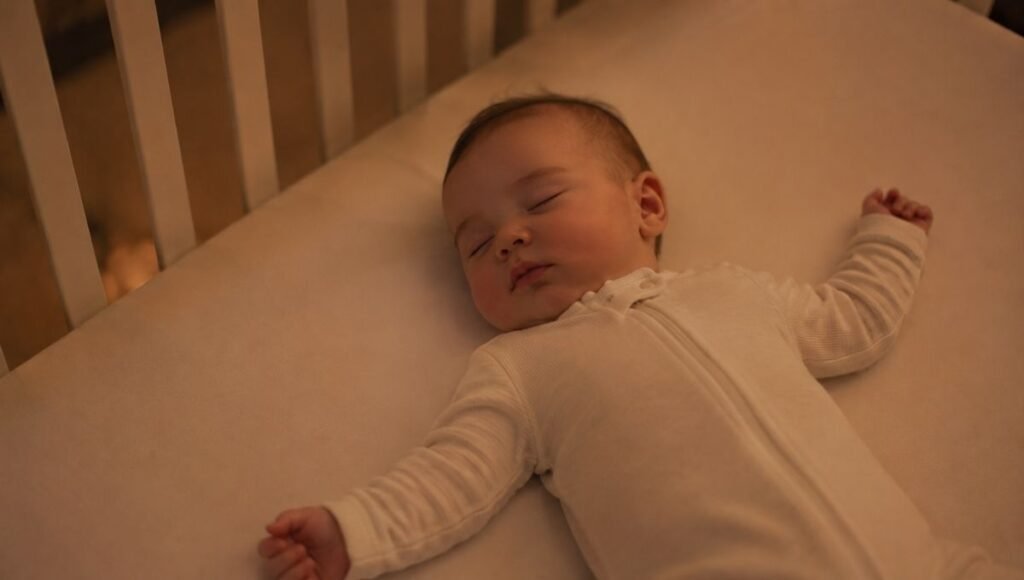
Here’s the thing about “when do babies sleep through the night” — the question implies a fixed finish line, a night when everything changes. It rarely works that way. It’s usually gradual. A 4-hour stretch becomes 5. 5 becomes 6. You have one good week and then a sleep regression strips it back, and you have to rebuild. And then one night — and you won’t necessarily know it was the night — you realize it’s been two weeks since you were up before 5 a.m.
That’s how it actually happens. Messily. Non-linearly. On your baby’s timeline, not the one you read about.
You’re not behind. You’re in it.
What to Read Next
- The 4-Month Sleep Regression: Why It Happens, How Long It Lasts & How to Cope — The specific regression that disrupts sleep for almost every family, explained clearly
- Baby Sleep Schedule: What to Expect Month by Month — How to build sustainable daytime and nighttime sleep structure as your baby grows
- Newborn Baby Care: The Complete Guide for First-Time Parents — Sleep sits inside a bigger picture of newborn care — this guide covers it all
References
- Pennestri MH, et al. Uninterrupted Infant Sleep, Development, and Maternal Mood. Pediatrics, 2018. doi:10.1542/peds.2017-4330
- Henderson JMT, et al. Sleeping Through the Night: The Consolidation of Self-regulated Sleep Across the First Year of Life. Pediatrics, 2010. doi:10.1542/peds.2009-1608
- American Academy of Pediatrics. Healthy Sleep Habits: How Many Hours Does Your Child Need? HealthyChildren.org, 2023. https://www.healthychildren.org/English/healthy-living/sleep/Pages/Healthy-Sleep-Habits-How-Many-Hours-Does-Your-Child-Need.aspx
- Healthline. When Do Babies Sleep Through the Night? Medically reviewed, 2023. https://www.healthline.com/health/when-do-babies-sleep-through-the-night
This article is for informational purposes only and does not constitute medical advice. Always consult your pediatrician with specific concerns about your baby’s sleep, growth, or development.